

A one-of-a-kind LGBTQ Latinx Theater ensemble located in San Jose. The plays produced are inspired by the queer Latinx experience. Rodrigo García and Ugho Badú direct the ensemble in addition to writing the plays that the ensemble performs. Every year the ensemble performs an originally written Christmas play that performs at the Mexican Heritage Plaza, Billy Defrank Center, and in Watsonville. In 2016, they produced a four-episode web series titled “SiemPrE Por Ti” funded by the Health Trust as part of the Getting to Zero strategy. Another project funded by Getting to Zero is “Canción de Cuna para Un Niño Herido/Lullaby for a Wounded Boy” which was met with great success. For three consecutive years, Teatro Alebrijes produced “Carlota” an original play by members of the ensemble, which performed to sold-out audiences that included English-speaking folks who attended despite the fact that the play was spoken in Spanish, but had subtitles projected on a screen in English. In 2019, Teatro Alebrijes was invited to perform at the historic El Teatro Campesino in San Juan Bautista for its Day of the Dead celebration. The ensemble used to rehearse 2-4 days a week at the School of Arts & Culture, and it’s now holding virtual rehearsals through the Zoom platform.
 queer silicon valley team
Colectivo ALA

In pursuit of creating strong leadership and community within local gay Latinos, Rodrigo Garcia and Omar Nuñez founded Colectivo Acción Latina de Ambiente, ALA, as a volunteer-run grassroots organization in 2011. Before this, Rodrigo had founded De Ambiente, a youth support group for young gay Latinos at Outlet. Having been involved in this and at Aguilas (an intervention program for bisexual and gay Latinos in San Francisco), Rodrigo had already seen the benefits of creating a Latino-based LGBTQ support group. Seeing the lack of organizations — especially in absence of ProLatino — Rodrigo linked up with Omar, who was working at the PACE Clinic and former ProLatino organizer. Together, along with the assistance of AACI (Asian Americans for Community Involvement) and the Billy DeFrank Center, Colectivo ALA was formed. The first meeting was on August 1, 2011. Ugho Badú (a.k.a. Hugo Badillo) was the first program coordinator. The mission of Colectivo ALA has and continues to be about providing a space for the freedom of expression, individual growth, and community building for LGBTQ Latinos and Latinas.
Colectivo ALA offers group sessions covering a wide array of topics. From HIV/PrEP, Sexual Health to Cultural Traditions and Identity to Social Media and Political Asylum, the organization has done their best to provide assistance for any issue the community brings to the table. They host a number of different programs and activities such as ALA, which is a bi-weekly meeting at the Billy DeFrank Center (on Zoom now due to COVID-19). Furthermore, there are many single-event activities to promote community participation, social interaction, and advocacy for the group, through participating in Pride and an annual summer weekend retreat for 40 gay or bisexual men members. As for art production, Teatro Alebrijes is a theater ensemble put together that creates LGBTQ Latinx-themed productions. Another part of Colectivo ALA is to welcome others into the group, including those from outside of the area to make everyone feel welcome while celebrating their cultural uniqueness.
You can learn more about Colectivo ALA at their website.
“And now we have in these meetings not only folks from the Bay Area, we have folks from Puerto Rico and Mexico. We have a guy from Boston, another guy from Michigan. So it has expanded… because there were places like De Ambiente like Colectivo ALA, where LGBTQ Latinx people have the opportunity to, to practice and become confident and feels empowered. You know, with people like that, these guys are able to take on leadership roles. And I hope that one of them, one day, feel inspired to do something more — but it starts from there, from nurturing those two spaces. When we came up with the idea of Colectivo ALA, we didn’t have anything, but there were allies who were supporting us with the resources that they had.” — Rodrigo Garcia
De Ambiente

Jóvenes De Ambiente was a safe space for Spanish speaking and multilingual youth under the age of 25. Not exclusively for Latinx youth, this group was a safe haven for over 50 youth from all over the peninsula and South Bay. This safe haven provided sexual health awareness and leadership development for those interested in activism. Youth participated in rallies, pride parades, retreats, dances, and panels in different schools and medical facilities to bring visibility and awareness about LGBTQ+ youth. Many of the participants today say that De Ambiente was and continues to be a family where they can find comfort and support. This group of individuals was an outlet that kept many away from isolation, depression, drugs and alcohol, and for some, it was a space for individual growth.
Learn more about the organization on their Facebook page.
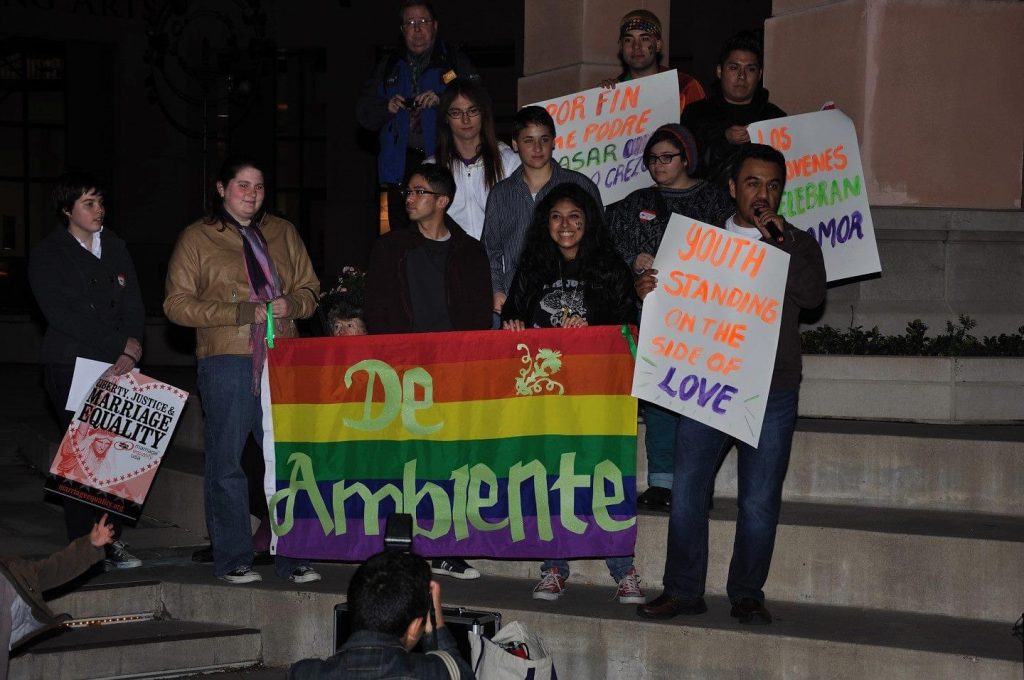
The De Ambiente Group protesting for marriage equality 
The De Ambiente Group standing together after marching at Pride 
The De Ambiente Group standing together after marching at Pride The De Ambiente Group standing together after marching at Pride
Aejaie Franciscus

Aejaie Franciscus’s story starts with a letter to Santa Claus at five years old, “I asked Santa, to make me a little girl for Christmas, as I was born a boy. To say the least, that present wasn’t under the tree, but it did set me on my life’s journey,” she recalled.
She endured bullying throughout high school and, with the support of her family, finished her transition before heading off to college in 1982. She moved to San Jose in 2004 and met her husband, Tony. The couple married during the “Summer of Love” in 2008.
“Other than the drag queens, people did not see much of this community. It was an underground community. It wasn’t until the last ten years that folks were seeing transgender folks in the LGBTQ community even,” Aejaie remembered, “I think it was about three years ago that the community saw representation at Pride events.”
Aejaie worked in the nonprofit arena for 20 years before being hired as the first transgender executive director of the Billy DeFrank Center. In an article from the Bay Area reporter, Aejaie mentioned that she was excited to start working, “This job offered me an opportunity to bring my personal life and professional life together. It’s like a coming out party.” This was the first job where she was able to speak about being transgender safely. She served as director from 2005 to 2008, during which time she spearheaded a HIV rapid testing program and worked with local schools to support kids dealing with homophobia.
Aejaie now owns the Carla’s Social Club, a space for transgender people to find resources for transitioning and get support among other transgender people.
“It will be interesting to see what happens once we come out of the pandemic, because the work we do is so social and interactive. We had events and discussion groups activities at Carla’s Salon that are online, but are more effective in person,” she explained about the local impact of the global COVID-19 crisis. “Other than discussion groups online, and anything else we can move online, there’s only so much social activity you can do. It’s hard to help girls pick out clothes online, you need to see someone in person to help them put together outfits. You need to see someone in person to give them a hug for support.”
Carla’s

In 1985, it was unsafe to be trans in public. As a response, private salons were opened for people in the community to dress as their true selves. Carla’s Salon opened in 1985 by Carla Blair, a heterosexual woman. Those who attended would have a private place to explore their gender identity. It was a combination tearoom, beauty salon, boutique, and social center that became popular worldwide within the transgender community.
“In 1985, the word ‘transgender’ had not gotten into the lexicon yet. Honestly, we use that word loosely now, but it was the transsexual community at the time,” Aejaie Franciscus remembered about the time Carla’s Salon was founded. “This was happening in the middle of the AIDS epidemic, yet people didn’t understand the gay community or the AIDS epidemic. When you introduce the idea of someone wanting to change their sex, they really didn’t understand that.”
In 2010, Aejaie Franciscus and her husband took over the Carla’s Salon from founder Carla Blair. Carla approached Aejaie one day and suggested the idea, and after some convincing Aejaie accepted. The name changed from Carla’s Salon to Carla’s Social Club.
Aejaie has noticed a change in clientele over the years. As people have become more comfortable with presenting in public, there’s less need for haircuts and make up, and more need for socialization and support. Carla’s is a great resource for finding doctors as well. People participating in the salon need help at every level of transition.
“I have been on the fringes of cross-dressing for a number of years now,” said one reviewer about Carla’s on their website. “Recently I decided to go deeper. I decided to have a makeover to see what I would look like as a woman. Aejaie could not have been more patient, supportive as well as doing an excellent job making me up and describing what she was doing and why. It is so comforting to know that I am not on this journey alone. Thank you so much Aejaie.”
Membership at Carla’s is around 200 people, including 70 active locker members and people who come from all over the world to attend events. “There are a lot of people you could talk to from over the years that would say Carla’s was a life saver; it was a great resource. Whether it be through me, or someone else, that that’s where they found their family and place,” Aejaie said.
As of 2020, Carla’s is still in operation, continuing to offer members locker rentals and a safe space for those to spend the day en femme. The services and memberships are listed on their website, Carlas.com.
Jules Chyten-Brennan

Jules Chyten-Brennan is the medical director of the Gender Health Center, where they are building a medical center for trans, non-binary, gender expansive people. Before moving to the Bay Area, they worked in New York City reforming health care for people incarcerated in jails.
Sera Fernando

Sera Fernando was born and raised in San Jose, and now works as a senior management analyst in Santa Clara County’s Office of LGBTQ affairs. As a transgender Filipino woman, she focuses on economic empowerment for people who are transgender, non-binary, gender non-conforming and gender diverse.
Marriage Gallery
This gallery contains many of the first same-sex weddings performed in Santa Clara County in 2013.
If you would like to watch the first ceremonies in Santa Clara County, click here.


The Commitment Campaign story
Reflections on the South Bay GLAAD Campaign for Same-Sex Commitment Ceremony Announcements in the San Jose Mercury News
By Robert Greeley
An interesting bit of South Bay LGBTQ history happened 29 years ago in February 1992 when a group of same-sex couples and their friends, led by South Bay GLAAD (Gay & Lesbian Alliance Against Defamation), held a Valentine’s Day rally at the San Jose Mercury News to protest their policy of excluding same-sex commitment ceremony announcements from their weddings page. What follows are my memories and reflections on that long ago day, set within the context of the full-on campaign for equality that surrounded it.
We at GLAAD couldn’t understand the paper’s insistence on strict legalism when it was totally unnecessary. The times were changing; gay and lesbian couples were becoming more visible and demanding equal treatment in society. The Mercury News was the paper of record in a generally progressive area. We weren’t asking them to be the first paper to print our announcements because the Oakland Tribune had already done so. Their argument was that same-sex marriage was not yet legal. Our response was “so what?”
Although we weren’t surprised by the initial denial, we did encounter a lot more push-back than we expected when we persisted. To our great dismay, the more we pressed them, the more they dug in their heels. At that point we realized we’d have to launch a major offensive to get them to reverse their policy.
We quickly decided on an inside/outside strategy. South Bay GLAAD Co-chair Christine Schmidt and key member Ralph Serpe worked the inside angle – connecting and coordinating with supportive employees at the paper, and dialoguing with and later formally meeting with management – while I headed up the external pressure operation – visibility actions, phone and letter-writing campaigns, rallying the community, encouraging same-sex couples to submit their commitment ceremony announcements, and so forth.
South Bay GLAAD members eagerly took up the challenge and threw themselves into all these activities. For many in our group, while this meant moving outside our comfort zones, it also meant discovering we could raise our voices for a good cause, find the inner strength to be out and proud, and learn the power of activism. For instance, some members were startled to discover they were bolder than they ever imagined when they confronted a Merc executive at a town hall meeting.
The culmination of our visibility campaign was a large, rowdy, full-throated protest on the doorstep of the Mercury News’s headquarters on Ridder Park Drive on Valentine’s Day 1992 – in the rain!
The bad weather did nothing to dampen the enthusiasm of the crowd, though, who waved colorful signs such as “Celebrate ALL Forms of Love” and “Gertrude and Alice… Why Not?” while fiercely chanting “Hey hey, ho ho, homophobia’s got to go!” and “2-4-6-8, why does the Merc discriminate?” We were grateful that Queer Nation turned out a good number of their members that day in support, and all together we had probably 25 or more highly charged, amped-up protesters demanding equality – it was exhilarating!

Christine Schmidt holding
“Gertrude and Alice… Why Not?”
Protesters outside of San Jose Mercury News headquarters 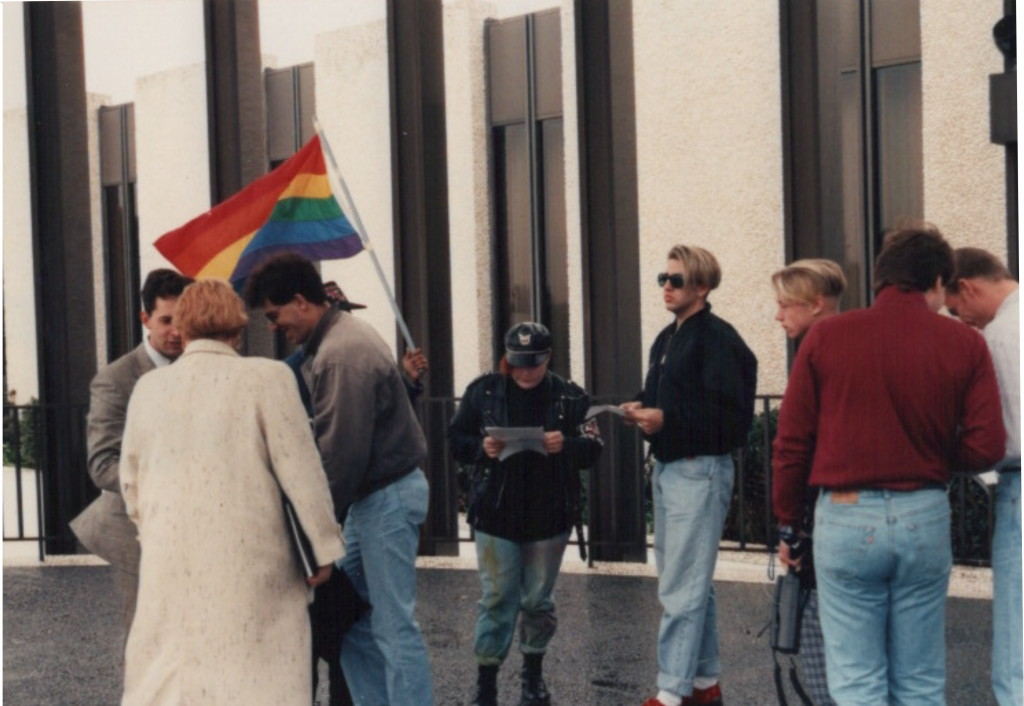
More protesters at San Jose Mercury News headquarters 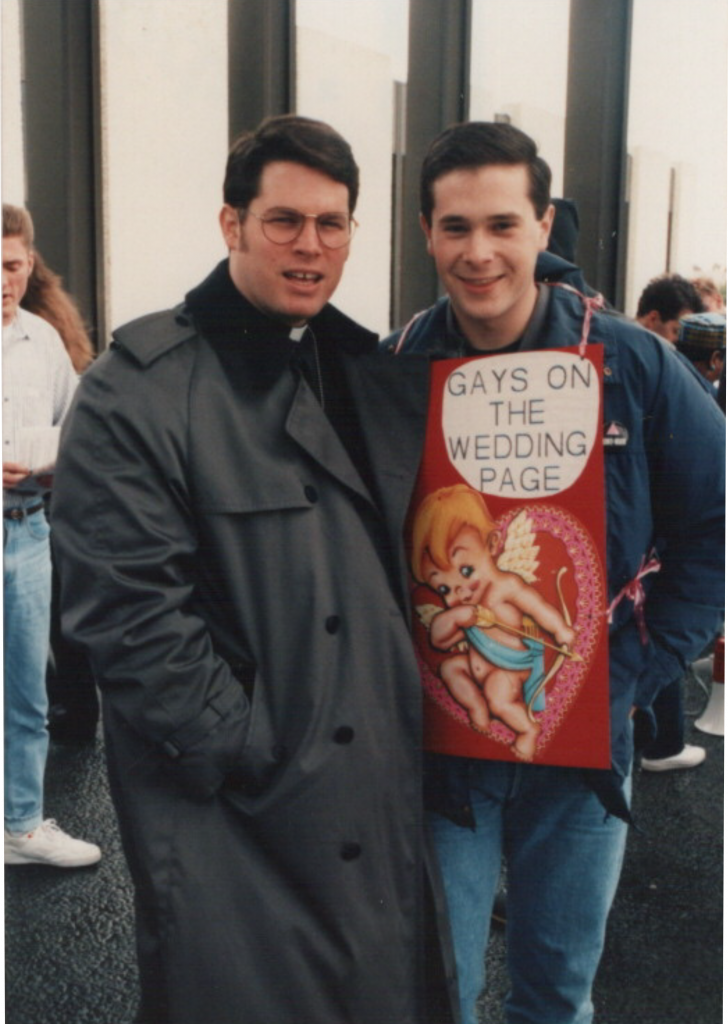
Ted Comerford (left)
and Mike Kemmerrer (right)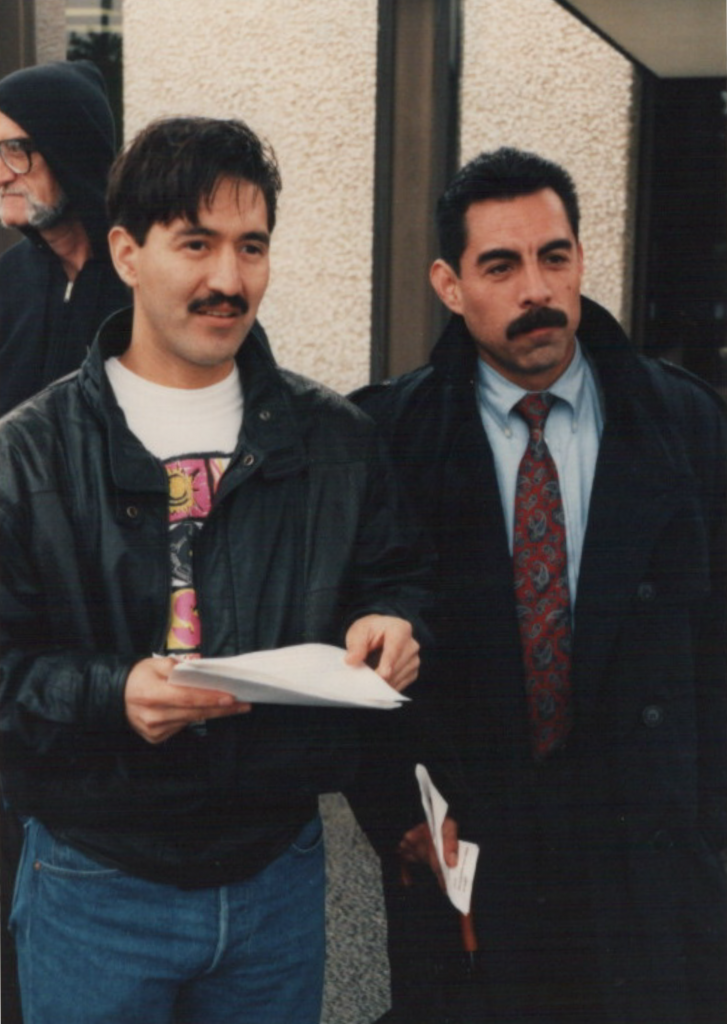
Isaac de la Rosa (left) 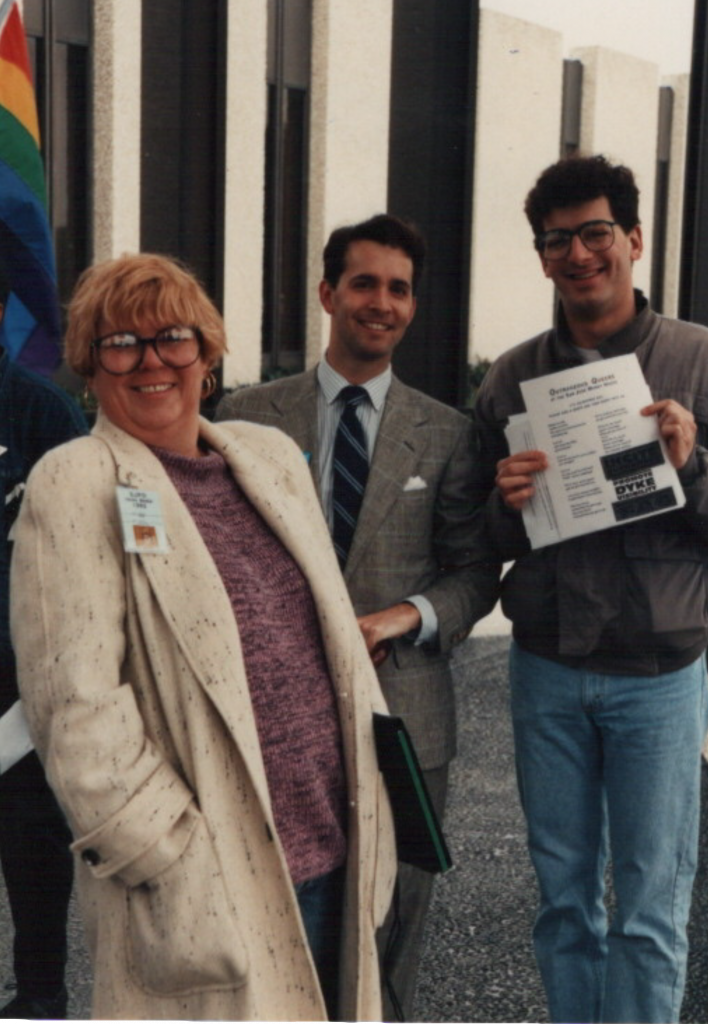
Robert Greeley (center) and
Andrew Gans (right)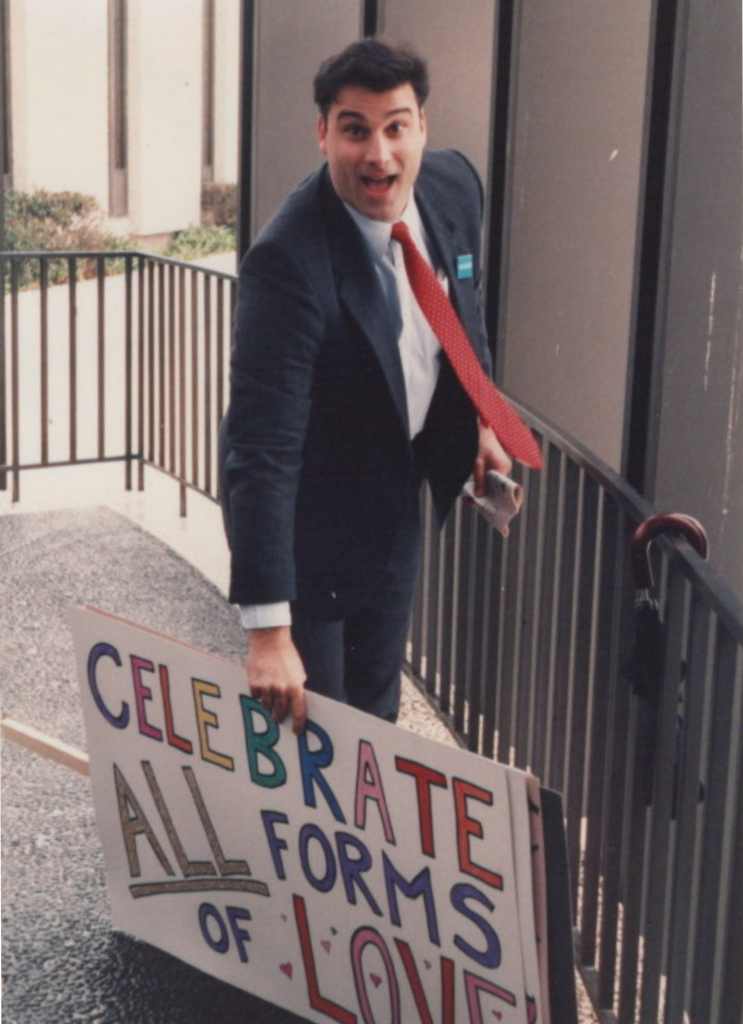
Ralph Serpe holding “Celebrate ALL forms of LOVE” 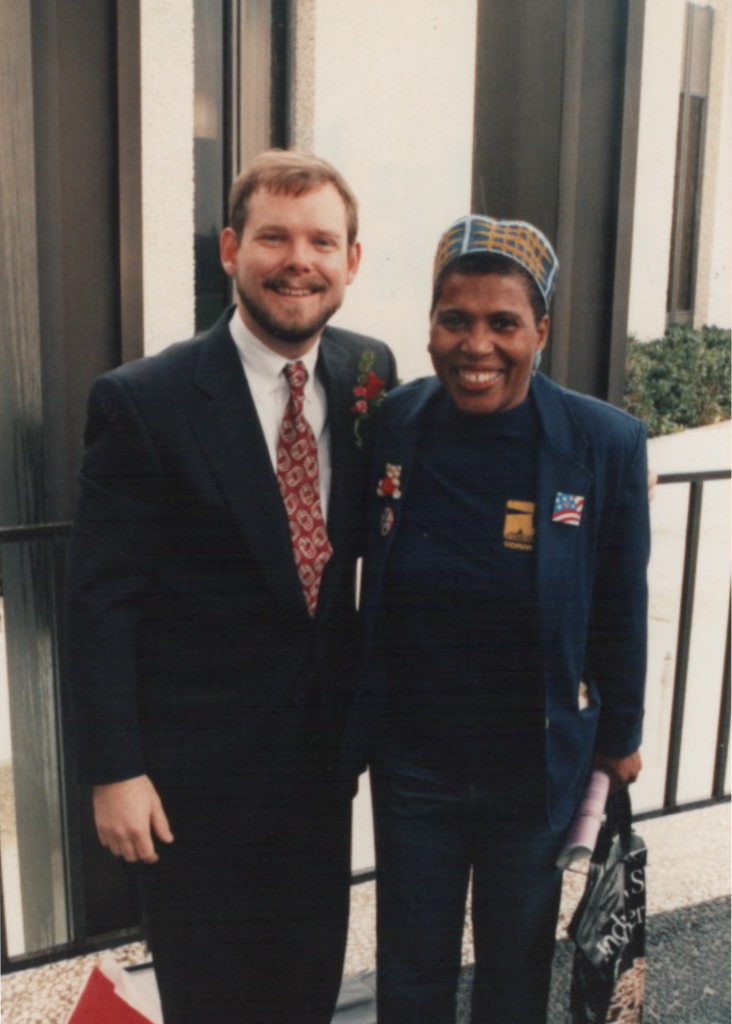
Mark Bonine (left) and Dr. SDiane Bogus (right)
A succession of speakers made our case with great passion and conviction, including couples who had previously been denied by the paper, and another couple publicly renewed their vows. When they finished, our eyes were even damper than the rest of us. I still remember vividly how raw our emotions were that day.
Following the rally at the Merc, a number of us went on to the County building to try to take out marriage licenses – knowing we’d be refused but determined to make the point loudly and publicly that state marriage law discriminated against us. We were boisterous, had fun, and reveled in the camaraderie that comes from being in struggle together against oppression.
While unfortunately we didn’t succeed in drawing any TV coverage that day, we did garner a bit of reporting in the Merc itself, as I recall, and of course the LGBTQ press covered it too. But the largest ripple effect that day was mostly unseen: During the protest one of our leaders received a discreet message that a group of Merc employees were 100% on our side and were “working from within” to press for change. Here was immediate proof that we were having an impact and changing minds!
Empowered by our bold, rainy Valentine’s Day protest, we continued to beat the drum of equal representation for many months thereafter, keeping the pressure on the paper until they finally relented. We were overjoyed when Amy Brinkman and Katy Viall’s announcement ran in November of that year – a sweet victory for them, for us in GLAAD, for our community, and for equality.
[On a personal note, my leadership of South Bay GLAAD and, within that, the campaign for equality in the Merc were the highpoints of my own work as an activist. It was a heady time.]
Amy Caffrey

Amy Caffrey’s father was in the military so she grew up moving around the country, but eventually settled in Virginia. She remembers growing up in Virginia as “a terrible place to come out. They’re still fighting the Civil War. I was dating a black woman and that really didn’t go well.” After doing research to find safer areas to live as a lesbian, she landed on moving to California and moved to San Jose in 1982.
A strong lesbian and women community existed at this time but they needed somewhere to meet. Amy had been collaborating with students at SJSU around the time that Sisterspirit was being born. “One of the reasons why Mary contacted me was due to my work at the San Jose State radio program, which I worked on with Kathy Carter. We played women’s music, which was a different type of music in the world at that time.” From there she met the other women and formed Sisterspirit alongside them.
Amy works in counseling, focusing on the LGBTQ community, and teaches at SJSU now. She advocates to have more conversations about same sex domestic violence and works with LGBTQ youth at SJSU to help them find community. Noticing that students come to her to try to find community, that it is not easy to get into groups, or it feels exclusive and not as open to everyone as it was previously. Amy does what she can to help guide them into the organizations she knows are still operating.
Reflecting on her time in San Jose, Amy said in a recent interview, “I’ve been here 37 years, which is cool because I’ve been with my partner for 36 of those, and it’s very cool that we still like each other. What’s interesting to me is that it’s a long time, but I’m not sure how much actually happened during that time in terms of progress. We have a lot further to go but how do you really get people interested again in fighting for rights when they think they already have them?”