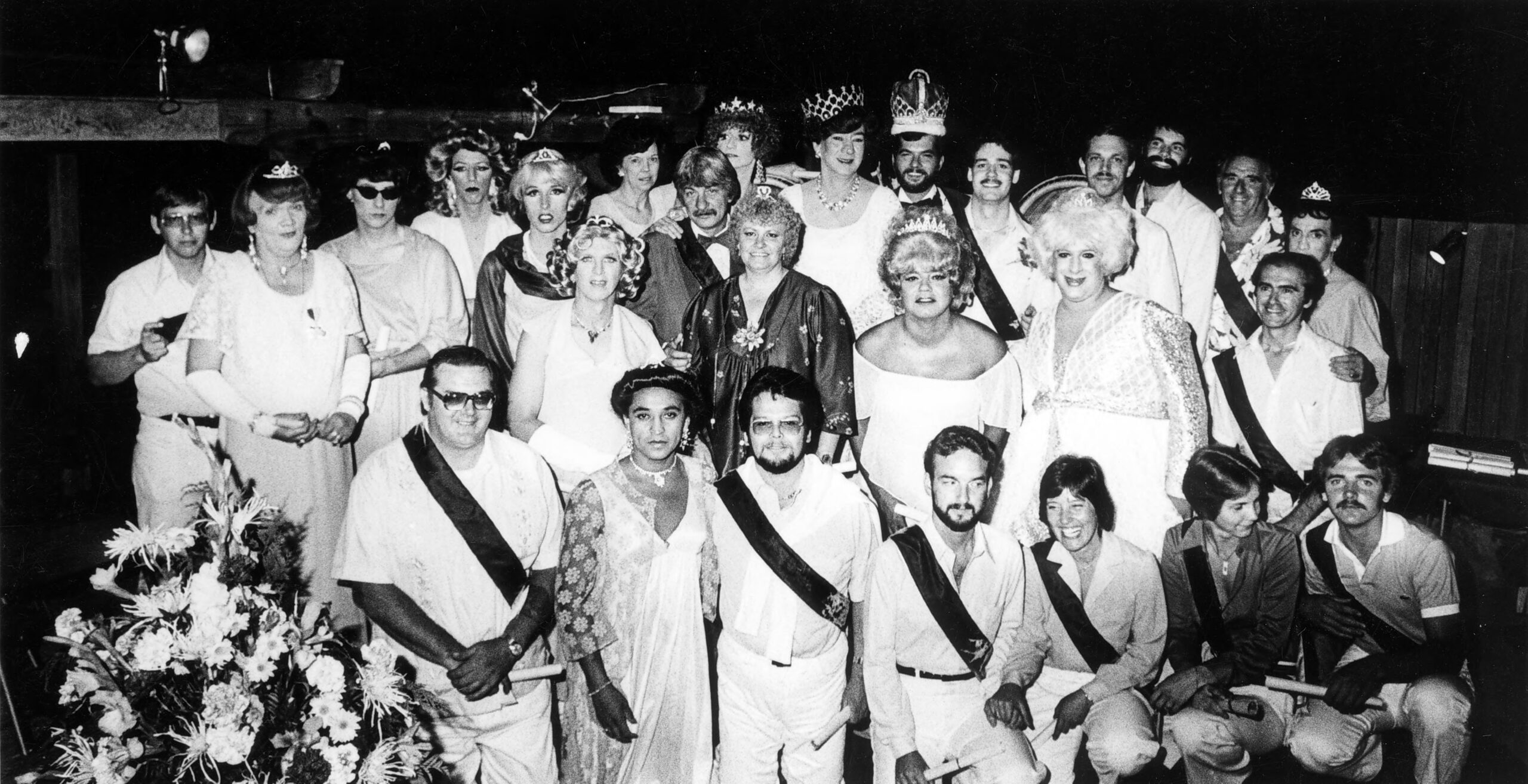
Currently in San Jose, Drag Queens participate in pageants or shows, where they express themselves through their performances. There is a strong partnership between the San Jose and Santa Clara County Queens and Kings and the San Francisco scene as well, making the community stronger with so many participating.
Since the onset of Covid-19, the performers have been turning to virtual spaces. To catch some of their shows, sign up for newsletters and notifications from the venues’ websites:
Jeff was an integral part of the gay community in the 80s and 90s. His performances as Kelli Collins in innumerable drag shows raised thousands of dollars for many causes, primarily for early AIDS victims who had no financial or medical support at that time. Jeff moved to the South ...
Kevin Roche, a member of the Imperial Courts, remembers that it was over fifty years ago when groups in Portland and San Francisco first started drag balls. “This is when being in drag was a more transgressive activity than it is considered nowadays,” he said in an interview. This was ...
In the early days of Casa de San Jose’s informal association of drag queens, they would travel to San Francisco for the city's world-famous drag shows. Ray Aguilar, a San Jose drag queen, requested permission to form an IICS chapter in San Jose, which formed as Casa de San Jose ...
Aguilar always urged family members to celebrate holidays together. He was a founding member of The Imperial AIDS Foundation, which provided hot meals, paid rent, prescriptions, and provided transportation to medical appointments for people living with AIDS . Ray Aguilar died due to complications from AIDS in February 1995 ...
The diverse, liberal work climates touted by Silicon Valley’s high-tech companies first began with a push for increased civil rights by gay and lesbian employees in the 1980s. As companies like Apple and HP advocated for internal nondiscrimination policies and domestic partner benefits, news spread through the software, hardware and conventions created by the tech industry itself. Gay employee groups and business collectives led to expanded networks of in-person, internal and inter-corporate communication, which directly helped disseminate increased protections inside company walls and national politics.
The liberally diverse culture within Silicon Valley’s high-tech companies was sparked by an employee-led push for increased civil rights for gay and lesbian employees in the mid-1980s.
At a time when California politics, like Propositions 6 and 64, pushed ideas of removing gay teachers from classrooms and quarantining people with AIDS altogether, South Bay companies from Apple to Hewlett-Packard approved internal nondiscrimination policies, with domestic partner benefits following throughout the next decade.
In the high-tech industry—where Silicon Valley employers battled each other for a stiffly competitive pool of talent—more LGBTQ people flocked to jobs where protections increased. This snowballed into a cultural shift that eventually applauded diversity, moving away from tech’s more conservative roots.
But at the same time, the AIDS crisis was devastating the LGBTQ community. While it forced many people to come out to family, friends and coworkers, being out at work was terrifying as the lack of safety in the corporate world left workers vulnerable to lose everything: jobs, families and homes.
Some came out by necessity, others as an attempt to humanize the disease and advocate for change. Many employees, however, stayed closeted out of retribution or being passed up for promotions, especially in high-tech government jobs that demanded security clearances.
Employees pushed back in 1983, when the Defense Industrial Security Clearance Office was sued by the South Bay-based group High Tech Gays (HTG) for subjecting gay and lesbian employees to more intense scrutiny and investigation for secret and top-secret clearances because of sexual orientation. A judge eventually sided with the Sunnyvale-based plaintiffs in 1990, closing the iconically named federal court case High Tech Gays v. DISCO.
The existence of HTG and conversation between gay people not only opened up a vision of possibility for other groups to start but also raised awareness with such a brazen name that was unable to be ignored.
Other unofficial gay employee social groups were established—such as Friends of Dorothy and the Gay and Lesbian Employee Network—which stretched across Silicon Valley corporations like HP, Sun Microsystems and Oracle.
Beginning as communities for connection, camaraderie and a dating pool, these gatherings soon led to redacted membership directories and discreet newsletters, which helped crowdsource knowledge of internal business practices across the high-tech sector to secure protections in workplaces at a time when no state or federal protections existed.
After a stint in political activism, Bennet Marks, a former Apple software manager inspired by stories from HTG and his experience on the company’s AIDS Response Committee, wanted to work directly with the company to develop staff policy.
He formed Apple Lambda in August 1986, and came out to the entire company in the process. Named after the Greek letter that had quietly emerged as a gay symbol at the time, the group welcomed in employees by word-of-mouth, even those otherwise afraid of retaliation.
Bennet said their work was the driving force behind Apple adopting nondiscrimination policies—the first Silicon Valley company believed to do so—and pushed others to follow.
By 1987, Apple Lambda marched in the San Francisco Pride Parade and started publicly shifting what was acceptable in the high-tech workplace.
But not all Silicon Valley companies welcomed these policies with open arms out of the gate. Older, more conservative companies took longer to welcome these employee protections.
Kim Harris, a manager at HP, learned from previous successes and failures in organization and advocacy from Bennet, with whom he was (and still is) in a relationship starting in 1982. Together, they eventually became known as the Silicon Valley poster boys.
Despite having one of the first unofficial gay employee groups, HP was hesitant to offer direct company resources. Kim began by stealthily parsing out company health plans, eventually calling out the denial of AIDS treatments for former staff.
“I marched right into HR and benefits, and I said, ‘Is this the kind of company you run? Is this the kind of company you’re proud of?’ Kim said. “All of a sudden it was approved.”
This got the ball moving at HP in working toward nondiscrimination and diversity education policies across the global company. After a unanimous “no” vote, Kim organized reader’s theater performances to dozens of executive staff, featuring personal stories from employees who dealt with internal harassment, jokes and the AIDS epidemic.
One year after the initial denial, an unanimous “yes” arrived in the late 1980s. Despite fears of negative reactions from the press and public, HP’s decision made only whispers in the local news. Combined with Apple’s work, however, the news started circulating regionally.
“Apple then was Apple; Apple now is Apple,” Bennet said. “It was my very strong opinion that anything we did at Apple would have ripple effects throughout Silicon Valley and throughout the country.”
It did ripple. The start of internal policies for gay and lesbian employees at Apple arrived not only before California state law, but also before federal precedent.
In September 1992, California Gov. Pete Wilson signed non-discrimination protections for sexual orientation into the state’s Labor Code—an effort first vetoed eight years prior. By 1993, there were around eight Fortune 500 companies that provided domestic partner benefits. The number was more than 100 by 2001.
This work was continued through external groups like the Bay Area Municipal Elections Committee (BAYMEC), Peninsula Business and Professional Association, and the invite-only HRC Business Council, as members met with hundreds of other gay employees and learned how internal business hierarchies and organization could advance approval of nondiscrimination policies.
Google, which was established in 1998, did not have any formal group until the Apple Lambda founder also helped create the Gayglers group in 2006.
That group continued to push for more civil rights for gay and lesbian employees, advocating in 2010 for “grossing up,” which increased compensation to offset unequal taxes for same-sex partners, and kicking off the nationwide “It Gets Better” project through Google subsidiary YouTube.
As LGBTQ issues continue to arise to the forefront, the work of gay employee groups remains vital to furthering liberal expectations for the high-tech industry in Silicon Valley and across the country, especially as they worked to create new expectations of office life.
“I think every generation paves the way for the next generation,” Bennet said. “I believe that the Silicon Valley corporations had a direct impact on (protections) going through the legislature.”
After moving to San Jose from rural Oroville in 1974, Johnie Staggs was emboldened with a vision for liberation. Together with Rosalie ‘Nikki’ Nichols, Lesbian Voices was founded that year as a quarterly journal for feminist-lesbians. Complementing Lesbian Voices was Ms. Atlas Press, which was established by them. It would later become the largest gay print shop and contribute to the publication of many of Silicon Valley’s gay newspapers. In 1976, Johnie became an avid volunteer at the newly formed Lambda News, which was the first gay newspaper in Silicon Valley.
The press wasn’t Johnie’s sole passion, however. Due to rising threat of the Briggs Initiative in 1977, she became heavily involved with local gay politics, with her work with the Santa Clara Valley Coalition for Human Right. The coalition was an organization primarily dedicated to the plight of the LGBTQ community and combating efforts to criminalize or discriminate against it. Johnie’s work helped to organize its first press conference in September 1977. However, after the temporary stop to the Briggs Initiative, the coalition lost momentum of its support for gay issues. Meanwhile, Johnie had continued to network with and establish groups like the Sisters of Sappha and the Susan B. Anthony Democratic Club.
By February 1978, the controversy over the recognition of Gay Pride Week in San Jose was all the rage. Johnie was instrumental in advocating for the resolution by organizing an overnight protest that gathered over a hundred people. After both mayoral candidate switched their votes against recognition, the gay community was caught in a dilemma whom to support. Since Johnie’s organizing and work was well known, community groups expressed their support for her and Sal Accardi (co-owner and founder of the Watergarden) to run for mayor and city councilmember respectively. Their write-in campaign was unsuccessful, but it was a significant step towards LGBTQ participation in electoral politics in Silicon Valley.
Despite the defeat of the Briggs Initiative in November 1978, there was an overwhelming presence of opposition towards the LGBTQ community with the rise of the Moral Majority and religious fundamentalists. Due to her previous work within the community, Johnie was thrust into the position of campaign manager for both the county-level Measure A and San Jose’s Measure B. While the campaign was wrought with a lack of funds and support, Johnie was credited with holding it together and upholding what was left of the opposition to the religious right.
The defeat of Measures A and B were incredibly devastating, with Johnie declaring her retirement from politics right after the election. For the community at large and those personally involved in the campaign, the loss was innumerable. Seeking a reprieve from those traumatizing events, Johnie went back to publishing Lesbian Voices with Nikki in 1980. In spite of her so-called retirement, Johnie would be elected to the State Democratic Party Executive Committee in December 1980.
After leaving Lambda News in 1982, Johnie remained involved in the gay press through the creation of Our Paper/Your Paper. She would continue her work in the newspaper until 1985, when she began a brief six-month publication of her own paper X-tra X-tra. Johnie would then retire from the press after 20 years, and moved away from San Jose with her partner Teri Espy that year.
Rosalie Nichols, who went by Nikki, was born in Sacramento and came to San Jose after attending Sacramento and San Francisco State Universities.
In 1975, she and her partner Johnie Staggs opened Ms. Atlas Press, a bookstore and publisher, on West San Fernando Street near downtown San Jose. It carried books and magazines by LGBTQ authors, and focused on the LGBTQ community. It also served as a social hub for the community at a time when there were not a lot of public gathering places for LGBTQ people in the South Bay besides bars.
Ms. Atlas Press also published the literary quarterly Lesbian Voices, which contained short stories, poetry, and essays. It had readers both across the United States as well as overseas.
Nikki became more active in LGBTQ politics in 1977 when she served as treasurer for the effort to defeat Proposition 6, otherwise known as the Briggs Initiative. In 1979, she was one of the founding members of San Jose’s Susan B. Anthony Democratic Club. As co-chair of that club she addressed the meeting of the California Democratic Party’s Executive Committee that was held in San Jose in July 1979.
Nikki and Johnie were also contributors to the pioneering South Bay LGBTQ newspaper Lambda News. Following disagreements with the paper’s publisher, she, Johnie and several others founded Our Paper in 1982. Lambda News would fold in 1983 but Our Paper continued regular publication until 1995.
She received a commendation from Santa Clara County’s Human Relations Commission in 1984. That same year she would become one of the first board members of BAYMEC.
Rich spent his childhood on the Peninsula before moving to Orange County for high school. He stayed in Southern California for college, at USC, before moving to the Midwest to attend divinity school at Northwestern. He was ordained as a Methodist minister and began working with homeless youth in inner city Chicago. He left the ministry rather than accept a transfer to a church near San Diego County’s massive Marine base at Camp Pendleton where he would mostly minister to suburban military families.
By this time, Rich knew his passion lay in helping those most in need, especially young people. He found a job doing social work through the YMCA, first in Orange County and then back on the Peninsula in Redwood City. He eventually formed a nonprofit group in San Mateo County—Youth and Family Assistance—that grew to have 60 employees and a $5 million annual budget.
Rich dated girls in high school and women in college. He would get married in 1974 to a woman he had met at a Methodist church in Southern California and who he had lived with for two years before marriage. However, by the time he was in his mid-30s he was ready to accept who he was. He undertook the difficult process of ending his marriage and coming out in 1982.
Rich had an early interest in politics. He was elected student body president in high school. His work with the YMCA and in the nonprofit sphere had already exposed him to public policy at the local level. Then, he began to get involved with the nascent LGBTQ political movement on the Peninsula. He became very active with the Peninsula Business Guild, a gay business group, and in late August 1984 Doug De Young introduced him at one of the founding meetings of the BAYMEC board. In September, he was elected to the board, and in 1985 he became BAYMEC’s president.
In 1992, Rich would run for San Mateo County Board of Education and win. Later in 1997, Rich was elected to the San Mateo County Board of Supervisors and in 2010 to the State Assembly, representing the heart of Silicon Valley – including parts of both San Mateo and Santa Clara counties. In the Assembly, he would spend more than four years as chair of the influential Rules Committee. In 2012, he was chosen to chair the full Legislature’s LGBTQ caucus, which would include two successive Assembly speakers during his tenure: John Perez and Toni Atkins. He would remain caucus chair until term limits forced him out of the Assembly.
In July 2017, Rich was named President and CEO of the California Forestry Association.
Today, the tech industry is hailed as a model of inclusiveness. It is considered to be one of the most LGBTQ-friendly industries in the U.S. The CEO of the world’s most valuable tech company, Apple, is gay.
This reputation did not happen naturally or overnight. It took years of struggle by LGBTQ engineers, programmers, and other tech workers. The late Rick Rudy played a key role in that struggle.
Rick was born and raised in New York City. He received his bachelor’s and master’s degrees in engineering from MIT and afterwards began a career in the tech industry that brought him to San Jose in the early 1970s.
In June 1982, more than two years before BAYMEC was founded, Rick was one of a handful of tech industry workers who met in San Jose to form a South Bay chapter of the San Francisco-based Lesbian and Gay Associated Engineers and Scientists. By the following February, the organization had separated from San Francisco and was renamed High Tech Gays. Rick would be its first president and help write its by-laws.
Rick was a board member of BAYMEC from the very beginning. He hosted some of the earliest meetings at his house, helped write their by-laws, and provided them with early publicity in the High Tech Gays newsletter. Rick made the time for BAYMEC when he was busier than ever. He had gotten involved in gay rights at a national level, joining the board of the National Gay and Lesbian Task Force in 1985. This led to interviews both locally in the Mercury News and nationally in the Advocate and the Wall Street Journal.
Sadly, Rick was one of the more than 2,000 Santa Clara County victims of the AIDS epidemic. His life was tragically cut short in 1990 at age 44.
Ron Taylor was motivated to become active in LGBTQ issues for reasons that are familiar to so many of us. In 1973, his partner died and the family wanted nothing to do with Ron. They swept into their house and took everything that had ever been purchased on his partner’s credit cards. For Ron, it was a dehumanizing moment. “This can’t go on,” Ron remembers thinking. “I need to get more politically involved.”
Part of that activism included getting involved in the anti-Briggs Initiative in 1978. Briggs had collected signatures to place an item on the California ballot to prohibit gays from teaching in public schools. The initiative was defeated, which was a great triumph. But optimism about the future of the gay movement was short lived with the rise of the Moral Majority and referenda in San Jose and Santa Clara County that overturned local gay rights ordinances in 1980. Even though he found the backlash demoralizing, he knew he couldn’t give up. “I just had to keep on fighting,” he said.
Ron became active with DIGNITY, the outreach and support group for gay Catholics. He also advised the diocese of San Jose on how to minister to the LGBTQ community, as well as to how to respond to health issues like AIDS. Ron had been strongly influenced by Vatican II and devoted much of his spare time trying to reconcile his Catholic faith with his life as a gay man.
Ron met Rick Rudy when High Tech Gays was just forming. He was active with HTG and often hosted the monthly Sunday potluck meetings at his house, before membership became so large that it needed to move to the Billy DeFrank Center. It was around this time that Ken Yeager attended one of these meetings at Ron’s house. The size of the crowd gave him the confidence that there were enough politically active gays and lesbians in San Jose to make an organization like BAYMEC successful.
By the mid-1980s, the AIDS epidemic began to consume much of Ron’s time. He became a training coordinator for ARIS, a support group for AIDS patients and their families. He served as one of the original members of the county’s AIDS Task Force.
Ron worked for the California Youth Authority for many years as a parole agent until his retirement.
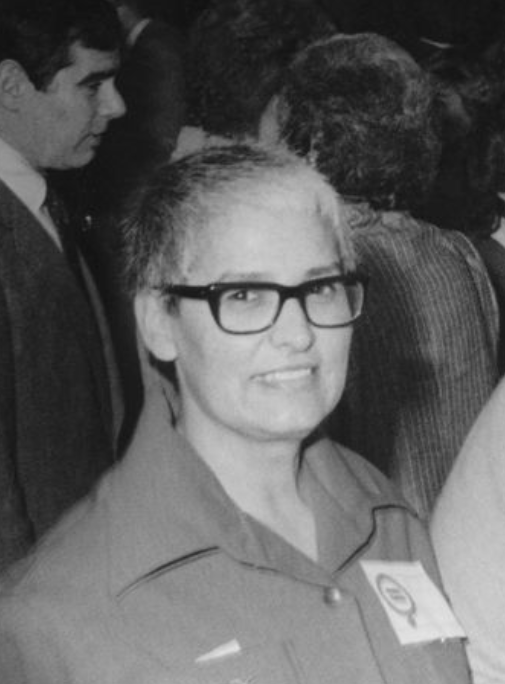
Born Aimee Devereaux Sivertsen in Southern California, she has gone by Wiggsy since early childhood, after her sister mispronounced “wiggles” to describe her rambunctiousness. She graduated from San Jose State University in 1962, and later received a master’s degree in social work from Tulane University in New Orleans.
Wiggsy’s career as an activist and community leader began after she was outed and then fired while working as a counselor at the Peninsula Children’s Center in Palo Alto. This traumatizing event would later push her to get involved with community organizing.She had already been working part-time at San Jose State’s counseling center so she was able to join the university’s staff full time in 1968. She was SJSU’s first openly gay employee.
While Wiggsy was out at San Jose State, she was not active politically until 1977 when State Senator John Briggs authored an initiative that would have banned gays and lesbians from teaching in California public schools. She took an active part in the campaign to defeat the Briggs Initiative, which was on the November 1978 ballot as Proposition 6, making appearances on both radio and television.
As a result of the Briggs Initiative, Wiggsy’s public profile began to steadily rise. Over the next two decades she would become one of the most visible members of the Silicon Valley’s LGBTQ community.
One night in the summer of 1984 at the Toyon bar in San Jose, Wiggsy and Ken Yeager talked about the need for an LGBTQ political group. The two of them devised the outlines of a regional LGBTQ political action committee focused on Santa Clara, San Mateo, and Santa Cruz counties. The committee would eventually be known as the Bay Area Municipal Elections Committee (BAYMEC), modeled after a similar organization in Southern California known as the Municipal Elections Committee of Los Angeles (MECLA).
Wiggsy heavily shaped how BAYMEC operated. She helped prepare their initial budget, was one of the signers of the first checks, and the architect of their endorsement policy for political candidates.
As a professor and counselor at San Jose State University, she campaigned against ROTC programs on campus because of the Defense Department’s discriminatory policies toward lesbians and gays. She was active in other ways on campus, too, including as a faculty advisor to the Gay and Lesbian Alliance and the Women’s Center. It was in these roles she counseled hundreds of students in the coming out process.
Wiggsy has been a tireless advocate, teaching classes to San Jose police officers about LGBTQ lifestyles, fighting for more programs for those who experienced domestic violence, advocating for LGBTQ seniors, being president of the California Faculty Union, and serving on the county’s Commission on the Status of Women, the Senior Commission, and the Human Rights Commission, to name a few. In 1988, she began teaching a sociology class at SJSU on gay and lesbian issues. In 1994, the university would establish a scholarship in her honor that focused on students who worked to support LGBTQ rights.
In short, there hasn’t been a single human rights issue that she hasn’t been involved in for the last half century.
Amy Caffrey’s father was in the military so she grew up moving around the country, but eventually settled in Virginia. She remembers growing up in Virginia as “a terrible place to come out. They’re still fighting the Civil War. I was dating a black woman and that really didn’t go well.” After doing research to find safer areas to live as a lesbian, she landed on moving to California and moved to San Jose in 1982.
A strong lesbian and women community existed at this time but they needed somewhere to meet. Amy had been collaborating with students at SJSU around the time that Sisterspirit was being born. “One of the reasons why Mary contacted me was due to my work at the San Jose State radio program, which I worked on with Kathy Carter. We played women’s music, which was a different type of music in the world at that time.” From there she met the other women and formed Sisterspirit alongside them.
Amy works in counseling, focusing on the LGBTQ community, and teaches at SJSU now. She advocates to have more conversations about same sex domestic violence and works with LGBTQ youth at SJSU to help them find community. Noticing that students come to her to try to find community, that it is not easy to get into groups, or it feels exclusive and not as open to everyone as it was previously. Amy does what she can to help guide them into the organizations she knows are still operating.
Reflecting on her time in San Jose, Amy said in a recent interview, “I’ve been here 37 years, which is cool because I’ve been with my partner for 36 of those, and it’s very cool that we still like each other. What’s interesting to me is that it’s a long time, but I’m not sure how much actually happened during that time in terms of progress. We have a lot further to go but how do you really get people interested again in fighting for rights when they think they already have them?”
Measures A and B. Anita Bryant. Rev. Marvin Rickard. The Los Gatos Christian Church.
Saying these names today is likely met with blank stares. But in 1980, they were at the center of a battle for local policies protecting LGBTQ people from discrimination in employment, housing, and public services.
In 1979, two years after Harvey Milk helped lead a statewide defeat of anti-gay Proposition 6, there was a push for anti-discrimination ordinances throughout Silicon Valley. Johnie Staggs, a pioneering lesbian activist in San Jose, recalled that the local gay community was “in a kind of euphoria [about Prop. 6]. We knew we were right and we wanted to live our lives openly. Unfortunately, many of us were kind of pie in the sky.” Passing an anti-discrimination ordinance in the first place, however, would be much more difficult.
Initially, it was envisioned that the City of San Jose would pass an anti-discrimination ordinance – but the mayoral race in 1979 bogged down any chance for the city council to make an issue of it. Subsequently, the push for anti-discrimination moved to the Board of Supervisors. David Steward, who was the only openly-gay member of the Human Rights Commission, was able to gather support (albeit lukewarm) from the commission to ask the Board of Supervisors to pass the ordinance; At the same time, Jim McEntee, Director of Santa Clara County Office of Human Relations, was able to bring the ordinance directly to the Board of Supervisors.
After receiving the proposed anti-discrimination ordinance, the Board of Supervisors oversaw six public hearings and more than 25 hours of testimony. The opposition was entrenched; Rev. Marvin Rickard of the Los Gatos Christian Church fervently argued against the ordinance and was able to bury the public hearings with hundreds of protesting fundamentalists.
By a 4 to 1 vote (with supervisors Diridon, McCorquodale, Steinberg and Wilson supporting and Supervisor Cortese opposed) the Santa Clara County Board of Supervisors would finally pass an ordinance that banned discrimination on the basis of sexual orientation. The opposition quickly responded with promises of retaliation on the ballot. With far less fanfare, the San Jose City Council voted 6 to 1 for a similar city ordinance.
Opponents wasted no time gathering signatures to stop the ordinances from taking effect. Two measures were placed on the June 1980 ballot, Measure A for the county and Measure B for the city of San Jose. A “yes” vote meant you favored the protections; a “no” vote signified you wanted them repealed.
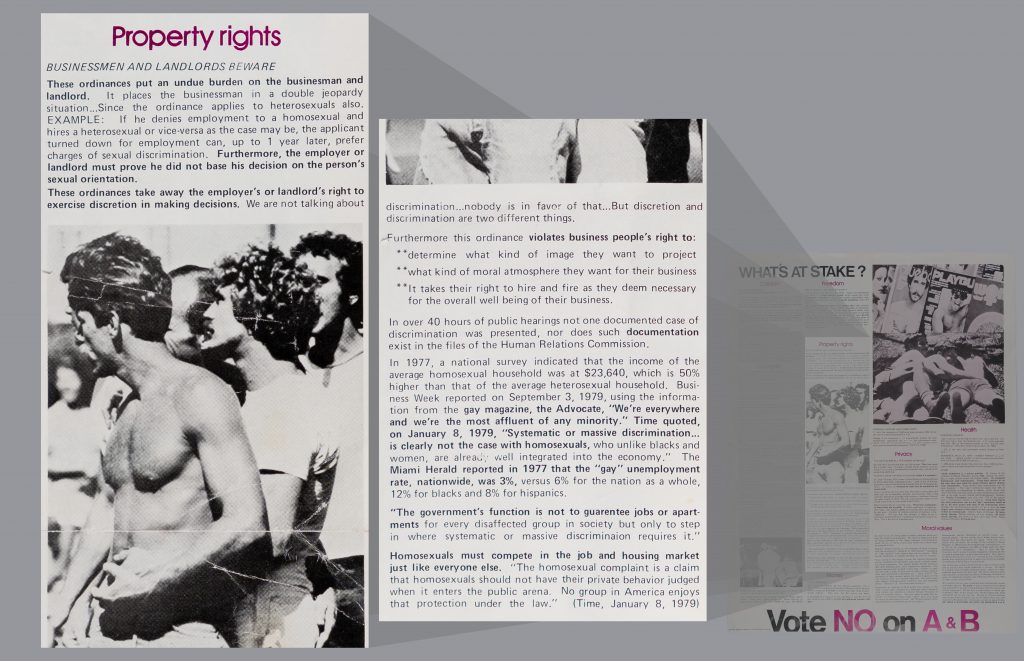
The campaign was ugly, with opponents receiving a great deal of support from out of the area, with money and organizers (even campaign manager) coming straight from Anita Bryant’s “Save Our Children” group in Florida. In the wake of the Moral Majority, there was a clear
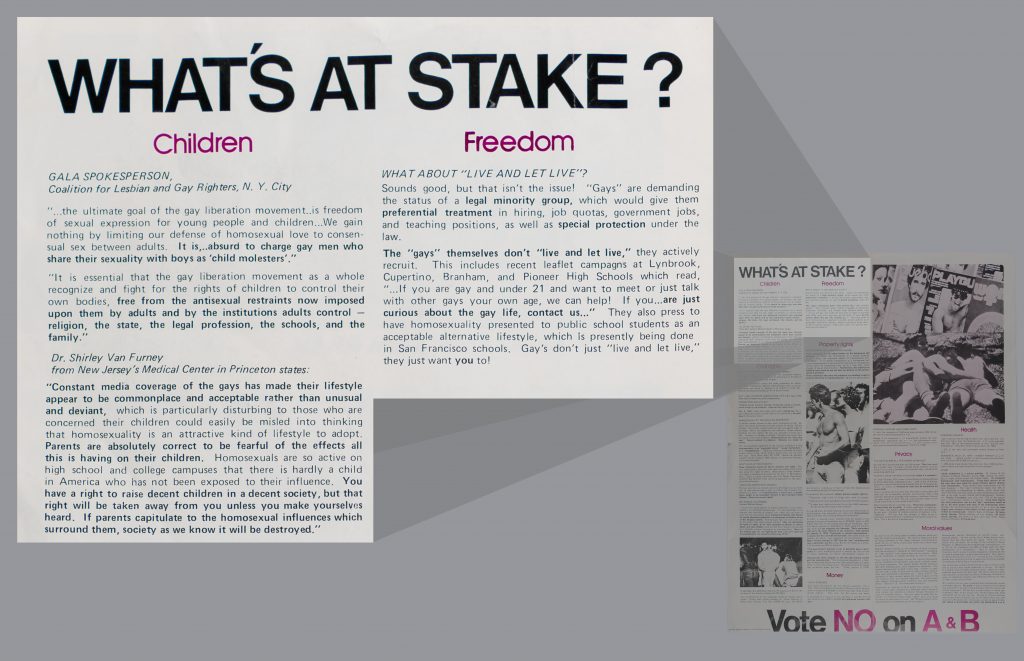
“Vote ‘no’ for the sake of our children. Don’t let it spread,” read their literature.
Don’t Let IT Spread!
GAYS say… Vote NO
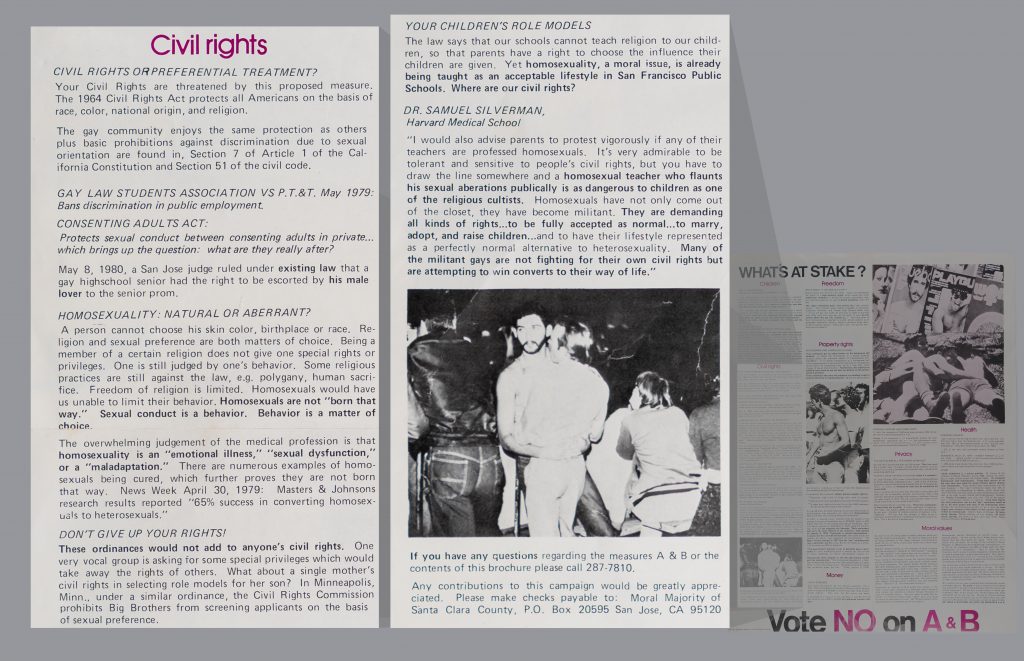
What’s At Stake
Children and Freedom
Civil Rights
Property
Money
Privacy and Health
Moral values
For proponents of Measures A and B, support was hard to find. Beleaguered organizers, lack of local interest, and vague platform significantly harmed the “Yes on A & B” campaign. Despite San Francisco’s sizeable gay political community, there was little to no support given, which was something campaign manager Johnie Staggs attributed to “a kind of arrogance because San Francisco is recognized, justifiably or not, as the gay Mecca.”
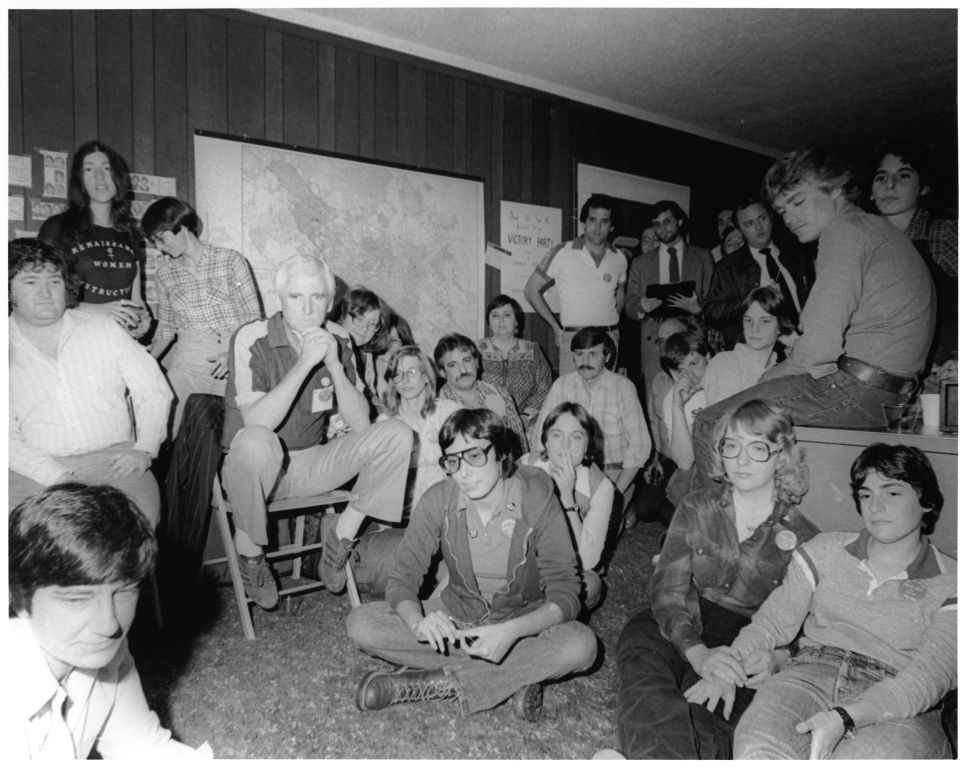
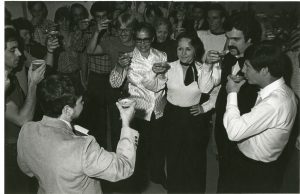
Rosalie “Nikki” Nichols (center left) and Johnie Staggs (center right) toast at a Yes on A & B event
The election was a blowout, with 70 percent of San Jose voters and 65 percent of Santa Clara County voters rejecting the ordinances. The message was clear: gays were not wanted.
The repercussions were immediate. The nascent LGBTQ rights movement vanished. Gay activism came to a dead stop. Supervisor Rod Diridon, who ran for state senate in the April 1980 special election, lost to a Republican. The Religious Right also successfully supported two San Jose City Council candidates that year. Moreover, many local political leaders backed away from gay rights issues, although not the supervisors who voted for the gay rights bill.
Four Former County Supervisors Recall the Turbulent Times of Measures A and B
Dan McCorquodale, Ken Yeager, Susie Wilson, Terry Christensen, Rod Diridon, Dominic Cortese
reunited for a panel discussion about Measures A and B on CreaTV’s Valley Politics show
Supervisor Susanne Wilson began with a recollection of her earlier experience with the religious right. In her previous position as a San Jose City Councilmember, conservative church members turned out in force to insist that the Council rescind a vote they had taken in March 1978, which provided recognition for a planned Gay Pride Week later that year.
She recalled the Council Chambers being packed with opponents of the Council’s action and that the crowds also filled to overflowing the downstairs cafeteria where the meeting was being broadcast. In the end, she and Councilmember Jim Self were the only ones who remained in support and refused to rescind their previous votes for the proclamation.
Supervisor Wilson also talked about the fallout from this vote she encountered when she walked door to door in her campaign that year for a seat on the Board of Supervisors. In the end, she was victorious in winning the Board seat, but she remembered experiencing lots of doors slammed in her face, something she noted had never happened to her when campaigning before her vote on gay pride.
Supervisor Dan McCorquodale commented that discrimination against gays was not a new issue for him. He recounted the anger and helplessness he felt when, as a young Marine, one of his friends was discharged from the Corps for having been seen leaving what was thought to be a gay bar.
There was no due process and no avenue for recourse. He said that he considered his 1979 vote on the anti-discrimination ordinance as one of his opportunities to speak out for equality and justice.
Supervisor Rod Diridon recalled, at the time of the gay antidiscrimination ordinance vote, he already was planning a campaign for a State Senate seat that would be decided in an April 1980 special election. He said that the Senate district electorate had become more conservative under Governor Ronald Reagan and with the growth of the Moral servative under Governor Ronald Reagan and with the growth of the Moral Majority, and he was aware a “yes” vote on this issue would impact his chance for success. However, despite the trepidation this caused, he felt he had to vote his conscience.
Supervisor Dominic Cortese said he considered the vote on the ordinance premature and that it concerned a moral issue to be discussed by the church and not legislated by government. “In many ways, I still feel that way.” He added his thought that “my church has not done enough to open that door.” He reminisced, “I was in a learning process. The whole country was in a learning process.” He concluded by saying, “I commend my colleagues for moving forward in a very bold manner. We had a very proactive Board.”
Sal Accardi (right) and other supporters applaud the anti-discrimination ordinance during the public hearing
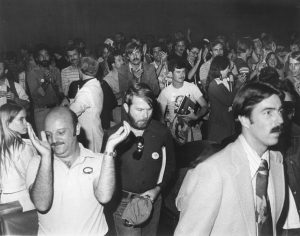
The crowd at the public hearing on the anti-discrimination ordinance
In response to a question concerning what the hearings were like, Wilson said she remembers, despite her previous experiences, still being amazed by the extent of the anger and hatred demonstrated by the ordinance opponents. Diridon said that the calls and letters received by the Board offices numbered at least 10 to 1 in opposition to the ordinance, but he didn’t believe the opponents reflected the entirecommunity. He commented that anti-gay sentiment was being preached from the pulpits of the conservation churches, as reflected, in part, by the number of calls against the ordinance the Board offices received on Monday mornings.
When asked if they saw the referendum coming, Wilson said “no”; Diridon said “yes”; Cortese said he felt the whole controversy was likely to set back the movement. McCorquodale said he could tell the proponents were in trouble from the very beginning but that rescinding the vote wasn’t an option as it would have been much “too disheartening for too many people.”
All described the campaign as “brutal.”
Diridon recalled leaving church with his wife and children on one occasion during that time and finding that every car in the church lot had a flyer on the windshield condemning his vote and stating “Diridon is a false person” and “actually he is gay.” He subsequently found out this distribution of flyers that Sunday morning involved virtually every car in all the church parking lots in his district.
Diridon went on to say that his support for the ordinance was a dominant factor in his losing the Senate election in April 1980. He clearly remembered being told by a state Democratic Party leader that “If he voted for this issue, he was committing suicide.” After his vote, he said some state Democratic leaders lost interest in his campaign. However, he concluded, “If you don’t vote your conscience, you’re not worth a damn.”
Wilson said that this issue didn’t seem to hurt her in her 1982 re-election campaign. Diridon, too, was reelected to the Board in 1982. Cortese won election to a seat in the State Assembly in the 1980 election, the same year as the Measure A and B vote. McCorquodale ran unopposed that year for another term on the Board of Supervisors.
However, in McCorquodale’s 1982 State Senate campaign, his opponent, incumbent Senator Dan O’Keefe, tried to make an issue of the gay rights vote in Stanislaus County, the more conservative part of the district. McCorquodale commented that, while he received negative reactions from certain individuals, the issue never seemed to gain traction.
When interviewer Terry Christensen asked if the supervisors ever regretted their vote, all said “no.” Cortese added that he had been consistent with his votes in support of LGBT issues over his 16 years in the Assembly. Diridon said that it was emancipating to vote his conscience despite the consequences. He expressed regret that the ordinance supporters hadn’t been better organized, though, because he thought the Measures A and B votes could have been successful.
Christensen asked if the supervisors had any advice to advocates of unpopular causes. Diridon responded, “Get organized early.” He went on to say that the Democratic Party, organized labor, the Council of Churches, and the Mercury News all supported the ordinances and, if the supporters had been organized, they could have won.
McCorquodale recommended that advocates research their issues carefully and also study and understand their oppositions’ issues in order to formulate responses. In addition, he suggested they make sure they have enough volunteers to go door to door and take the issue to the public.
Wilson said when you feel something deeply, you must stand up and fight for it. Cortese added that he always recommends following the golden rule and treating people with respect. Further, he said it is important to analyze the issues, make considered decisions, and stick with them.
McCorquodale said he wanted to take the opportunity to recognize the contributions of then-Human Relations Commissioner David Steward, the first openly gay commissioner, who secured a unanimous vote from the Commission to send the ordinance to the Board. He called Steward “the spark plug.”
Diridon and Cortese both added that the role of then-Human Relations Director Jim McEntee shouldn’t be overlooked. Diridon noted that McEntee never hesitated in his support for the ordinance, and Cortese recalled that “Jim McEntee gave of himself unconditionally.”
When asked how the supervisors thought the County was functioning now, Wilson said, “very well” and concluded with, “They are taking care of people.” McCorquodale made special note of the County’s fine hospital and park system. Cortese added to his positive comments about the current Board that he was extremely proud of his son, former Board President Dave Cortese, and that “Dave was his legacy.” Diridon expressed that he perceived that the dynamics of the current Board were similar to the Board at the times of Measures A and B, and that they were “taking up progressive issues” and “doing a wonderful job.”