Reflections on the South Bay GLAAD Campaign for Same-Sex Commitment Ceremony Announcements in the San Jose Mercury News
By Robert Greeley
An interesting bit of South Bay LGBTQ history happened 29 years ago in February 1992 when a group of same-sex couples and their friends, led by South Bay GLAAD (Gay & Lesbian Alliance Against Defamation), held a Valentine’s Day rally at the San Jose Mercury News to protest their policy of excluding same-sex commitment ceremony announcements from their weddings page. What follows are my memories and reflections on that long ago day, set within the context of the full-on campaign for equality that surrounded it.
We at GLAAD couldn’t understand the paper’s insistence on strict legalism when it was totally unnecessary. The times were changing; gay and lesbian couples were becoming more visible and demanding equal treatment in society. The Mercury News was the paper of record in a generally progressive area. We weren’t asking them to be the first paper to print our announcements because the Oakland Tribune had already done so. Their argument was that same-sex marriage was not yet legal. Our response was “so what?”
Although we weren’t surprised by the initial denial, we did encounter a lot more push-back than we expected when we persisted. To our great dismay, the more we pressed them, the more they dug in their heels. At that point we realized we’d have to launch a major offensive to get them to reverse their policy.
We quickly decided on an inside/outside strategy. South Bay GLAAD Co-chair Christine Schmidt and key member Ralph Serpe worked the inside angle – connecting and coordinating with supportive employees at the paper, and dialoguing with and later formally meeting with management – while I headed up the external pressure operation – visibility actions, phone and letter-writing campaigns, rallying the community, encouraging same-sex couples to submit their commitment ceremony announcements, and so forth.
South Bay GLAAD members eagerly took up the challenge and threw themselves into all these activities. For many in our group, while this meant moving outside our comfort zones, it also meant discovering we could raise our voices for a good cause, find the inner strength to be out and proud, and learn the power of activism. For instance, some members were startled to discover they were bolder than they ever imagined when they confronted a Merc executive at a town hall meeting.
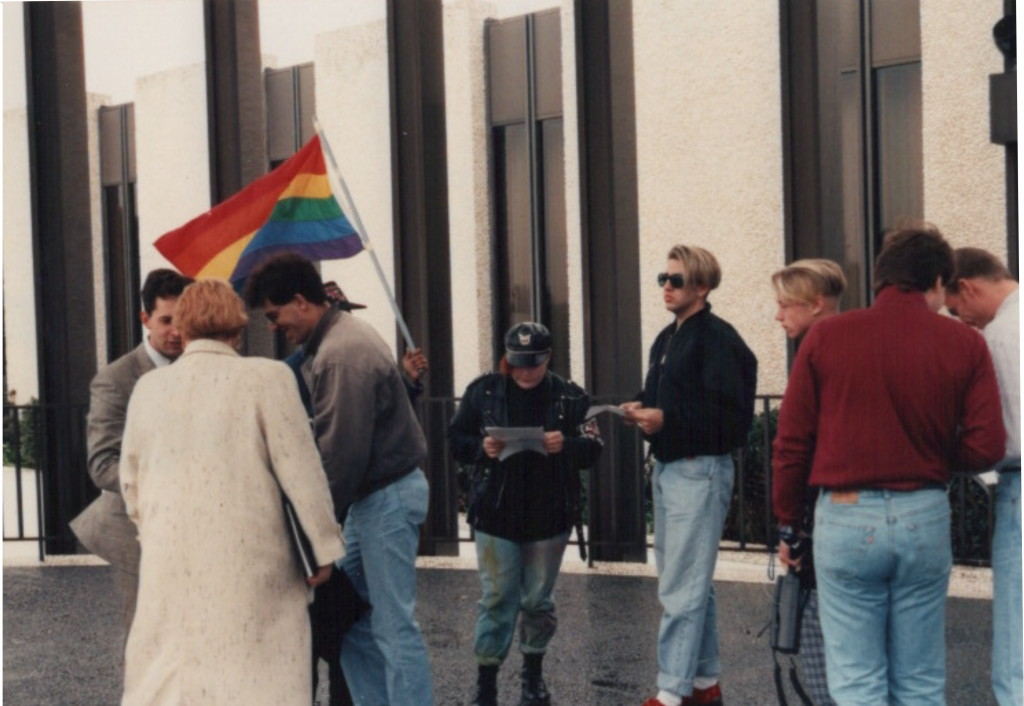
The culmination of our visibility campaign was a large, rowdy, full-throated protest on the doorstep of the Mercury News’s headquarters on Ridder Park Drive on Valentine’s Day 1992 – in the rain!
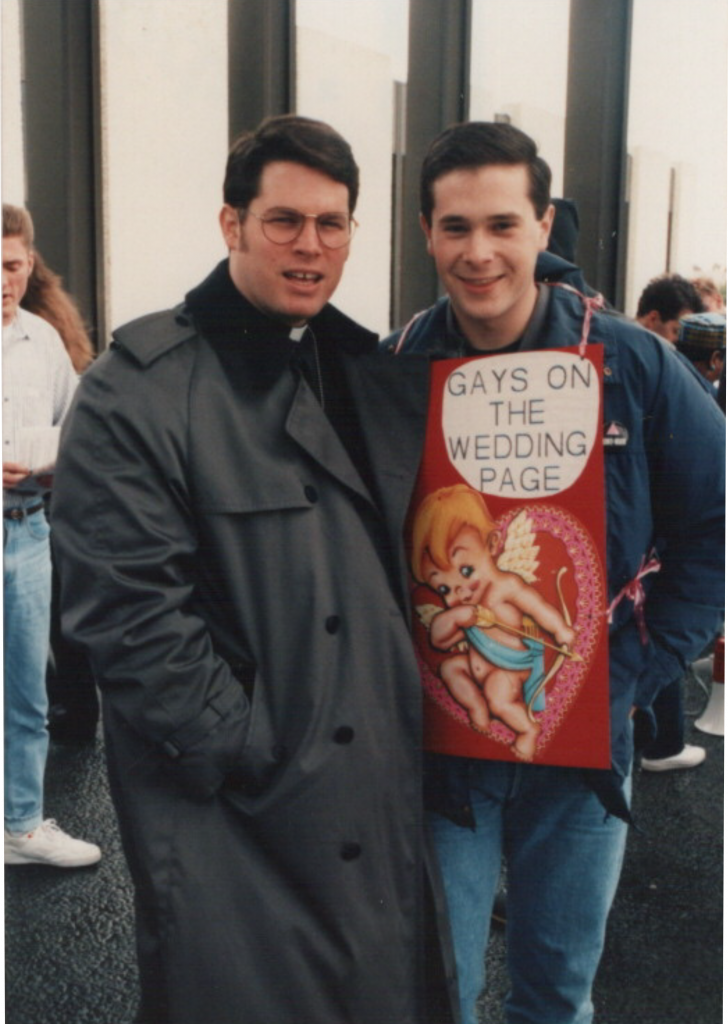
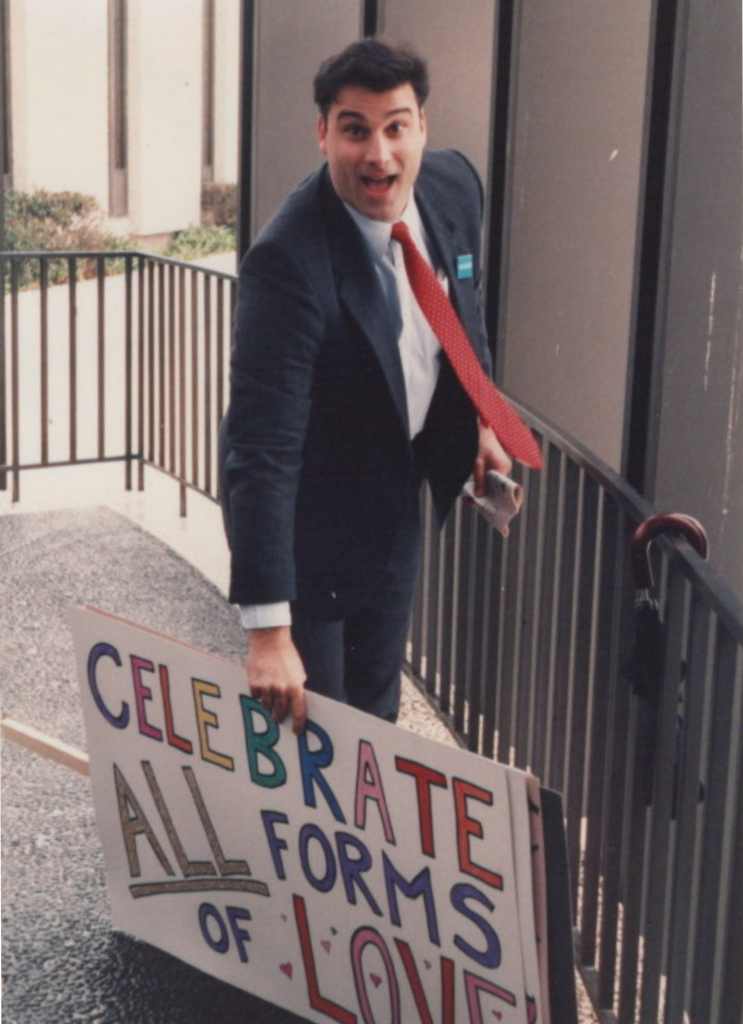
The bad weather did nothing to dampen the enthusiasm of the crowd, though, who waved colorful signs such as “Celebrate ALL Forms of Love” and “Gertrude and Alice… Why Not?” while fiercely chanting “Hey hey, ho ho, homophobia’s got to go!” and “2-4-6-8, why does the Merc discriminate?” We were grateful that Queer Nation turned out a good number of their members that day in support, and all together we had probably 25 or more highly charged, amped-up protesters demanding equality – it was exhilarating!
Christine Schmidt holding “Gertrude and Alice… Why Not?”
Protesters outside of San Jose Mercury News headquarters
More protesters at San Jose Mercury News headquarters
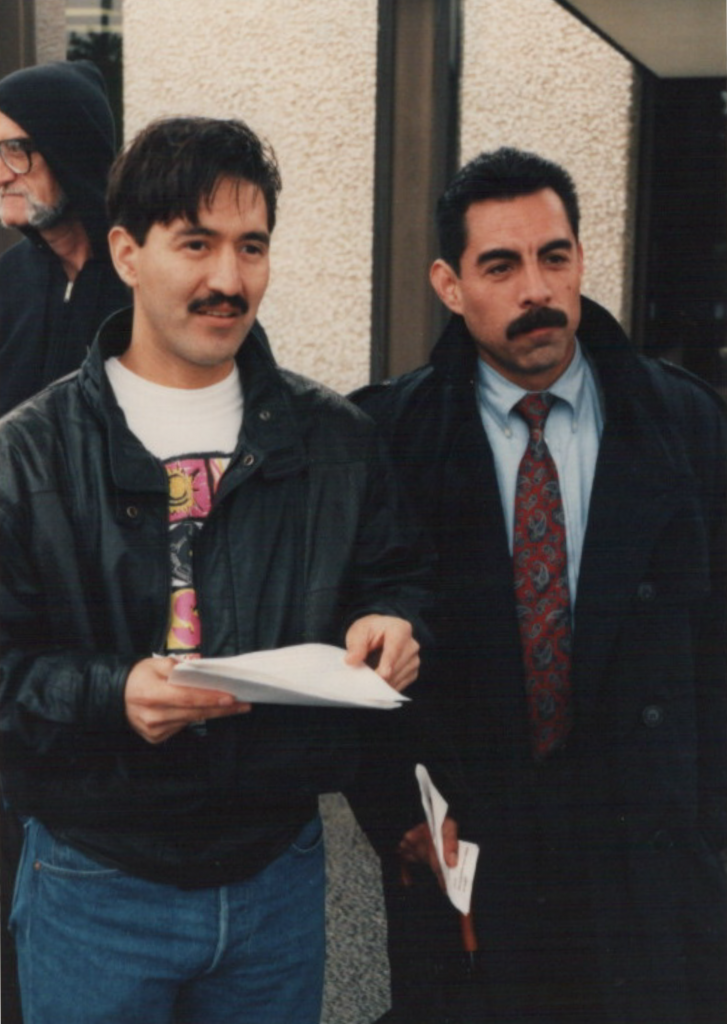
Ted Comerford (left) and Mike Kemmerrer (right)
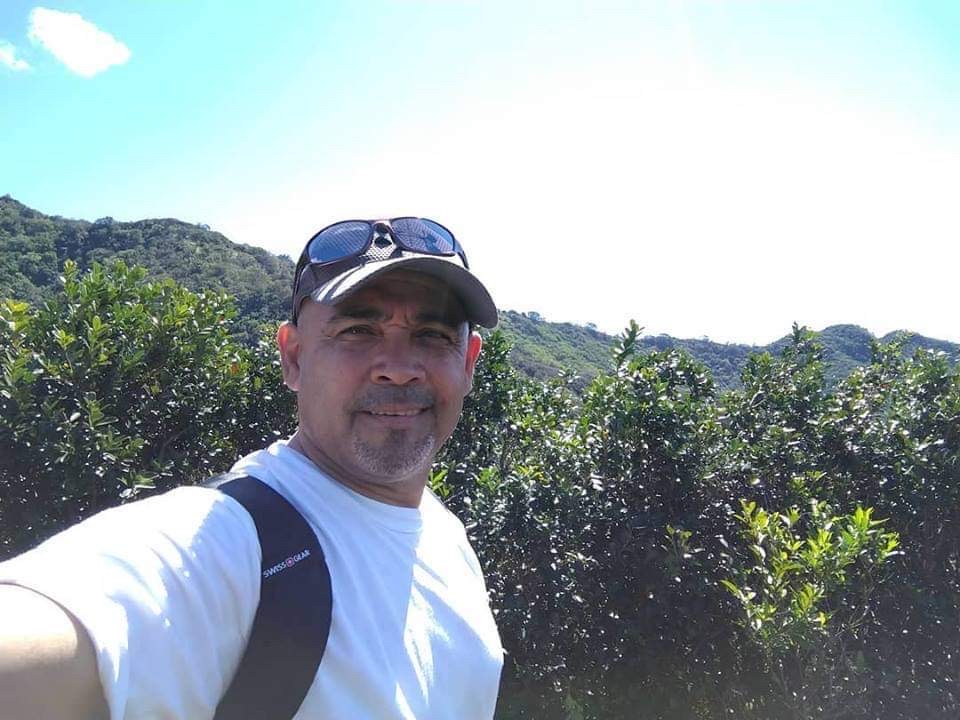
Isaac de la Rosa (left)
Robert Greeley (center) and Andrew Gans (right)
Ralph Serpe holding “Celebrate ALL forms of LOVE”
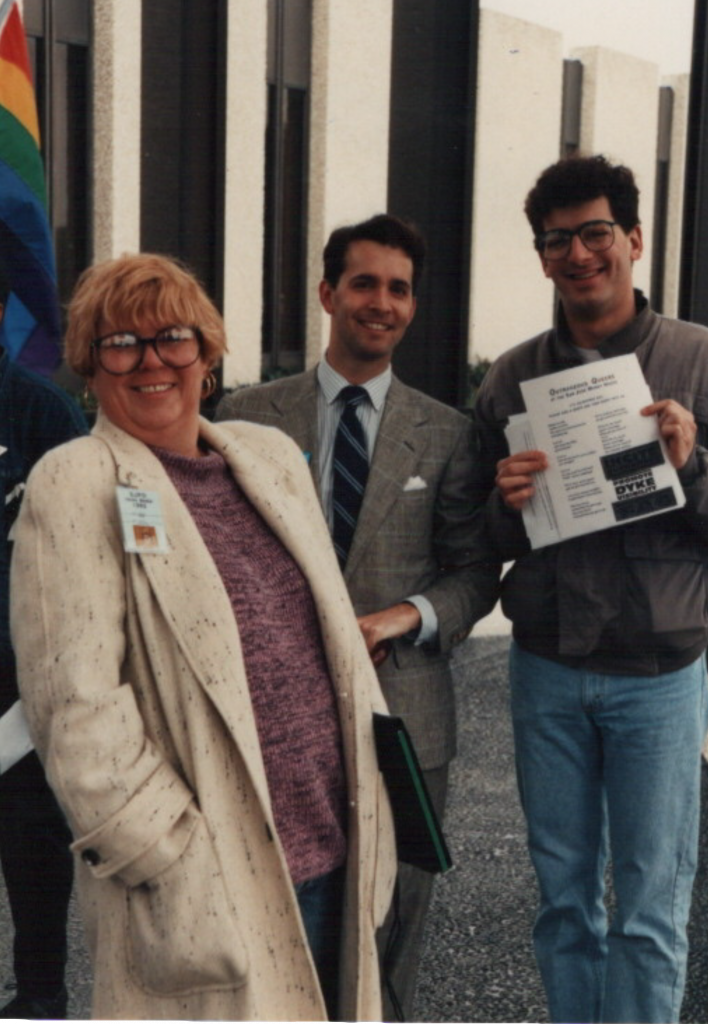
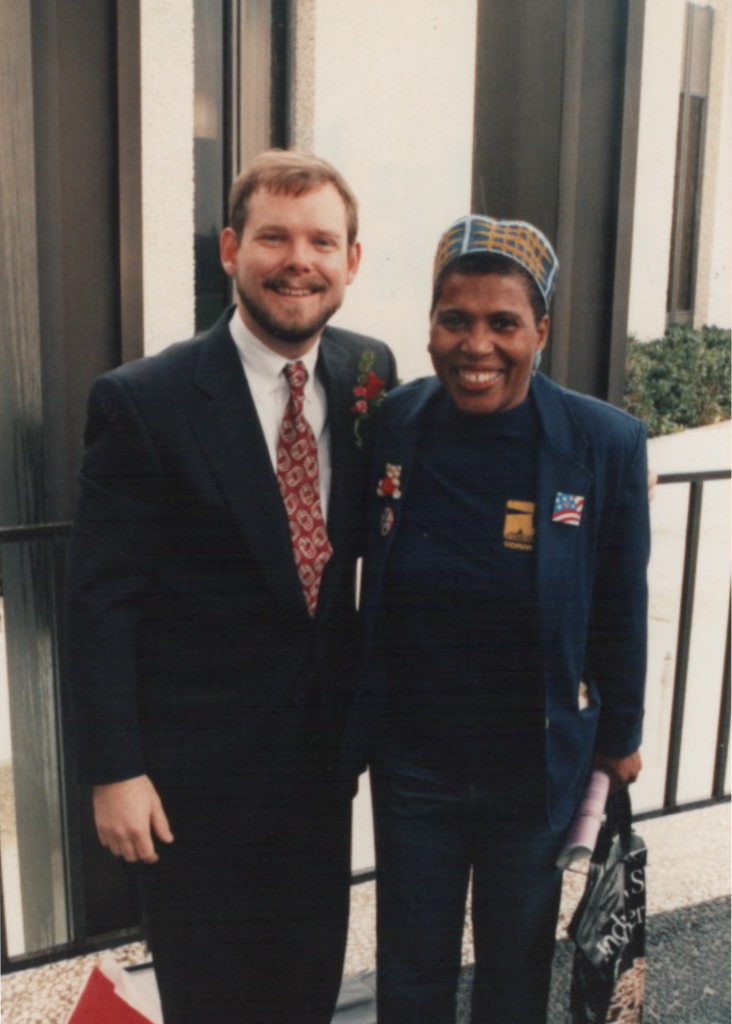
Mark Bonine (left) and Dr. SDiane Bogus (right)
A succession of speakers made our case with great passion and conviction, including couples who had previously been denied by the paper, and another couple publicly renewed their vows. When they finished, our eyes were even damper than the rest of us. I still remember vividly how raw our emotions were that day.
Following the rally at the Merc, a number of us went on to the County building to try to take out marriage licenses – knowing we’d be refused but determined to make the point loudly and publicly that state marriage law discriminated against us. We were boisterous, had fun, and reveled in the camaraderie that comes from being in struggle together against oppression.
While unfortunately we didn’t succeed in drawing any TV coverage that day, we did garner a bit of reporting in the Merc itself, as I recall, and of course the LGBTQ press covered it too. But the largest ripple effect that day was mostly unseen: During the protest one of our leaders received a discreet message that a group of Merc employees were 100% on our side and were “working from within” to press for change. Here was immediate proof that we were having an impact and changing minds!
Empowered by our bold, rainy Valentine’s Day protest, we continued to beat the drum of equal representation for many months thereafter, keeping the pressure on the paper until they finally relented. We were overjoyed when Amy Brinkman and Katy Viall’s announcement ran in November of that year – a sweet victory for them, for us in GLAAD, for our community, and for equality.
[On a personal note, my leadership of South Bay GLAAD and, within that, the campaign for equality in the Merc were the highpoints of my own work as an activist. It was a heady time.]
Sal Accardi is the President of the Board of the Watergarden bathhouse in San Jose. Throughout the AIDS crises, his position on keeping the Watergarden open has raised controversy in our community. South Bay Times met with Sal to discuss his views on AIDS, bathhouse closings, and some of the other political issues he has been involved with.
Q: You are probably best known in our community as the President of the Board of the Watergarden. How has AIDS affected your business?
A: We started off with 64 investors when the Watergarden opened up. When AIDS hit a lot of them panicked and it was very difficult to try to make good their investments so quickly. But we set up payment schedules, and I can proudly say that no one has lost a dime; everyone has made a profit In the Watergarden.
Now It’s a smaller corporation, and that works out better, with less problems that I have to deal with. On the other hand, my ideal was to have a community bathhouse that was actually owned by the community. We’ve got people from literally all walks of life that have been and are investors In the Watergarden – business people, religious people, laymen, old and young.
The Watergarden staff is presented with a certificate of recognition by the Santa Clara County Health Department for their efforts in STD prevention
I think the Watergarden has, through the employees, the managers, and the executives, developed an advertising program that has been tremendous, a whole promotional concept about how to deal with AIDS. We’ve spent $ 140,000 on safe sex advertising and programs.
I’m proud of the way we’ve dealt with AIDS as a community and the way the Watergarden has dealt with it… Some time ago, I came to a reckoning about the Watergarden and the AIDS crises, and it was clear to me that I was right on track. Something in my gut lead me in this direction, and I know we’re doing the right thing, there is no question in my mind.
AIDS is a tremendous crisis and setback for us… It’s been very difficult for me watching my friends die around me, but still I’m so proud that we’ve managed to survive the way we have. To me AIDS is eventually going to make a statement about life, not about death. It’s going to show how we are on a one-to-one basis and on a collective basis as a group.
People need love, they need compassion, and that’s not going to stop. There are many selfish, greedy people who think that they are going to stop us, or make us go back in the closet, but that’s not going to happen… When they find a cure, we’re going to be so much better for having gone through this, I’m convinced of it. We’ll have a perspective on ourselves that maybe we wouldn’t have had If we had not had the crises.
San Jose Mayor Janet Gray Hayes (center) and Sal Accardi (right)
O: Many cities have closed their bathhouses, haven’t they?
A: No, not many. That’s an impression that the politicians like to give. Initially, in the beginning of the crises, people were very frustrated. All they saw was the rising statistics of AIDS. And some politicians, especially Diane Feinstein who became obsessed with the issue, got on a vendetta and wanted the baths closed. Actually very few cities have followed suit, thank God.
I not only felt it was unwise – and I don’t mean that from a vested interest – it was downright threatening to the community because it was counter-productive. It was forcing people to go into environments where they were going to continue to have sex, but in a less safe environment with no options for cleanliness or for condom use or for safe sex consciousness raising. I thought It was ideal for the baths to be instrumental in being part of the solution rather than being part of the problem. But politicians want to grandstand, especially when they know homosexuality Is going on. They want to use it somehow…
I think gay people are more than sexual objects, but some of them choose to have a more limited persona. But to me, I’m convinced that the bottom line is not horniness or the desire to get laid. The bottom line Is a need for companionship and an affirmation of ourselves as human beings.
However, many people have learned to use sex as a means of getting attention and establishing human rapport. They get caught up in the superficial to the extent that they lose sight of their real goal – to become at one with themselves and with each other. I think that is the bottom line of human sexuality, and if that is true, we should try to foster environments that encourage people to express themselves in a variety of ways as long as they are not laying a trip on somebody else. That’s the philosophy of where I’m coming from with the Watergarden.
O:You’ve also been politically active for a long time?
A: Ironically, the first time I went to college, at Foothill College in the sixties, I was openly gay but conservative. I wasn’t for the Vietnam war, (but rather) for either winning it or getting out. I realize now that there was no chance of winning it, that it was an ignoble war.
During the whole period of the flower children and the consciousness raising and the encounters and the gestalt, I got very actively involved in psychology and transactional analysis. I was very much into that. It was my rebellion, I guess, against the times when I considered myself conservative, I went from conservative fascist to hippie to being a left-wing entrepreneur.
O: You grew up in Santa Clara County. Were you born here also?
A: No. I was born In Brooklyn, New York. I came out to California in 1959, when I was thirteen years old, and I learned three things in that year: I learned how to ride the bicycle, I learned how to masturbate, and I learned that most people weren’t Italian or Jewish. I had lived in the middle of a Jewish neighborhood and all the people I knew were family people or neighbors that were Jewish. I never understood why we had a Protestant president. The whole world seemed to me to be Irish, Jewish, or Italian.
I got in touch with my homosexuality at a very personal level – I had to confront It -when I was seventeen. I grew quite attached to a fellow at Los Altos High School in my Junior year, and I had sort of a mini-breakdown because It was scary. I got all sick. But I got over that period and went to the other extreme. I became vociferous in my gayness. At the time it was not so much political but a psychological reinforcement for myself. The more I talked about it, the more comfortable I was. It was a way to stir people, and it worked.
I was very popular in high school, in the sense that even though I was openly gay, I was very successful as an actor. I was very popular even with the football team – we used to play poker games on Fridays and Saturdays at my house.
I came from a very loving supportive family, so It was easy for me to come out… My grandmother’s philosophy was – and she was the head of the household – she said “You were given a special kind of love, and therefore you need to be loved in a special kind of way.” And then she told my family that If anyone didn’t accept my “situation” they could get out, and that anybody that I loved would be loved and respected in our home.
It was as simple as that, and from then on my homosexuality, I feel, has been an advantage to me. I like to deal with the issue. It gives me a way to confront society and shake up society. But If I hadn’t been homosexual, I probably would have been rebelling on some other issue.
Q: You went to college here also, right?
A: Yes. I went to Foothill and San Jose State. While I was going to San Jose State I worked In a third-rate health club/bath house in Redwood City, and that’s when I got Interested In the baths environment. I was a Jack-of-all trades -It was a small operation -I was a receptionist, I was a laundry person, etc.
While l was going to San Jose State I also started coming out socially In the gay world. Up until then I had had a lover for five years. It was a very closed, quiet, paranoid, uptight relationship. He was unhappy and I was unhappy for the last two years of that relationship. We were too afraid to be ourselves, and I didn’t know anything else.
After we broke up I was forced to find my first bar, the Locker Room, and I paced for two hours up and down the street before I had the courage to walk In. As soon as I walked in the bartender said “Oh. This must be the first time you’re in a gay bar.He had spotted me!
After that I thought the best way to get involved, and a more comfortable way to get involved than by being a patron, was to become a cocktail waiter… I could be the person In control, I could limit it, and I could be less inhibited. I didn’t have to be rejected or repudiated as easily, and that helped me to come out…
During my time at San Jose State I also co-founded the gay student union there. That was in 74- ’75. There was a lesbian friend of mine in the drama department, and we wanted to make some waves. It was done almost for fun at first, but then we realized that there was a need there. We started having semesterly elections, and so on. A lot of people wanted to get Involved for social reasons; I was Into It for political reasons, to make a statement.
Q: What other organizations have you been involved with?
A: I kind of regret it now, but when I was a kid, when I was thirteen, I was captain of the Young Republicans in Los Altos. Later on I was actively involved with Richard Nixon’s first campaign against Kennedy. I regret that now, but I was politically active from early on.
I’ve found a need, certainly through the Watergarden, to remain vigilant as to the possibility that homophobic people would want to moralize or use the Watergarden as some kind of football. I see the Watergarden as a cause, not just a business. There was a need for a bathhouse when I opened It, and It was a political statement.
We have a lot of business dealings and we try to spend our money within the gay community to keep other businesses going. And that’s been a philosophy of mine. Sometimes I pay a little more for that, and sometimes I have no choice – we suffer discrimination. When the AIDS crises hit contractors wouldn’t work for us because they were afraid to get AIDS.
I’m temperamentally suited to politics in an activist way. I’m not a moderate type person. I’m very theatrical, and my theatricalism plus my political interest plus my homosexuality and my Italian background created who I am. But I’m more Italian than I am gay. I think of myself as very Italian. I’m very proud of my heritage, the language. the food, the culture, everything. And for the public record, I am not a member of any Mafia organization, even though I am three quarters Sicilian!
Q: How about social activities and hobbies?
A: I love food, as you can see. I love to eat, and every now and then I love to cook. It’s very relaxing to me, but because of my Job – I travel a lot – I eat a lot at restaurants. Predominantly Italian restaurants.
I’m not an outgoing sportsman/activist type person. I like to read a lot, magazines and books, mostly biographies, be they political biographies, historical biographies, or Hollywood-type biographies. I love movies, and I like television. To the disappointment of my lover I can look forward to a whole weekend of going home on Friday evening when I get out of work, taking off my clothes, and literally staying In bed for three days, reading, watching television, and from time to time petting my cat.
Occasionally I go out to the bars, but I don’t party as much as I used to. I also like the peace and tranquility of going to the Russian river or going fishing, and I like theatre a lot – I go to New York usually every year. I’m not into hiking or boating; I’m not into sports, but I do like looking at the guys who are. They seem to be better developed than me. I wonder if there is a correlation between that? I don’t know which came first, their bodies or their physical activity!
In 1996, San Jose was the site of one of the biggest upsets in American figure skating history when Rudy Galindo became the oldest male national champion of the modern era at age 26. Galindo was also the first openly gay figure skating champion, having come out before the competition began.
Galindo was raised in a trailer home in East San Jose with his sister Laura. He began figure skating at an early age and his career took off when he began skating pairs with Fremont native Kristi Yamaguchi. As a team Galindo and Yamaguchi won three U.S. national championships. However, after 1990 Yamaguchi retired from pairs competition to focus on individual skating.
The AIDS epidemic had a major impact on Galindo’s personal and professional lives. His and Yamaguchi’s first coach, Jim Hulick, died of AIDS in 1989. In 1994, Galindo lost both his brother George and another coach Rick Inglesi to AIDS.
Despite those hardships, Galindo won the men’s singles champion title in front of a hometown crowd as the U.S. Figure Skating Championships were held at the San Jose Arena on January 20th, 1996. In the competition, he was the only male competitor to land combination triple jumps. After his performance Rudy chanted the names Jess, George, Jim, and Rick, who had all helped him to achieve the victory.
His championship defied the norms of the U.S. Figure Skating Association. Galindo later said he feared being an out skater might lower his score because of some judge’s discomfort with his identity.
In 1997, he released his autobiography Icebreaker. Proceeds from the book were donated toward funding the expansion of the San Jose Public Library’s Biblioteca Latinoamericana.
In 2000, Galindo announced he was HIV positive.
Today, he coaches figure skating at Sharks Ice in San Jose. His students include Kristi Yamaguchi’s daughter.
He was inducted into the San Jose Sports Hall of Fame in 2011 and the U.S. Figure Skating Hall of Fame in 2013. He has set the path for numerous LGBT and HIV-positive athletes to be themselves.
The fatal police shooting of Black teen Melvin Truss sparked public outcry as many called into question the conduct of the officer responsible for his death and the handling of the case by the grand jury, law enforcement and city officials.
SJPD’s version of events
On May 4, 1985, San Jose police officer Paul Ewing was on duty in the Street Crimes Unit, wearing civilian clothes and driving an unmarked police car. Around 6:45 pm, Ewing claimed he saw Melvin Truss dressed in women’s clothes and jewelry, soliciting drivers at Second and San Carlos streets, according to a city memo authored by San Jose Police Chief Joseph McNamara.
Truss approached Ewing’s car and asked if he was looking for a date, the memo continued. Ewing drove Truss first to a Highway 280 overpass, then to San Jose Bible College, and finally to Olinder School.
According to McNamara’s memo, Truss then began to act agitated and took a steak knife out of a rolled-up windbreaker on his lap, demanding Ewing’s money. Ewing said he distracted Truss and drew his .357 magnum service revolver, pointing it at Truss in hopes that he would retreat. As Truss came toward him, Ewing fired five rounds and jumped out of the car without any injuries.
Truss was transported to San Jose Hospital, where he died at 9:05 pm the same night, according to records from the Human Relations Commission of the County of Santa Clara. He was 17.
(It should be noted that Truss weighed 115 pounds while Ewing was 6’1″ and weighed 200 pounds.)
Public uproar followed as community members and Truss’s family disputed police accounts. While a police spokesman labelled Truss a “transvestite,” Our Paper reported that advocates denounced police for waging a slander campaign against Truss.
A community fights back
Family and friends knew Truss as a shy but polite kid, a fan of Michael Jackson, Metro reported. “Melvin was the kind of person anyone could read like a book. By that I mean he did not carry any false pretenses” said Sharon Youngblood in a statement to Santa Clara County’s Human Relations Commission. Youngblood, a business instructor at James Lick High School who knew Truss for over two years, also noted: “You could look into his eyes and read his ‘soul.’”
Constance Carpenter, a lawyer with the Attorneys Committee on Police Practices, pointed out to the Human Relations Commission that police attempted to find the rest of Truss’s set of steak knives but found no matches.
In addition, in an attempt to try to identify him as an armed robbery suspect, the police pulled 380 reports of armed robberies, grand thefts, and aggravated assaults in the city, Carpenter detailed: 66 cases were investigated further and none of the victims identified Truss as the suspect, according to Carpenter’s statement to the commission.
A grand jury voted in May 1985 not to indict Ewing for fatally shooting Truss. Ewing returned to regular duty.
After the grand jury result, Laura White, an aunt who helped raise Truss, told the Mercury News: “If this is allowed to stand, the people in San Jose and this society had better watch out. Because every month, these trigger-happy police officers who have taken the oath to preserve and protect are going to be dropping people in the street right and left.”
Despite calls for an independent citizens committee to investigate the shooting, in June 1985 the San Jose City Council voted against the proposal after nearly two hours of testimony from attorneys, friends of Truss, and several police officers. According to the Mercury News, one of Truss’ classmates testified that Truss would never hurt anyone, “especially someone older than him and a lot bigger than him.”
During the council meeting, police in full uniform lined the walls of city hall, opposing the proposed independent investigation, according to Metro reports. White was especially angered by Assistant Police Chief Stan Horton, who said Truss “died because of his lifestyle.”
The legacy of Truss’s death
“No one will ever know what really happened at the time of the shooting,” stated Ken Yeager, a spokesperson for BAYMEC, said at the time “But it isn’t difficult to imagine the circumstances that created the situation in the first place, nor the attitudes of the policeman involved. This is what we find very frightening.”
“Our focus now is to call attention to the fact that police in San Jose seem to believe anyone who might be Lesbian or Gay is a criminal or in the process of committing a crime, notably solicitation or prostitution,” said Wiggsy Sivertsen, BAYMEC’s vice-president. “The ramifications of this are enormous.”
Upon request from BAYMEC, the San Jose City Council approved a program in June 1985 through which San Jose police officers would receive training on gay and lesbian lifestyle. The move was met by opposition from the police, as reported in the Mercury News. The training was done by Sivertsen,
Responding to community concerns, the Santa Clara County Human Relations Commission held a public hearing in August 1985. Youngblood, an advisor for James Lick’s Black Student Union, recalled the time when Truss participated in the group’s fall fashion show.
“He was scared to death on that stage and it was written all over his face, but he knew it was for a worthwhile cause and it was exciting for him too,” Youngblood told the commission. “Melvin was not capable of violence.”
In 1989, a federal jury cleared officer Paul Ewing of violating Truss’ civil rights in a civil suit brought by Truss’s mother.
The first meeting of ProLatino was held in February 1992 at the Billy DeFrank Center. Thirteen people attended. The group formed out of the need for a safe environment for gay Latinos to meet and discuss their community, health, and HIV/AIDS. J Alejandro (Alex) Campos Vidrio was the first president of the group, and Omar Nunez was vice-president.
Alex organized meetings every other Tuesday, asking participants to bring a new person with them at each meeting. The group grew from 13 to 27, then 38, and kept going from there. Eventually, they couldn’t fit in the original meeting rooms. They moved to the main ballroom in the Billy DeFrank Center’s Stockton Avenue location. Sixty people came to each meeting and participated in a variety of events.
Although forming ProLatino was a huge step in the direction of healing the LGBTQ+ Latino community, Alex’s goal of creating a safe environment was still not met. Working with Esperanza Garcia Walters, they wrote a grant proposal to host a retreat for the LGBTQ+ Latino community, which they received. The first retreat was held at a Catholic center in Mission San Juan Bautista with 30 gay men participating. Discussions included breaking down institutionalized and cultural homophobia, and the layers of growing up gay in a community that rejected them. They heard stories like being dragged by a horse through their hometowns in Mexico for being gay, or wanting to commit suicide because of their sexuality. These were shared in a safe space with a focus on healing. The retreat was so successful that over time they offered as many retreats as they could afford, which is what Alex had set out to accomplish.
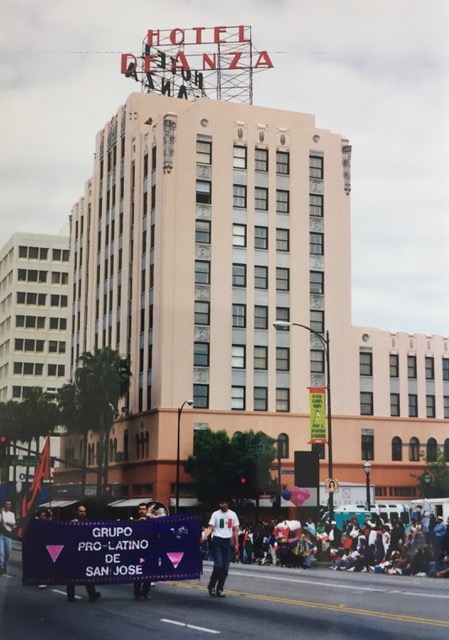
The initial years were very busy. In 1993 they were invited to be part of the San Jose gay parade, the first Latino group to march in it. Members who did drag were embraced as a way to show that no one from any part of the LGBTQ community was excluded. ProLatino worked with other LGBTQ organizations to be more welcoming of the Latino community. At ARIS, for example, they worked to create the group “Entre Hombres” for gay Latino men who were HIV positive. They produced information about AIDS in Spanish, the only such literature available.
Alex remembers the Latino community had the idea that if you were gay, it makes you part woman, which makes you less than a man. “This idea makes you feel and think that you don’t deserve much, but ProLatino broke through those barriers,” he said. Alex made sure to reach out to other groups, including Puerto Ricans, Dominicans, and others. “Our group felt safe because it wasn’t led by a white man–it was led by peers in the community,” he said.
In 1996, the group became a 501(c)(3) with a board of directors and co-chairs to run the organization. Omar Nunez was one of only two people who remained active with the group from the time it formed in 1992 until it went out of existence around 2011/2012. He remembers the retreats fondly. “They were open to everyone who wanted to attend, and people came from all over the Bay Area. Many of the men who attended were immigrants who only spoke Spanish. The retreats created a safe space for them that they had never experienced. It was very empowering.”
The workshops put on by ProLatino were very popular. They provided a place separate from the bars where people could get to know each other. “There was a tremendous void for the Latino community,” said Omar. “Here we were, almost a majority of the population, and there was nothing for us. ProLatino filled that void. It provided social and cultural programs, along with AIDS prevention services. Along with retreats, we did exhibits, education, art, theater, and parties. I’d say we had a couple hundred people a year attend our programs, resulting in well over a thousand gay Latinos connecting to our group.”
“It was an interesting and wonderful time,” said Omar. “People were ready and willing to do something for their community. It was a very unique period. I haven’t seen that type of community spirit since. It may never happen again.”
In 2005, Omar ran the program “Vida y Salud” (Life and Health) for gay Latino men with HIV.
In 2010, he was hired at the Santa Clara County’s PACE Clinic, a county-run clinic for HIV/AIDS patients. As a Community Health Outreach Specialist, he does outreach for the clinic, education for new patients, and interpretation services for doctors.
In 2000, with the support of Miquel Perez, David Castro was elected president of ProLatino. He remembers it as a tough time to get program funding because of the stiff competition for dollars. Since ProLatino had become a non-profit, they were able to receive grants from the state to provide HIV/AIDS services to the Spanish-speaking community. “Neil Christie was very supportive of us and he wrote a request for funding for a new support group,” David said. The center, which would become the Neil Christie Living Center after Neil passed away from AIDS, is where ProLatino began to have educational programs for the Spanish-speaking community. Eventually, due to lack of funding, The Health Trust began to manage the center.
The blending of ProLatino as a social group and the non-profit “Grupo ProLatino de San Jose” proved to be problematic, especially since David was advocating for both. Eventually, the non-profit lost its financing and no longer had money to pay staff. David then left the board and moved to Arizona in 2005 where he attended college and got a BA in Spanish and English translation and interpretation and continued to work on his master’s degree.
David has fond memories of the services that ProLatino provided to the Spanish-speaking community. “I used to get calls from married men with children who learned they were HIV positive, and it was difficult for them to handle their personal life. They only spoke Spanish so they didn’t know which way to go or what to do, and many wanted to commit suicide. I would meet with them after work and we would talk for hours about everything that was going on. I would eventually get them services, and I felt very good about that.”
ProLatino members together at an event
ProLatino members together at an event
ProLatino members together at an event
ProLatino members together at an event
Drag Queens at a ProLatino event
ProLatino members together at an event
ProLatino members together at an event
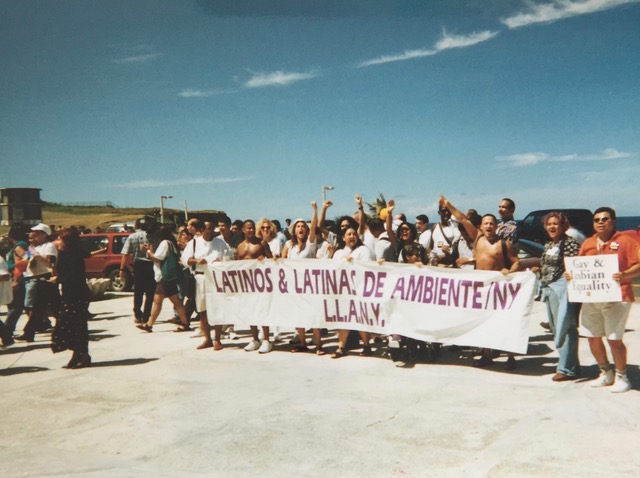
ProLatino members marching together with flags and banners
ProLatino members in a group photo together
ProLatino members at Walk for AIDS event
ProLatino members at an anniversary event
ProLatino members marching in the Pride parade
ProLatino members marching in the Pride parade
ProLatino members marching in the Pride parade
ProLatino members marching in the Pride parade
ProLatino members walking with various flags from Latin American and Afro-Caribbean countries in Pride
Image of Pro Latino members holding banner in gay Pride parade
In the late 1980s, J Alejandro (Alex) Campos Vidrio was a 21-year-old gay Mexican college student at San Jose. Like most Latinos, he grew up in a homophobic community, where he found that the stigma of being gay and the stigma of HIV was widespread enough for him not to come out. One of his friends had been in a relationship with someone who tested positive for HIV, so he accompanied him to the free clinic for an HIV test.
At the time, Alex knew nothing of the disease. In a counseling session, a nurse asked him a series of questions to determine if he was at risk. Before that, Alex had not told anyone he was gay, but when the nurse asked the question, he confirmed his sexuality. Because he was gay, this put him in the high risk group for HIV, so he took the test.
Two weeks later, he arrived at the clinic alone to receive his results: he was negative. The visit was so short that he stopped the nurse from leaving the appointment to ask her how he could help his Latino community get informed about HIV and learn how to protect themselves. The nurse explained there was no program for that at the time and suggested he get involved in creating options for his community. So he began volunteering. It was there that he met nurse Esperanza Garcia Walters and nurse Maria who would assist him in spreading awareness to the Latino LGBTQ community.
Alex’s first volunteer event was at Stanford University’s Walk for AIDS. Although he was there to help, he kept a distance between himself and the leaders with HIV, still scared of attracting the stigma of HIV. The walk, and how many people participated in it, made an impact on him.
Alex began attending a meeting of gay men in the Latino community at Club St. John on Mondays. Over time, he brought condoms and pamphlets and offered HIV counseling. Outside the meetings, participants didn’t even acknowledge each other for fear of being identified as gay.
At that time, Alex began seeing a Catholic Latino. One weekend he joined him on a retreat, which emphasized that participants were in a safe environment and would be protected by their peers and a higher power. The retreat changed his worldview: He wanted that kind of space for the gay Latino community to gather.
After he returned, he approached the Billy DeFrank Center, asking to host a gay Latino community night. They quickly turned him down, saying he was too young and not serious enough. He kept trying. Through his volunteering at the clinic, Esperanza Garcia Walters invited him to have dinner at an HIV patient’s home. He became close friends with the couple, and the dinner became a weekly gathering of friends. Alex and others fixed up the house, making it brighter, more comfortable, so it felt like a safe space. They called him “Chispa,” meaning “spark,” because he made them feel more alive.
Alex continued to pass out literature and condoms, attempting to connect with his community. His efforts were met with resistance; he was kicked out of many clubs and restaurants for doing so. He attended a meeting at the Billy DeFrank Center, voicing concerns that literature wasn’t available in Spanish for the Latino community, that they had neither a safe place to congregate nor resources away from the public. The DeFrank Center finally offered him space on Monday nights. Campos made a flyer inviting folks to “come and share with us,” as a way around using stigmatizing words like “gay” or “HIV.”
For the first meeting in 1992, Alex made 25 folders with pamphlets of information, condoms, and other resources. Thirteen people showed up, beating his own expectations. Attendees asked him to hold another meeting, so he spoke to Mark and was approved. The meetings were scheduled every other Tuesday. Every person attending committed to bring one more person with them to each meeting. This was the beginning of ProLatino.
In 1998, Alex decided to step down from ProLatino in order to take care of himself. He moved to San Francisco and joined the HIV Prevention Working Group of the State of California, traveling across the state, gathering data and analyzing trends in the virus’s spread.
In 1999, Alex went on vacation to Hawaii and according to him “never left.” He attended the University of Hawaii and worked at the School of Medicine as a director of the Pre-Health Career Corps. Due to the pandemic, he has not been working since March 2020.
One of Alejandro Campos’s proudest moments working with ProLatino came while attending a conference with the Department of Education in Hawaii in 2011. He learned about LLEGO’s (National Latino/a Lesbian and Gay Organization) opportunities for the LGBTQ+ community and attended a workshop about retreats. The Hawaiian group cited what they learned about retreats from a San Francisco group, which they learned from a Bay Area local, who turned out to be Campos. This moment validated all the work he did through ProLatino. His ideals had spread throughout the country, even making it to Hawaii. — Alejandro Campos
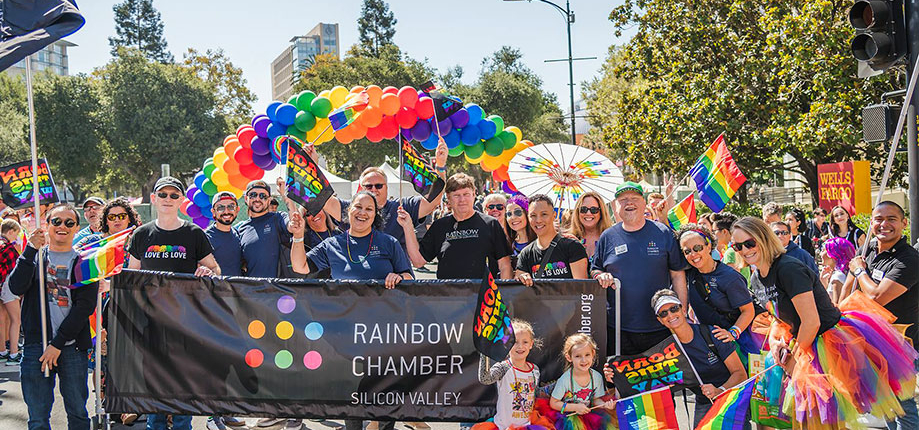
The celebration of pride in Silicon Valley can be characterized as a series of struggles and triumphs. Whether it was presiding over one the largest pride events in between San Francisco and Los Angeles to staving-off bankruptcy and uneven organization, Pride in Silicon Valley has persevered and evolved into a wondrous event that the LGBTQ community eagerly awaits every year.
The Gay Student Union was able to organize the first pride event in Silicon Valley. The main event began at 9:30 am, with other events held in various parts of the SJSU campus. Workshops included bisexuality, drag, couples, legal rights, religion, and sadomasochism. The day was closed with a potluck dinner and dance at the Student Union Ballroom.
St. James Park (1976-1980)
Sponsored by the Lambda Association, the first Gay Freedom Rally and Dance was held downtown at St. James Park. More than 300 people attended, and it was considered a small but strong showing for Silicon Valley’s first official pride event. Guests included Harvey Milk, who was a speaker in 1978. This would be come to the location for pride for the next four years.
City Park Plaza (1981-1982)
The Lambda Association moved its Gay Freedom Rally to City Park Plaza (now known as Plaza de Cesar Chavez) on San Carlos and Market Streets.
St. James Park (1983-1985)
Renamed Gay Pride Celebration in 1983, the organizers returned the festival to St. James Park. By then, there were more gay businesses and organizations participating than ever before.
5,000 people participated in 1985, marking a huge milestone for Pride and the LGBTQ community in Silicon Valley.
SJSU Athletic Fields (1986)
Due to redevelopment efforts at St. James Park, San Jose Pride moved to the SJSU Athletic Fields on 10th and Alma. Attendance remained stable, despite the financial constraints and a venue change.
Santa Clara County Fairgrounds (1987-1993)
After 1986, the Santa Clara County Fairgrounds was chosen as a less expensive alternative to St. James Park, one that also allowed for more flexibility with vendors and better accessibility to facilities. Though Pride had been cast out of downtown, festivities and attendance continued to grow each year.
The Alameda Pride and Parade (1993)
While the location of Pride at The Alameda was brief, it drew a great deal more attention and recognition than it had in the past. Mayor Susan Hammer was named one of the grand marshals, the first time a San Jose mayor participated in Pride. With 10,000 people attending, Pride became far more than a niche event for the local LGBTQ community.
Stockton Strip (1994)
Despite the previous year’s success, Pride was endangered. The Gay Pride Celebration had lost thousands of dollars the previous year. In an effort to preserve its momentum, Stockton Avenue was chosen as a cost-effective way of organizing gay businesses and activities in a central area. While there was a significant decrease in attendance (only about 2,000 per day), Stockton Avenue kept Pride alive in Silicon Valley.
Discovery Meadow (1995-2014)
The move to Discovery Meadow in 1995 ushered in a more stable and organized era of Pride in San Jose. Attendance broke a new record with 12,000 attendees. Five years later it reached 20,000. Additionally, the appearance of high-profile individuals, including drag superstar RuPaul in 1998, offered even more reasons for people to participate in Pride. Discovery Meadow remained Pride’s home for several years. In 2014, San Jose Pride was renamed Silicon Valley Pride to be more inclusive of neighboring communities.
2014 Silicon Valley Pride Poster
2015 Silicon Valley Pride Poster
2016 Silicon Valley Pride Poster
Park Avenue and Almaden Boulevard (2015-2016)
Under new chair Thaddeus Campbell, Silicon Valley Pride had its first parade event in years. This new parade also coincided with a new event location on Park Avenue and Almaden Boulevard. In 2016, the organization launched the first Saturday Night Festival.
2017 Silicon Valley Pride Poster
2018 Silicon Valley Pride Poster
2019 Silicon Valley Pride Poster
2020 Poster
Plaza de Cesar Chavez (2017-2019, 2021-present)
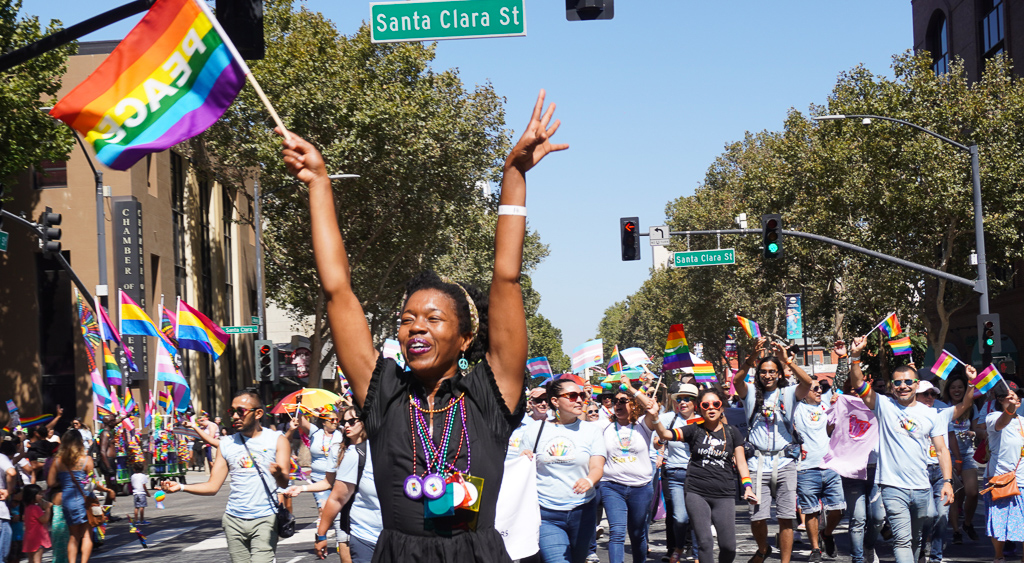
After successfully restarting Pride with a new parade and location, along with unloading the troublesome debt accrued in previous years, Thaddeus Campbell oversaw Silicon Valley Pride’s move back to Plaza de Cesar Chavez. Because Pride tends to be majority male driven events, in 2018 the organization launched HEY GIRL, a queer female identified group under Silicon Valley Pride umbrella started by Liz Asborno and Nicole Altamirano, as well as the first Trans and Friends Rally and a Drag Queen Cooking Showdown. Due to the COVID-19 pandemic, Silicon Valley Pride debuted a virtual celebration of Pride in 2020. Community members were invited to submit videos of their art, dance, or a simple greeting to commemorate Pride. In 2021, it resumed in-person celebrations at the plaza.
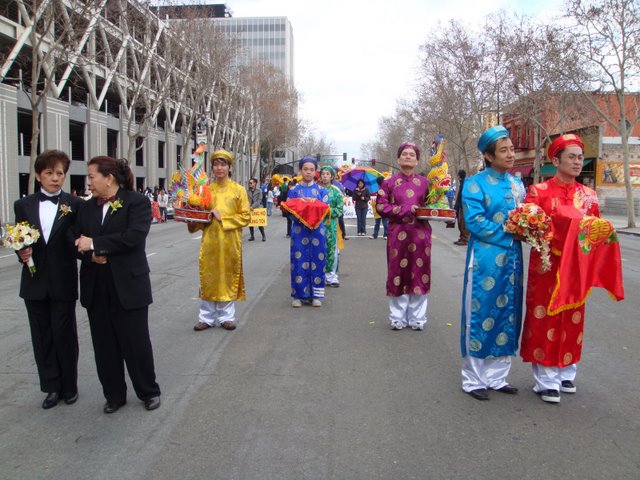
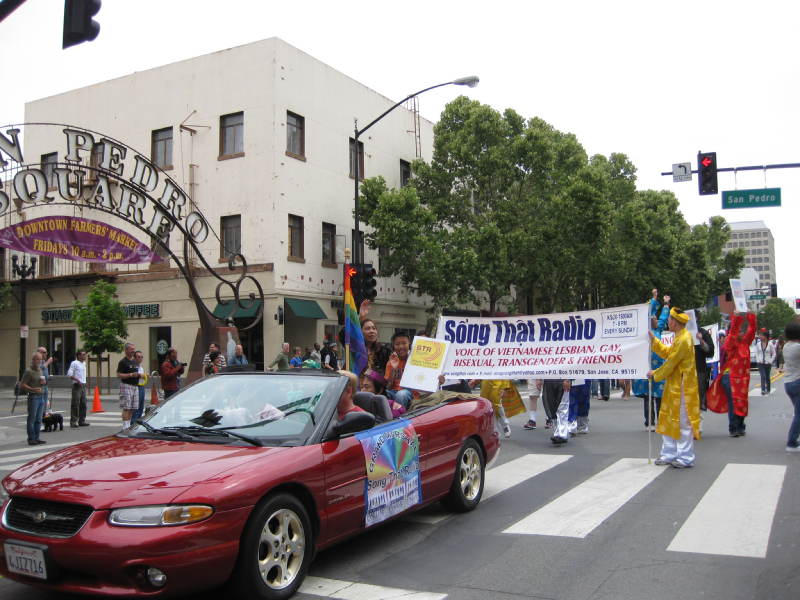
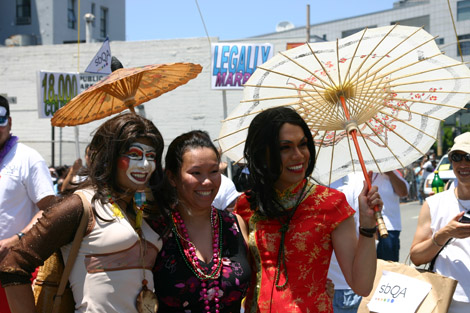
Heralded as the first pride parade in the South Bay, the 1991 San Jose Gay Pride Parade marked the first in many efforts in heightening the visibility of the LGBTQ community. The parade was on Stockton Avenue, going from Taylor Street to the Alameda, and concluded at the Billy DeFrank Center. Stockon Avenue was a prime location for the parade, largely owing to the Stockton Strip and its gay clubs and businesses.
Market Street Parade (1995-2009, 2015-2019, 2021-present)
After the move of the Gay Pride Celebration to Discovery Park, the parade was able to resume in 1995. The new downtown route was along Market Street, beginning at St. James Street and ending at Park Avenue. Attendance was consistent, with parade having an uninterrupted 14-year streak. Unfortunately, in 2009, the recession had hit organizers deeply, leading to an end of the parade. In 2015, after rebranding itself as Silicon Valley Pride, the parade made a successful comeback along its regular route on Market Street. After being postponed in 2020 due to the COVID-19 pandemic, the parade resumed on Market Street in 2021, where it continues to channel the spirit and resilience of Silicon Valley’s LGBTQ+ community.