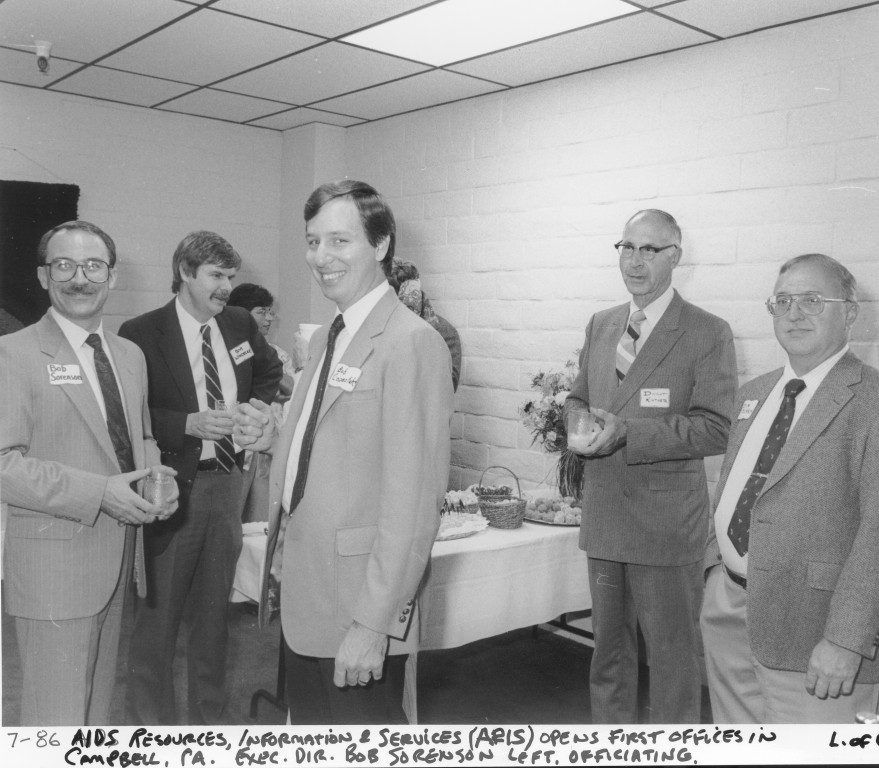
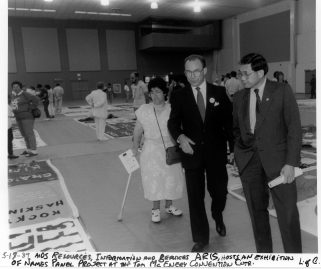
The AIDS Resources, Information & Services (ARIS) Foundation formed in 1986 to provide information, resources, and support for AIDS & HIV positive patients in Santa Clara County. ARIS supplied assistance to patients through a monthly food basket and nutritional supplements program, a 24-hour residential care facility, transportation services, and weekly emotional support groups. ARIS offered a housing program for the HIV and AIDS patients who needed assistance: they had 4 houses and 18 bedrooms for patients with regularly scheduled visiting nurses.
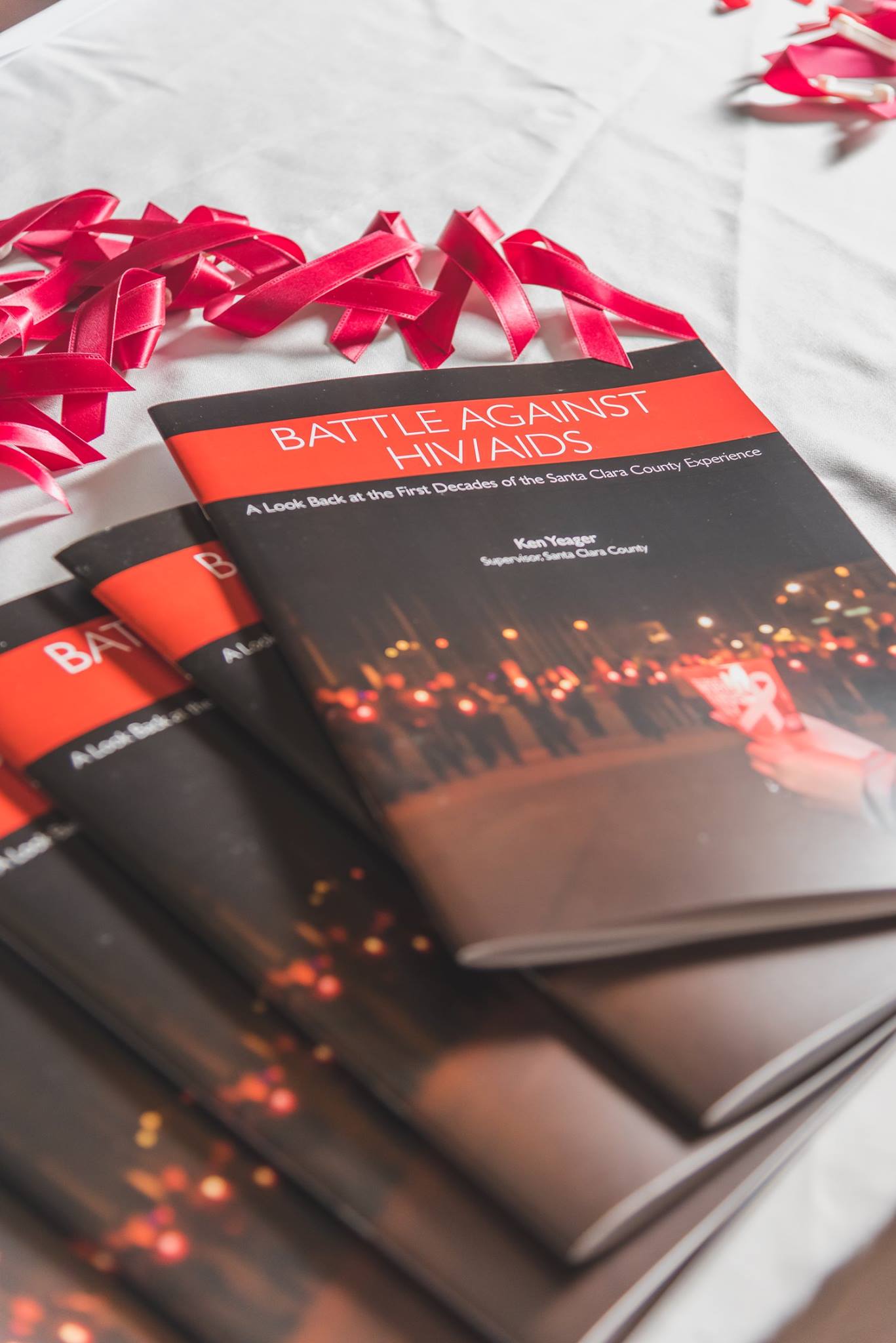
ARIS was working closely with the Public Health Department to create public education programs to end the stigmatization of HIV & AIDS, as well as a sex education program to prevent the spread of HIV. The foundation shut down in 2003. Read more about the organization in Battle Against HIV/AIDS (PDF).
In the wake of Lambda News’ worsening prospects, Our Paper/Your Paper was first published in September 1982 by Lambda News alumni Steve Century, David DeLong, Al Bonvouloir, Winn Crannell, Johnie Staggs, and Rosalie ‘Nikki’ Nichols. Seeking to define the gay suburban communities of the South Bay, Our Paper/Your Paper was intended to offer a platform distinct from the gay press of San Francisco, which dominated the entire Bay Area in the years prior.
On June 5, 1981, the U.S. Centers for Disease Control and Prevention’s newsletter Morbidity and Mortality Weekly Report published a story about five young, previously healthy gay men who had come down with a rare lung infection, pneumocystis pneumonia. This was the first public mention of what the CDC would name in just over a year the Acquired Immune Deficiency Syndrome. The AIDS epidemic had begun in the United States.
Karl Vidt, who became a prominent local HIV/AIDS advocate—including a multi-year term as chair of the Santa Clara County World AIDS Day committee—said that during 1981-82 people in Santa Clara County thought AIDS was “something affecting people in San Francisco.”
A crisis emerges
In 1983 that attitude changed rapidly. AIDS arrived in Santa Clara County with the first diagnosis being confirmed by the public health department in April. The first signs of AIDS-related fear followed shortly afterwards.
The Santa Clara County Public Health Department’s AIDS Program was formed in 1983 to conduct community education. Utilizing a small grant from the state, the team began to educate people in jails, gay bars, and elsewhere. They also distributed condoms. In November, Santa Clara County obtained its first state funding for AIDS.
In 1985, the first HIV tests became available and the Public Health Department opened Santa Clara County’s first HIV clinic. Numbers were climbing: 53 deaths, 148 people living with HIV/AIDS.
Dr. Marty Fenstersheib took on the difficult role of telling people they were HIV positive. In a 2012 San Jose Business Journal interview, he recalled the reactions of those earliest patients, “They would run out, bang doors, sometimes they’d cry, sometimes they’d scream. It was horrible.”
In January 1986, BAYMEC, led by BAYMEC co-founder Ken Yeager, successfully secured the support of the Santa Clara County Board of Supervisors to make a substantial commitment to funding AIDS-related services. Even as the County was facing tight budget times, they were committing critical dollars to AIDS services. Yeager was also named chair on the new Santa Clara County AIDS Task Force. The epidemic, and the lack of an adequate government response to it, was becoming the dominant issue in the LGBTQ community.
Life expectancy from diagnosis to death was around two years. People got sick and died very fast. Tens of thousands of families learned for the first time that their sons were gay only after they became sick. Often parents had to simultaneously come to grips with their son’s sexuality and their deaths.
The total death count continued to climb from 1986 to 1990: 96, 172, 265, 296, 433.
As the 1980s came to a close, the death toll from AIDS continued to rise, reaching 124 new deaths in Santa Clara County in 1989. By 1990, total deaths reached 433 with more than a thousand people living with HIV/AIDS.
Dark times
The early 1990s were some of the darkest times of the AIDS epidemic. Death tolls continued to increase locally and nationally. 1993 and 1994 were the years of highest deaths in Santa Clara County: 219 in 1993 and 220 in 1994.
AIDS patients continued to die at a rapid pace. At the end of 1994, the Public Health Department produced an analysis of the first 10 years of the epidemic in the county. It revealed that through 1990 more than 90% of individuals diagnosed with AIDS had died within the same year. In both 1983 and 1986, every single individual in Santa Clara County died the same year they were diagnosed with AIDS.
Thankfully, 1995 would bring some hope for HIV/AIDS sufferers. A medical breakthrough, whose impact continues to be felt today, dramatically transformed an AIDS diagnosis from a likely death sentence to a serious but manageable health condition.
Finally, a breakthrough
Public pressure and the growing death toll from AIDS led the Food and Drug Administration to approve the protease inhibitor Saquinavir for use outside of clinical trials in June 1995. The era of the AIDS cocktail had begun. It would not become widely used in the U.S. until 1996, but the earliest results were extremely promising.
By 1997 the full effects of the “cocktail” were becoming apparent to public health officials in Santa Clara County as the year-end statistics showed that only 67 people died of AIDS-related causes. That is a drop of almost 50% compared to the previous year.
Almost overnight, HIV/AIDS went from being a near-certain death sentence to a manageable health condition if diagnosed and treated. This change was extremely welcome after more than a decade of darkness, when friends and loved ones got sick, wasted away, and then died with blinding speed.
From 1984 when the first AIDS deaths were reported in the county to the end of 2017, there had been a total of 2,498 deaths from AIDS. A tragic loss.
While HIV/AIDS has been a treatable condition for almost a quarter-century, it is still a health crisis that impacts thousands in our community.
African-American and Hispanic residents continue to be disproportionately impacted, with rates among African-Americans more than four times higher than rates among non-Hispanic Whites.
We have come so far since those early dark days. But much work still needs to be done.
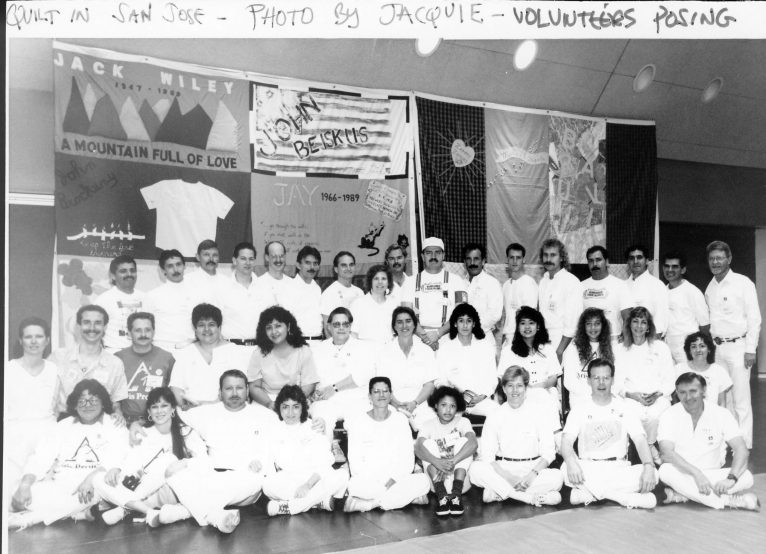
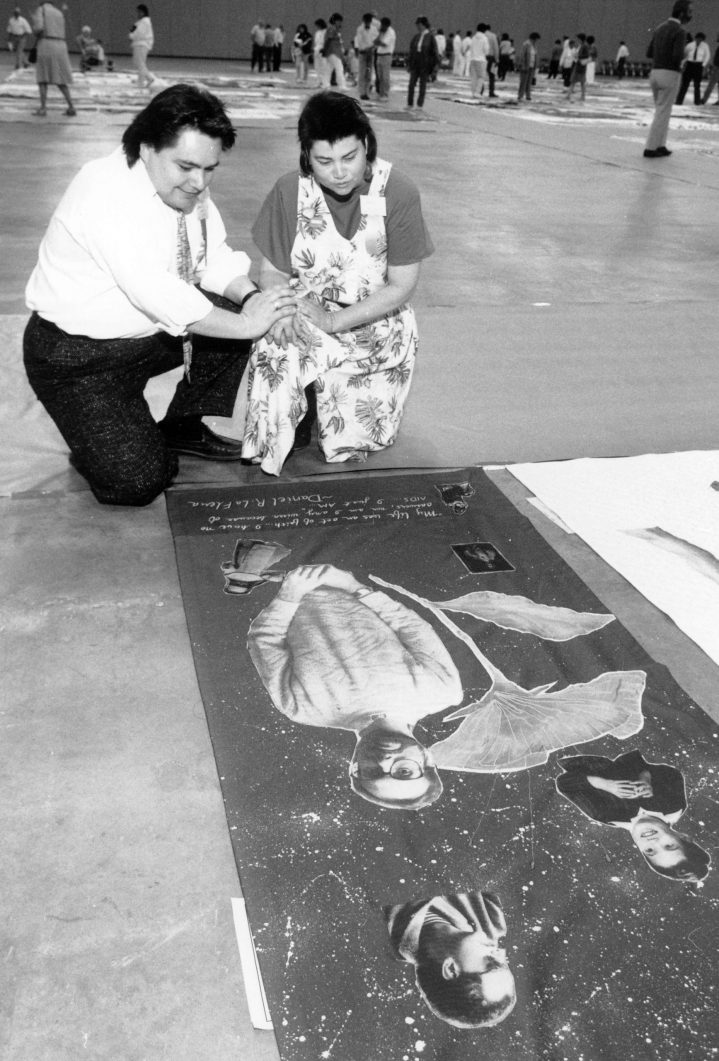
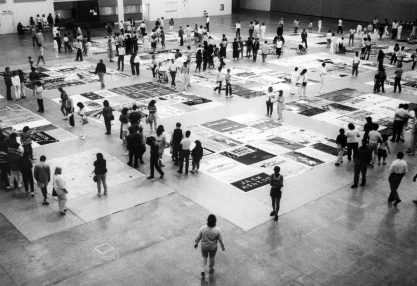
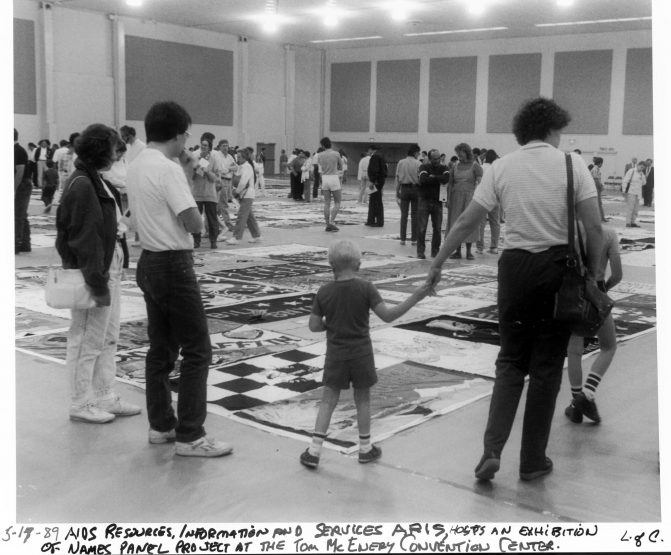
Folks viewing the AIDS memorial quilt at the Tom McEnery Convention Center hosted by ARIS. Photograph from the Ted Sahl Archives at SJSU.
ARIS staff at the opening of their first offices. Photograph from the Ted Sahl Archives at SJSU.
Folks viewing the AIDS memorial quilt at the Tom McEnery Convention Center hosted by ARIS. Photograph from the Ted Sahl Archives at SJSU.
Folks viewing the AIDS memorial quilt at the Tom McEnery Convention Center hosted by ARIS. Photograph from the Ted Sahl Archives at SJSU.
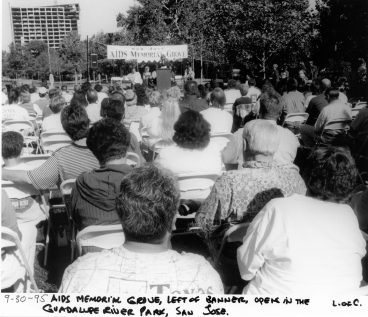
Opening of the AIDS Memorial Grove in Guadalupe River Park, San Jose. Photograph from the Ted Sahl Archive at SJSU.
Button reading We > AIDS, greaterthan.org
Button reading “ACT UP,” referring to the ACT UP organization
Folks viewing the AIDS memorial quilt at the Tom McEnery Convention Center hosted by ARIS. Photograph from the Ted Sahl Archives at SJSU.
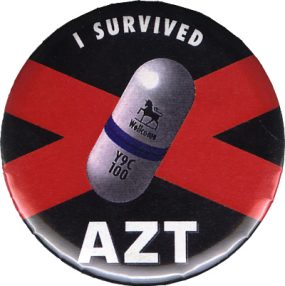
A button depicting an AZT pill and the text “I Survived AZT”
The San Jose AIDS Memorial Grove dedication plaque. It reads, “Dedicated to those living with HIV and those who have died of AIDS. September 30, 1995.”
Folks viewing the AIDS memorial quilt at the Tom McEnery Convention Center hosted by ARIS. Photograph from the Ted Sahl Archives at SJSU.
Created as Lambda Association’s eponymous newsletter arm in 1976, Lambda News–run by Dan Relic–was one of the first examples of local gay press in Silicon Valley. Evolving from a simple newsletter, Lambda News reported on local gay organizations, businesses, and events around Silicon Valley. Originally a purely volunteer-run paper, Lambda News faced constraints that led to Relic taking it over as a private venture to ensure its future viability. In April 1983, Lambda News dissolved as a result of low ad revenue and disorganization.
The celebration of pride in Silicon Valley can be characterized as a series of struggles and triumphs. Whether it was presiding over one the largest pride events in between San Francisco and Los Angeles to staving-off bankruptcy and uneven organization, Pride in Silicon Valley has persevered and evolved into a wondrous event that the LGBTQ community eagerly awaits every year.
The Gay Student Union was able to organize the first pride event in Silicon Valley. The main event began at 9:30 am, with other events held in various parts of the SJSU campus. Workshops included bisexuality, drag, couples, legal rights, religion, and sadomasochism. The day was closed with a potluck dinner and dance at the Student Union Ballroom.
St. James Park (1976-1980)
Sponsored by the Lambda Association, the first Gay Freedom Rally and Dance was held downtown at St. James Park. More than 300 people attended, and it was considered a small but strong showing for Silicon Valley’s first official pride event. Guests included Harvey Milk, who was a speaker in 1978. This would be come to the location for pride for the next four years.
City Park Plaza (1981-1982)
The Lambda Association moved its Gay Freedom Rally to City Park Plaza (now known as Plaza de Cesar Chavez) on San Carlos and Market Streets.
St. James Park (1983-1985)
Renamed Gay Pride Celebration in 1983, the organizers returned the festival to St. James Park. By then, there were more gay businesses and organizations participating than ever before.
5,000 people participated in 1985, marking a huge milestone for Pride and the LGBTQ community in Silicon Valley.
SJSU Athletic Fields (1986)
Due to redevelopment efforts at St. James Park, San Jose Pride moved to the SJSU Athletic Fields on 10th and Alma. Attendance remained stable, despite the financial constraints and a venue change.
Santa Clara County Fairgrounds (1987-1993)
After 1986, the Santa Clara County Fairgrounds was chosen as a less expensive alternative to St. James Park, one that also allowed for more flexibility with vendors and better accessibility to facilities. Though Pride had been cast out of downtown, festivities and attendance continued to grow each year.
The Alameda Pride and Parade (1993)
While the location of Pride at The Alameda was brief, it drew a great deal more attention and recognition than it had in the past. Mayor Susan Hammer was named one of the grand marshals, the first time a San Jose mayor participated in Pride. With 10,000 people attending, Pride became far more than a niche event for the local LGBTQ community.
Stockton Strip (1994)
Despite the previous year’s success, Pride was endangered. The Gay Pride Celebration had lost thousands of dollars the previous year. In an effort to preserve its momentum, Stockton Avenue was chosen as a cost-effective way of organizing gay businesses and activities in a central area. While there was a significant decrease in attendance (only about 2,000 per day), Stockton Avenue kept Pride alive in Silicon Valley.
Discovery Meadow (1995-2014)
The move to Discovery Meadow in 1995 ushered in a more stable and organized era of Pride in San Jose. Attendance broke a new record with 12,000 attendees. Five years later it reached 20,000. Additionally, the appearance of high-profile individuals, including drag superstar RuPaul in 1998, offered even more reasons for people to participate in Pride. Discovery Meadow remained Pride’s home for several years. In 2014, San Jose Pride was renamed Silicon Valley Pride to be more inclusive of neighboring communities.
2014 Silicon Valley Pride Poster
2015 Silicon Valley Pride Poster
2016 Silicon Valley Pride Poster
Park Avenue and Almaden Boulevard (2015-2016)
Under new chair Thaddeus Campbell, Silicon Valley Pride had its first parade event in years. This new parade also coincided with a new event location on Park Avenue and Almaden Boulevard. In 2016, the organization launched the first Saturday Night Festival.
2017 Silicon Valley Pride Poster
2018 Silicon Valley Pride Poster
2019 Silicon Valley Pride Poster
2020 Poster
Plaza de Cesar Chavez (2017-2019, 2021-present)
After successfully restarting Pride with a new parade and location, along with unloading the troublesome debt accrued in previous years, Thaddeus Campbell oversaw Silicon Valley Pride’s move back to Plaza de Cesar Chavez. Because Pride tends to be majority male driven events, in 2018 the organization launched HEY GIRL, a queer female identified group under Silicon Valley Pride umbrella started by Liz Asborno and Nicole Altamirano, as well as the first Trans and Friends Rally and a Drag Queen Cooking Showdown. Due to the COVID-19 pandemic, Silicon Valley Pride debuted a virtual celebration of Pride in 2020. Community members were invited to submit videos of their art, dance, or a simple greeting to commemorate Pride. In 2021, it resumed in-person celebrations at the plaza.
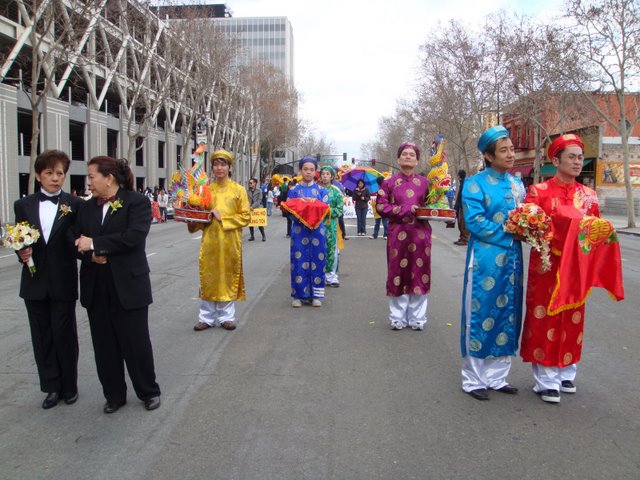
Heralded as the first pride parade in the South Bay, the 1991 San Jose Gay Pride Parade marked the first in many efforts in heightening the visibility of the LGBTQ community. The parade was on Stockton Avenue, going from Taylor Street to the Alameda, and concluded at the Billy DeFrank Center. Stockon Avenue was a prime location for the parade, largely owing to the Stockton Strip and its gay clubs and businesses.
Market Street Parade (1995-2009, 2015-2019, 2021-present)
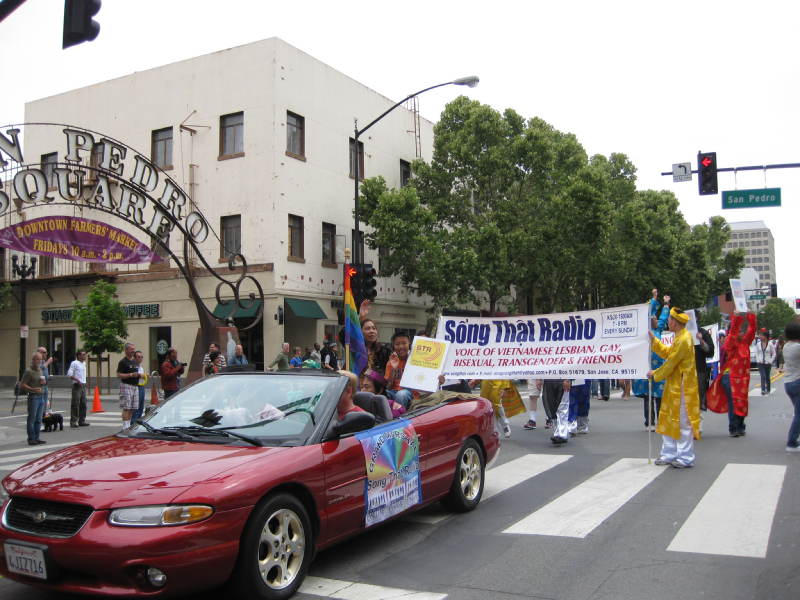
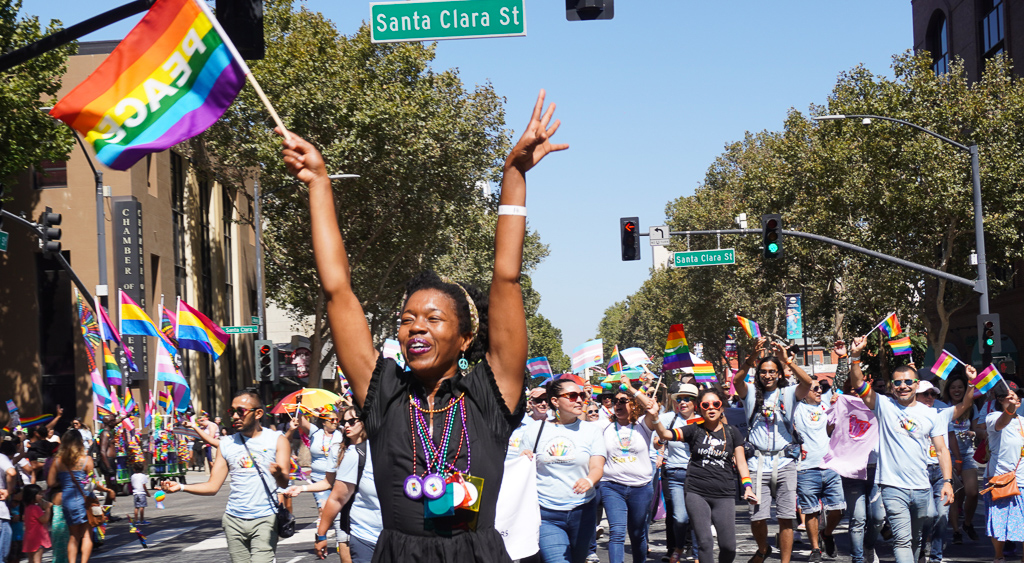
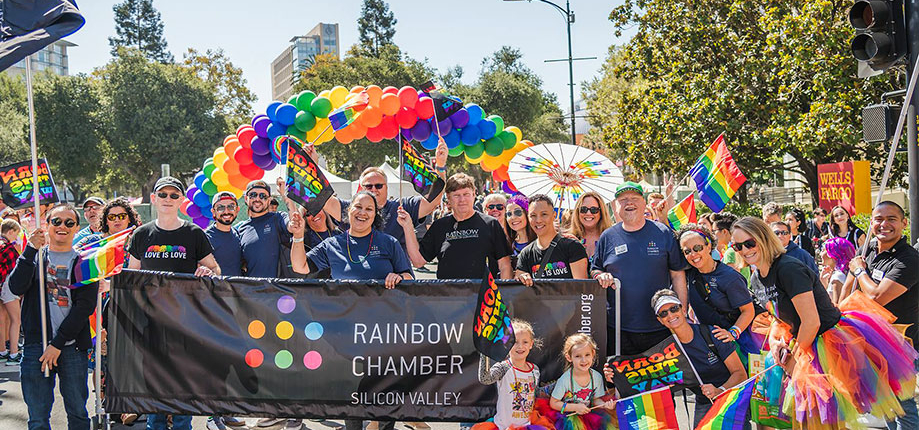
After the move of the Gay Pride Celebration to Discovery Park, the parade was able to resume in 1995. The new downtown route was along Market Street, beginning at St. James Street and ending at Park Avenue. Attendance was consistent, with parade having an uninterrupted 14-year streak. Unfortunately, in 2009, the recession had hit organizers deeply, leading to an end of the parade. In 2015, after rebranding itself as Silicon Valley Pride, the parade made a successful comeback along its regular route on Market Street. After being postponed in 2020 due to the COVID-19 pandemic, the parade resumed on Market Street in 2021, where it continues to channel the spirit and resilience of Silicon Valley’s LGBTQ+ community.
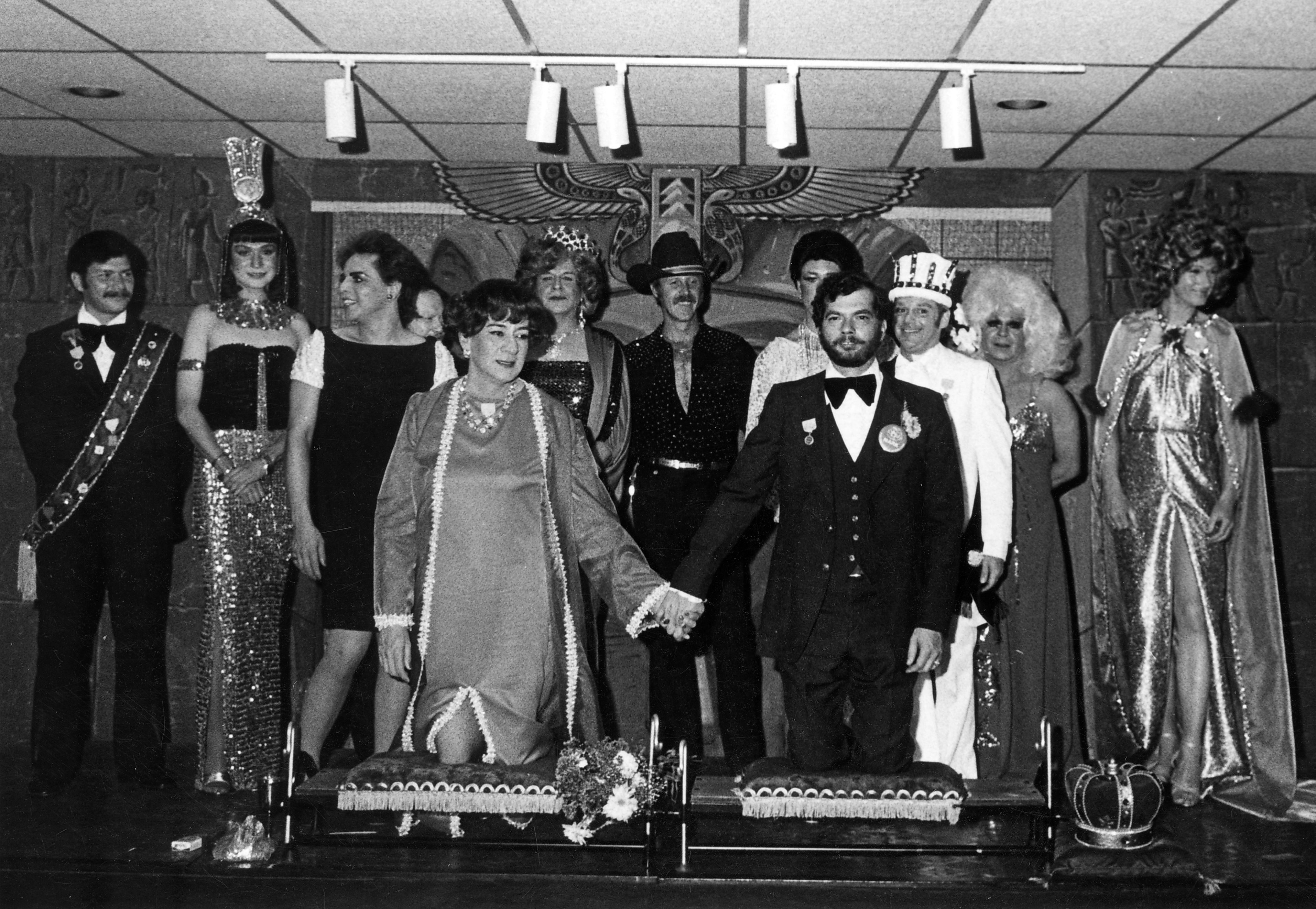
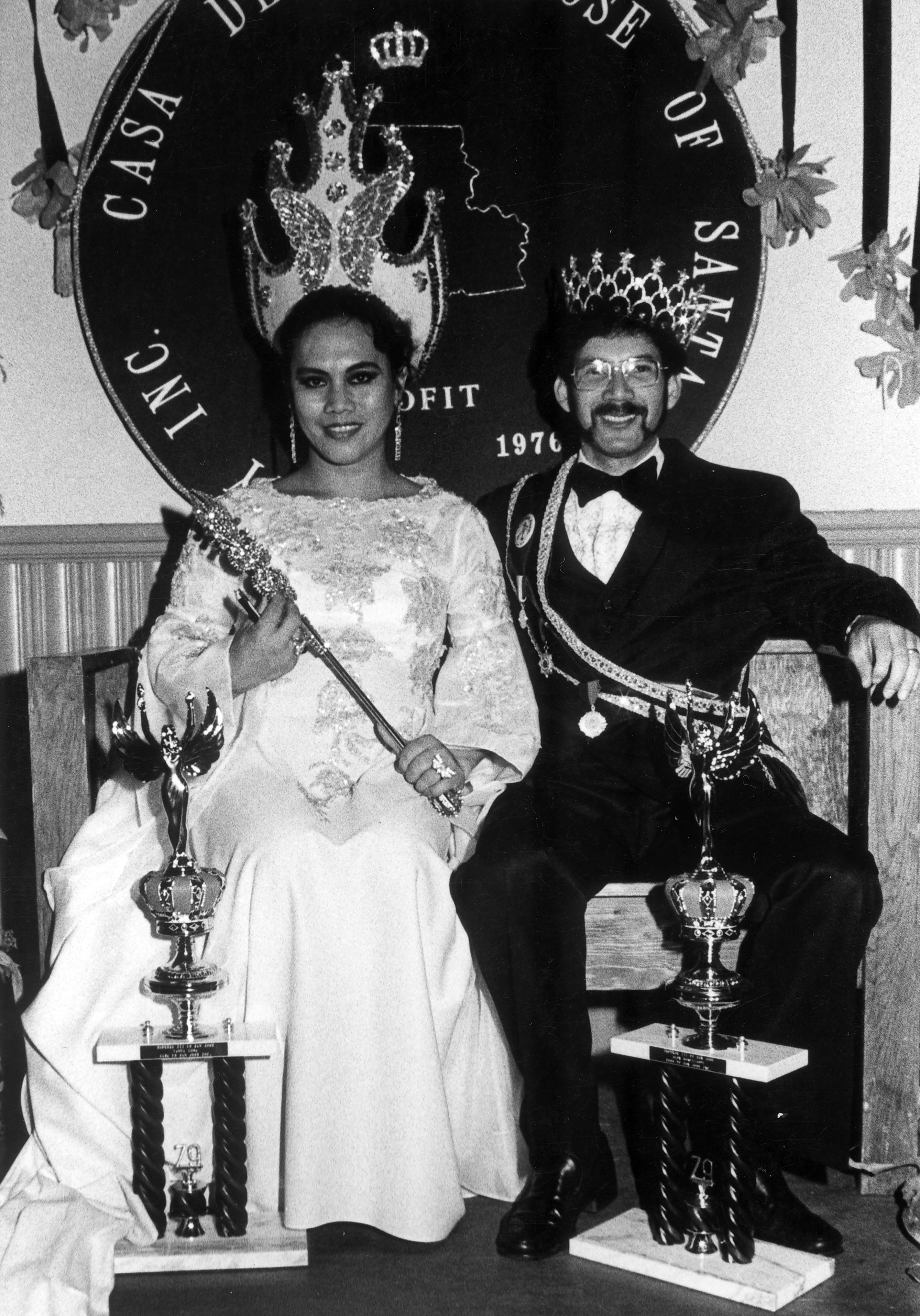
In the early days of Casa de San Jose’s informal association of drag queens, they would travel to San Francisco for the city’s world-famous drag shows. Ray Aguilar, a San Jose drag queen, requested permission to form an IICS chapter in San Jose, which formed as Casa de San Jose of Santa Clara County Inc in the early 1970s. In 1990, the organization was reincorporated as The Imperial Royal Lion Monarchy, Inc. of San Jose.
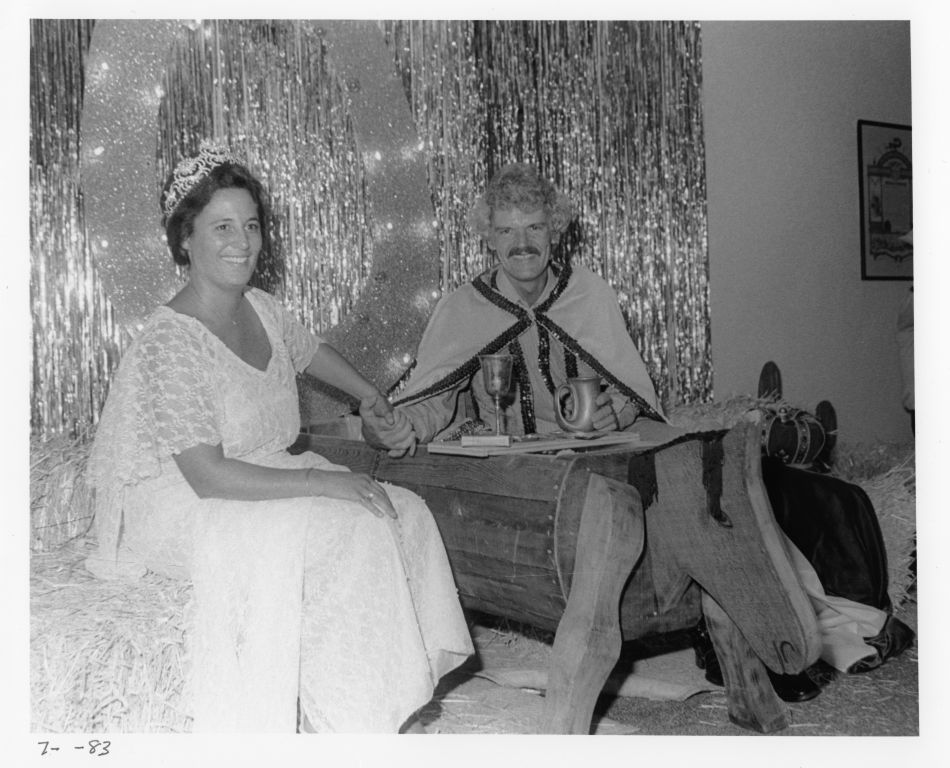
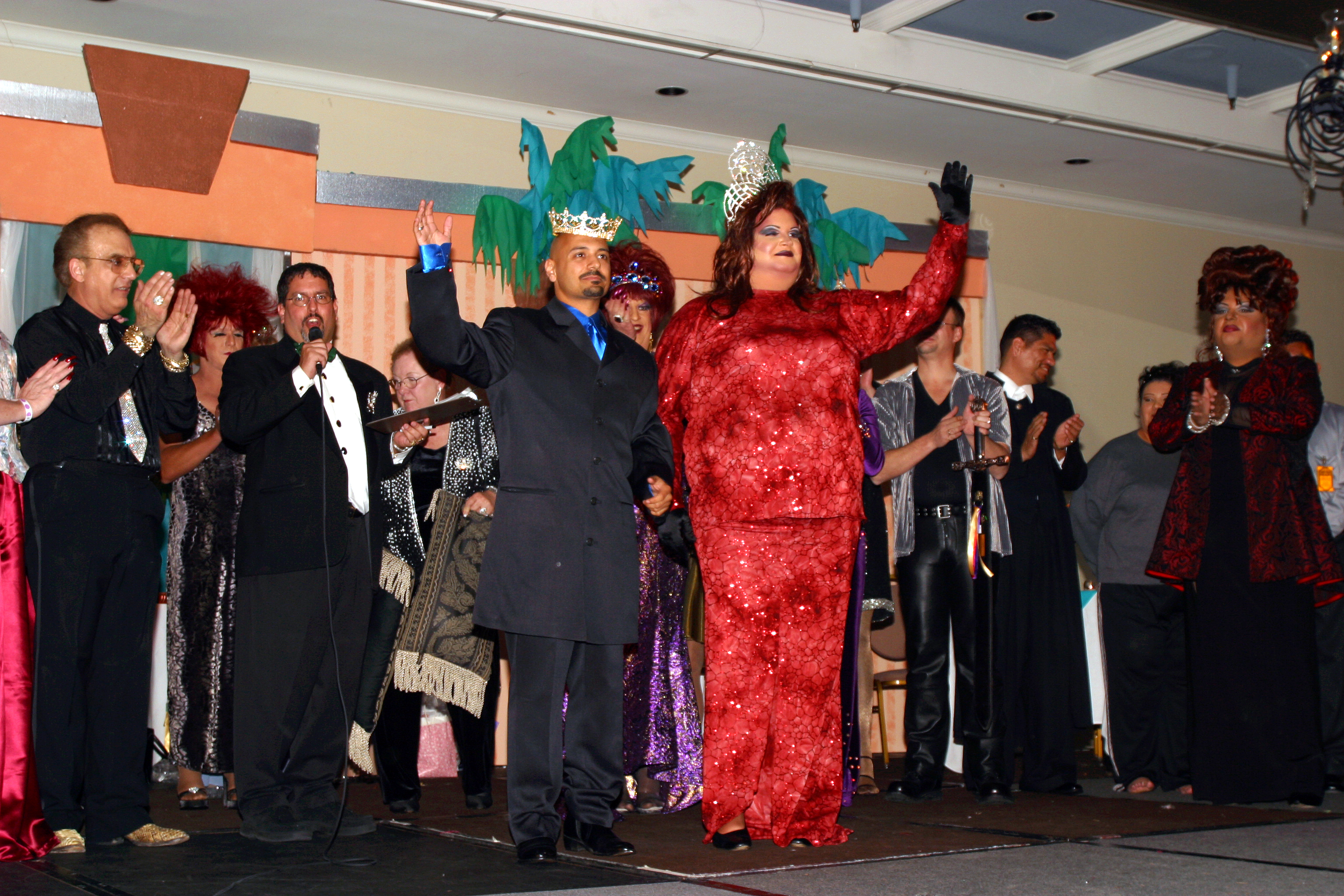
Casa de San Jose elected a full royal court every year: an emperor and empress, crown princes and princesses, czar and czarina, and grand dukes and duchesses. Every March, the Grand Coronation Ball served as large fundraising events and the election of the new emperor, empress, and court. Title rules were as follows: anyone was eligible, regardless of sexual orientation and gender, but they must reside in Santa Clara County and demonstrate successful sponsorship of community fundraising events.
Unlike many other courts, the Imperial Court in San Jose was open to people of all genders and sexual orientations to participate, including running for emperor and empress. Anyone in attendance could vote (with proof of residence) by placing their ballots at a table in the front of the hall to be counted later. Winners were then escorted on stage to be crowned by the host emperor and empress.
Kevin Roche remembers during his time as an Emperor: “My empress is actually transgender and she had strong connections into that community. We actually got a bunch of members of Carla Salon, which is a transgender social club, to come out and join us. Carla’s was a place where they could go and they could dress up and no one would see them, but they could do that at a court event because no one was surprised to see masculine looking people in dresses. A number of them actually joined and were some of our most effective members. That was really fun to see them being in public where that part of themselves could come out.”
Various balls raised money for different causes. The money raised was donated to charitable organizations, including the American Heart Association and American Cancer Research. As the AIDS crisis grew, they began donating to the Visiting Nurses Association and local AIDS charities.
In the early days, almost every drag performer in San Jose was involved in the Imperial Court. To join the Imperial Court, one had to come out during the Closet Ball. The Closet Ball was a way for amateurs new to performing to debut their drag personas and find mentors to help develop their performance. The performers had to be sponsored by an established queen and they were given an hour to transform into their drag persona.
Kevin Roche’s experience at the Closet Ball was showbusiness disappointment. “San Jose has had both drag queens and drag kings. So Lucy [Manhattan] talked me into entering the Closet Ball one year. It was awful. I worked really hard on it and the person who won had actually been performing weekly, but Lucy said, ‘If you’ll forgive me for getting you into this, there’s a charity show I’m doing in a month and I’d like to work with you and help you actually put together an act.’”
In recent years, pageants overtook the Imperial Court in popularity in San Jose. Pageants run outside the Imperial Court system, and many have opted to participate in those instead. The Imperial Court of San Jose dissolved in 2018. Those who wanted to continue participating in court traditions joined the San Francisco Imperial Court, which also permitted them to keep any titles earned in San Jose.