Ira Greene

ira greene profile

In 1981, Dr. Ira Greene was already a well-respected and beloved doctor. As the Chief of Dermatology at Santa Clara Valley Medical Center (VMC), he began seeing an increasing number of patients with Kaposi’s sarcoma (KS). At the time, he didn’t know that he was treating an illness that would soon grow into an epidemic.

Greene attended medical school at the University of North Carolina, and after initial training as an internist in Arizona, he made his way to Stanford for a residency in dermatology. He eventually became a clinical professor there, in addition to his role at VMC.

The KS cases Greene saw in the early 1980s caught his attention because they began appearing in relatively young men. Until that time, KS was an extremely rare condition that mostly afflicted elderly patients. Because Greene had experience in internal medicine, he also took note of the strange mix of skin lesions, swollen glands, lethargy, pneumonia, and other symptoms affecting these patients.

That laundry list of symptoms soon became associated with the syndrome doctors would come to call AIDS. Greene’s knowledge and background as a gay health care professional made him a logical choice for leading the effort to combat the emerging disease. Alongside Dr. David Stevens, Greene established a specialty treatment center at VMC that eventually became known as the Partners in AIDS Care and Education (PACE) Clinic. However, it was his empathy and connection to his patients that truly made him the right person for the job.

By 1988, Greene became associate director of Santa Clara County’s AIDS program. Even though that leadership role took much of his time, Greene never stopped seeing people with AIDS one-on-one as a primary care physician. His compassion during these often bleak years was steadfast. He did all that he could for his patients, often securing experimental treatments in a last-ditch effort to save the dying.

Friends who knew Greene saw the emotional toll that this work exacted. He developed many close personal ties to patients who ultimately succumbed to the epidemic. Still, he continued to make visits to AIDS patients through the 1990s.

“When you work with dying people, you learn a lot about yourself. You are forced to confront your own feelings about death. You feel very mortal,” Greene said in an interview with the San Jose Mercury News in the late 1980s.

Tragically, Greene died in 1998 when his Palo Alto home caught fire. It was a shocking loss for the community.


Karl Vidt

karl vidt profile

Karl Vidt moved to Santa Clara County in 1969. When the AIDS epidemic began in the early 1980s, he did not pay much attention to it, believing it was “something affecting people in San Francisco.”

Vidt became much more aware of the disease and the toll it was taking in 1985 when he joined the board of the Metropolitan Community Church, one of the first denominations in the South Bay to provide a welcoming and inclusive atmosphere for the LGBTQ community. Coincidentally, the church became the original home of the Aris Project the same year that Vidt joined its board.

Despite his work with the church, Vidt did not get tested until 1989 when he learned that he was HIV positive. He remembers being “just numb” after getting the news. He says that the tester who told him he was positive, Sandy Gudino, was kind and spent more than an hour with him answering questions and giving him information.

Vidt told few people about his diagnosis. “I just picked up and went on.” However, by 1991 he had gotten sick and was taking regular medications. In the fall of 1992, he came down with Pneumocystis carinii, the strain of pneumonia that had been closely associated with the AIDS epidemic since the early 80s.

In 1993, he developed an infection in his eyes that eventually led to his blindness in December 1996. Throughout the early 90s, Vidt survived with virtually no T-cells whatsoever. Luckily, by the mid-90s his T-cell count began to grow with the introduction of new medications. This led to an overall improvement in his health. He got his first guide dog in 1999, which significantly improved his self-sufficiency and mobility. He was able to play an active role in the community again and continued working at Metropolitan Community Church as the half-time church
administrator.

Vidt also threw himself into the thick of the fight against HIV/AIDS in the South Bay. He joined the Santa Clara County HIV Planning Council for Prevention and Care in 2002. He spent multiple years as chair of its Care and Treatment Committee. He also served a stint as the chair of its Planning and Resources Committee. In addition to his HIV Planning Council service, Vidt also served on the City of San Jose’s Disability Advisory Commission and spent four years as chair of the Santa Clara County World AIDS Day Committee.

Vidt says all of the volunteer service is just his way of contributing to the health care system that he believes has taken such good care of him since his diagnosis. “There was a time when I thought my parents would have to take care of me. Who would have guessed that now I am taking care of my mom,” he said.

In 2008, Vidt received the Leslie David Burgess Lifetime Achievement Award in recognition of his service to HIV/AIDS prevention and care, along with being a shining example for others with HIV/AIDS.

El Camino Reelers

El Camino Reelers 2021

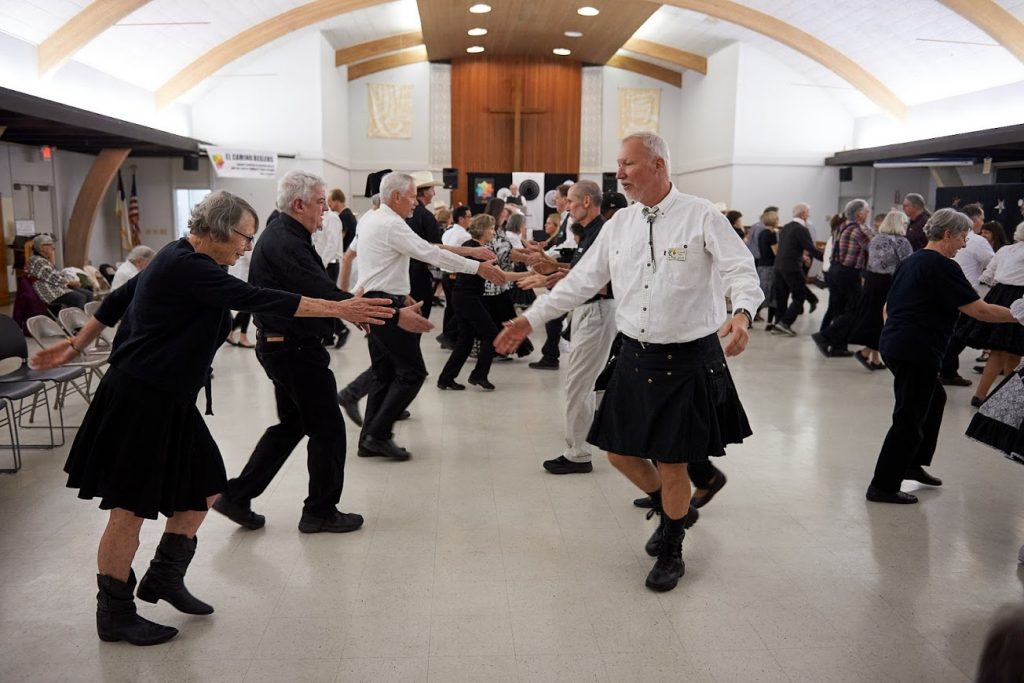
Square Dance calls to “Do-Si-Do,” “Promenade” and “Roll Away To A Half Sashay” became a welcome pastime for the LGBTQ community to socialize, stay active and sometimes even find love. 

The El Camino Reelers is a modern Western Square Dance club in the South Bay, formed in Palo Alto in September 1985 by lesbians and gay men looking to have fun and meet open-minded people.

More than three decades later, members continue to square dance to country music and traditional folk, as well as soul, disco and show tunes inside St. Andrews United Methodist Church, 20 minutes west of San Jose.

Tickets to attend the smoke-free and alcohol-free environment never require a partner, fancy outfit, coordination or knowledge about dancing. Members don’t even need to be part of the LGBTQ community.

This is far from an isolated phenomenon in the South Bay.

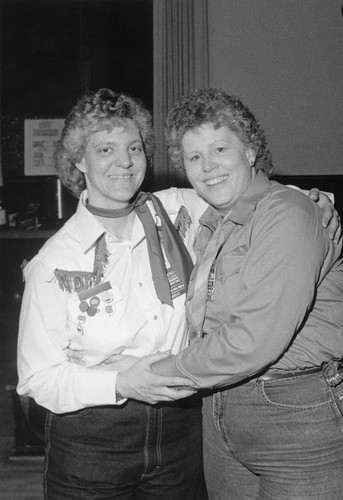
Marilyn Martinyak Pat Dixon
Marilyn Martinyak (left) and Pat Dixon (right)

El Camino Reelers were part of a wave of LGBTQ square dancing clubs that popped up nationwide, after intramural social “teams” first organized in Miami in January 1977. That same year, square dancing found its way 3,000 miles west in San Francisco, and three GLBTQ square dance clubs had formed by 1981.

Eventually, two members of San Francisco’s Western Star Dancers — Marilyn Martinyak and Patricia Dixon — started El Camino Reelers as an alternative to the clubs an hour away in the city. Marilyn and Pat were together for 27 years before marrying in Sunnyvale in 2008.

Early membership was comprised of mostly women during initial classes, but attendance grew through word of mouth and advertisements in newsletters of LGBTQ organizations, including High Tech Gays.

Within a year of its inception, El Camino Reelers became a member of the International Association of Gay Square Dance Clubs. As of 2021, the IAGSDC includes more than 80 clubs – primarily in the United States and Canada – and hosts an annual convention that brings together more than 1,000 dancers.

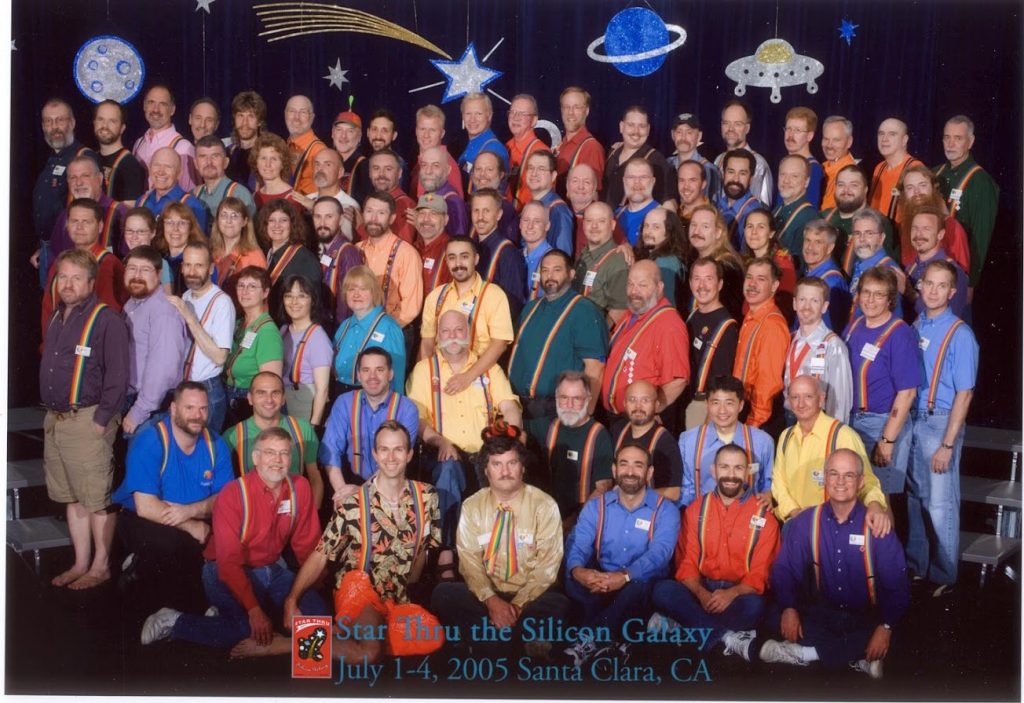
The El Camino Reelers became well-known as a “geek repository” due to its location in Silicon Valley, and members who worked at Adobe, Sun, Google, and Yahoo. The club lived up to that reputation in 2005, when they hosted more than 800 attendees at the 22nd annual convention, dubbed “Star Thru The Silicon Galaxy,” at the Marriott Santa Clara. Several smaller weekend gatherings, called “fly-ins,” were held every fews years in Cupertino, Palo Alto, Redwood City and San Jose from 1995 to 2010.

The El Camino Reelers are one of a dozens of clubs across the Bay Area, but remain the sole LGBTQ-specific organization in Santa Clara County.

The last live club night was Wednesday, March 11, before the Covid-19 pandemic halted in-person gatherings and activities. Virtual club nights resumed on April 14, hosted through Zoom every other week.

More information can be found on the El Camino Reelers website, as well as within the IAGSDC History Project, founded by Allan Hurst, a dancer, caller, and writer from Sunnyvale, California.

Pam Walton

Pam Walton profile

In 1989, documentarian Pam Walton released “Out in Suburbia,” a 30-minute short film about the lives of 11 lesbian women – aged 25 to 67 – living in the South Bay.

Pam, who lived in Palo Alto and Mountain View, featured friends, neighbors and other local women in one-on-one and group interviews. They discussed everything from how they knew they were gay and the difficulties of coming out, to their thoughts on religion and expectations within relationships.

Released amid the AIDS epidemic and the disbandment of the Moral Majority, “Out in Suburbia” aimed to capture the ordinary lives of these teachers, students, lawyers, activists, wives, mothers, daughters and ordinary women, beyond stereotypes and assumptions of how lesbians live and love.

Out in Suburbia cover
Out in Suburbia Cover

“A lot of (the feedback) was, ‘Oh, it’s shocking to see that lesbians look like regular women,’” Pam said. “That’s what we wanted to accomplish.”

Becoming a filmmaker was an act of coming out for Pam. Growing up in Los Altos Hills, she remained closeted while teaching high school English for 20 years, prior to returning to Stanford University for a master’s in film and video production in 1985.

“When I got to Stanford, I thought, ‘I’m going to come out big time,’ and decided that my thesis film would be about the women I knew in suburbia, more or less in my neighborhood,” she said, “When I would go to the gay and lesbian film festivals in San Francisco or LA, I was sort of appalled that I never saw me or my friends in the festival, so I decided to make one that showed more of my life experiences.”

The women featured on-screen were Wiggsy Sivertsen, Elizabeth Birch, Jo-Ann Birch, Marilyn Gum, Marie Ceciliani, Jackie Brown, Diane Porath, Joyce Fulton, MaryBell Wilson, Luciana Profaca and Rosemary Murphy.

Pam said “Out in Suburbia” was one of the first lesbian documetaries to come out of Stanford’s film department, where she met Ruth Carranza, her partner and associate director.

The film was awarded “Best Documentary” by the audience at the San Francisco International Lesbian and Gay Film Festival, which is now known as the Frameline Film Festival, the judge’s award at the Sinking Creek Film Celebration in Nashville, and a nod from the National Council on Human Rights.

Many of Pam’s other productions also highlight LGBTQ lives, including “Family Values: An American Tragedy,” “Gay Youth,” and the aptly named, “Lesbians.” She and Ruth are still making films, most recently featuring the Fountaingrove Lodge, an LGBT retirement community in Santa Rosa, where they currently call home.

Jeff McGee AKA Kelli Collins

Kelli Collins 1

Jeff was an integral part of the gay community in the 80s and 90s. His performances as Kelli Collins in innumerable drag shows raised thousands of dollars for many causes, primarily for early AIDS victims who had no financial or medical support at that time.

Jeff moved to the South Bay in 1981. It wasn’t long after arriving in San Jose that AIDS became a tragic reality for the entire community. Jeff began to attend and host fundraisers with the Imperial AIDS Foundation to help support awareness.

Before long, he found himself more deeply involved with the community and started doing drag and performing at various events at The Savoy, TD’s, Club St. John, Mac’s Club, Buck’s, and any other venue whose doors and hearts were open.

Fundraising for the AIDS victims united lesbians and gay men, and also enabled much needed financial help for so many victims of this then-misunderstood disease.

While fundraising for the Imperial AIDS Foundation, he was asked if he’d be interested in joining a group of entertainers, fundraisers, and club personalities in the South Bay community by becoming part of a group representing the Imperial Court System, a nationwide organization.

The South Bay chapter of the Imperial Court System was called the Imperial Royal Lion Monarchy (IRLM). The figureheads of the organization were called Emperors and the Empresses. Jeff accepted the nomination for Empress, and in 1990, as his stage persona Kelli Collins, was crowned Empress 20 of the Imperial Royal Lion Monarchy. 

The AIDS crisis continued, so the fundraising and the generosity of the community, both lesbian and gay alike, came together and supported the fight against discrimination, AIDS and many other issues of the day. There was a true sense of community during those times. Everyone opened their hearts and their wallets and joined forces to get done what needed to be done.

Claudia and the Savoy

claudia intro paragraph photo

For more than twenty years Claudia Thomas was the house DJ at The Savoy, a women’s bar located in Santa Clara. In addition, during the 1990s Claudia played at several of the mobile clubs for women including the G Spot  in San Francisco and The Office in San Jose.

Claudia was always willing to lend her talents to community fundraisers and  the Gay Pride celebration.

Note: Photo taken in  1992 during a Gay Cruise on the San Francisco Bay

An Insight Into the Bar Scene With Darlene

darlene lutz profile

Known throughout the gay community for her signature “beehive” hairdo and fundraising skills, Darlene Lutz Montalbano became a member of the San Jose area LGBTQ community in 1969. She began working as a bartender for Mom and Pop, the original owners of The Savoy  (women’s bar) in 1972. Over the years she worked as a bartender at Toyon Bar, continued working for Toyon when it moved from Cupertino to The Alameda in San Jose, and then went back to Savoy for a short time in 1984. Darlene then found an opportunity to open her own bar, Dar’s Hideaway in the old Silver Fox bar in Cupertino.

Darlene was also one of the first women to be accepted into Casa de San Jose, San Jose’s gay court/fundraising organization.  Darlene was the first woman Empress of CASA. She raised a great deal of money, organized many successful picnics and other events, and brought the men and women of the gay community together.

She assisted in some capacity with CASA for years after her reign, and then worked with the IRLM (Imperial Royal Lion Monarchy, another gay court), to continue organizing events and raising money for various causes.

During the AIDS crisis in Santa Clara County, she rallied the women of the community to support individuals diagnosed with AIDS with many fundraising events, hosting spaghetti dinners, gay cruises on the San Francisco Bay, and lending any support needed.

She feels the younger LGBTQ generation doesn’t have the same opportunities these days to connect:

“The younger community doesn’t have guidance from somebody who is my age or someone who is willing to get out there and get people connected. I miss that myself. It was a joy to be able to do stuff for other people.”