

- Campbell City Council (2010-2014, 2016-2020)
- Mayor (2014, 2019)
 queer silicon valley team

Raising the Rainbow, Transgender, and Bisexual Visibility Flags
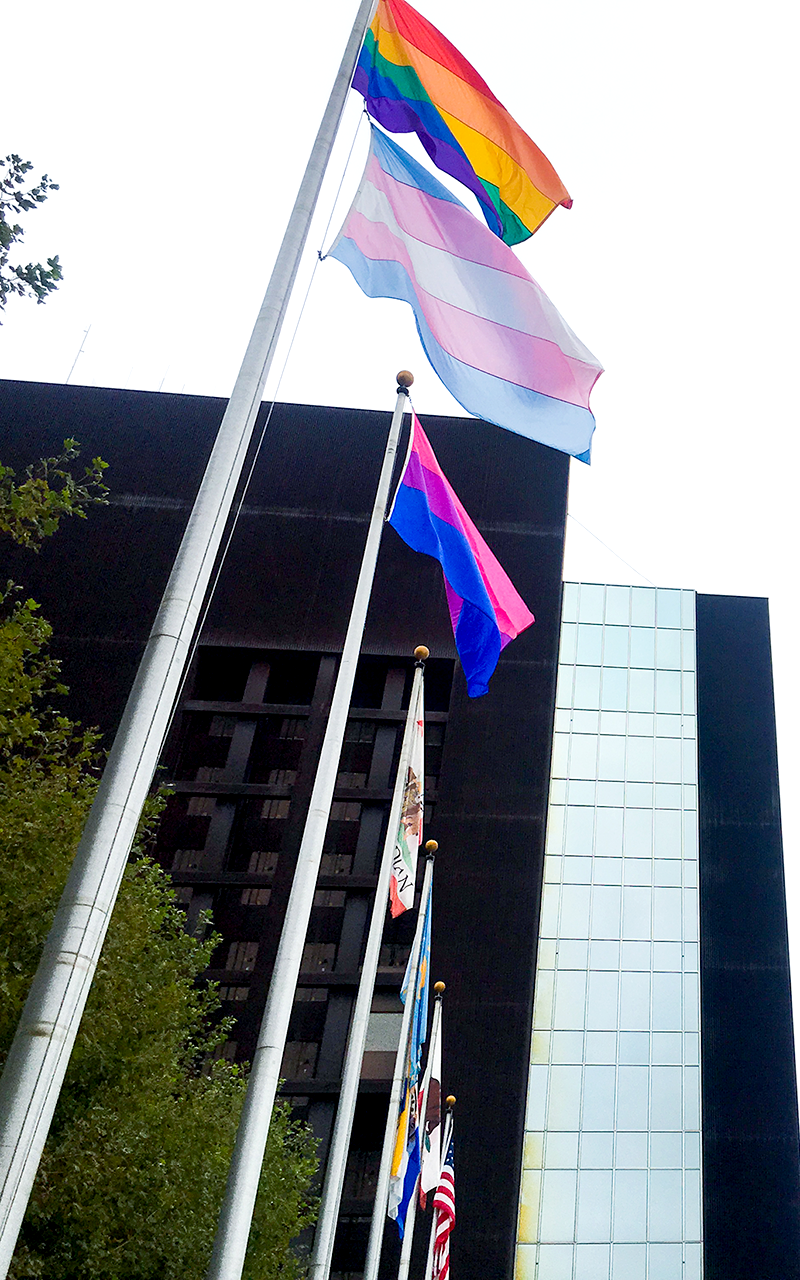
The month of June holds special meaning for many people because it is known around the world as LGBTQ Pride Month. In San Jose and Santa Clara County, the governing boards issue pride proclamations and raise the rainbow flag, usually at their first meeting in June.
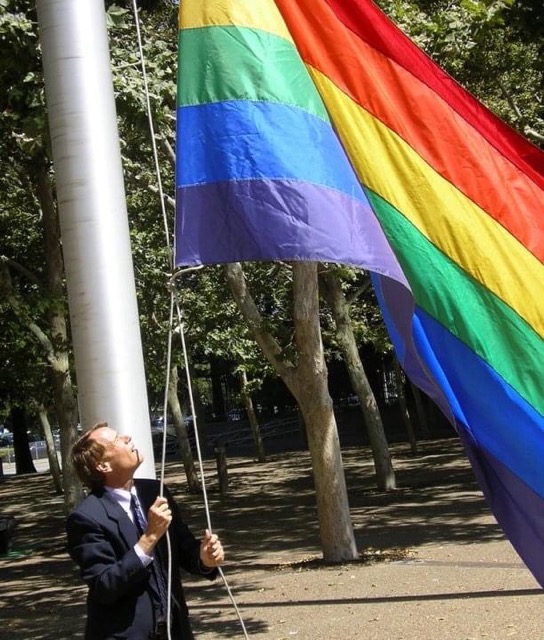
Ken Yeager was the first openly gay councilmember elected to the San Jose City Council in November 2000, taking office January 1, 2001. In June 2001, Yeager asked the city manager and Mayor Ron Gonzales if he could raise the rainbow flag in front of what is now called Old City Hall on Mission Street. They both agreed.
It was the first time the Pride flag was flown there, so there was quite a media event around the flagpole. The Silicon Valley Gay Men’s Chorus sang a moving rendition of the “Star Spangled Banner.”
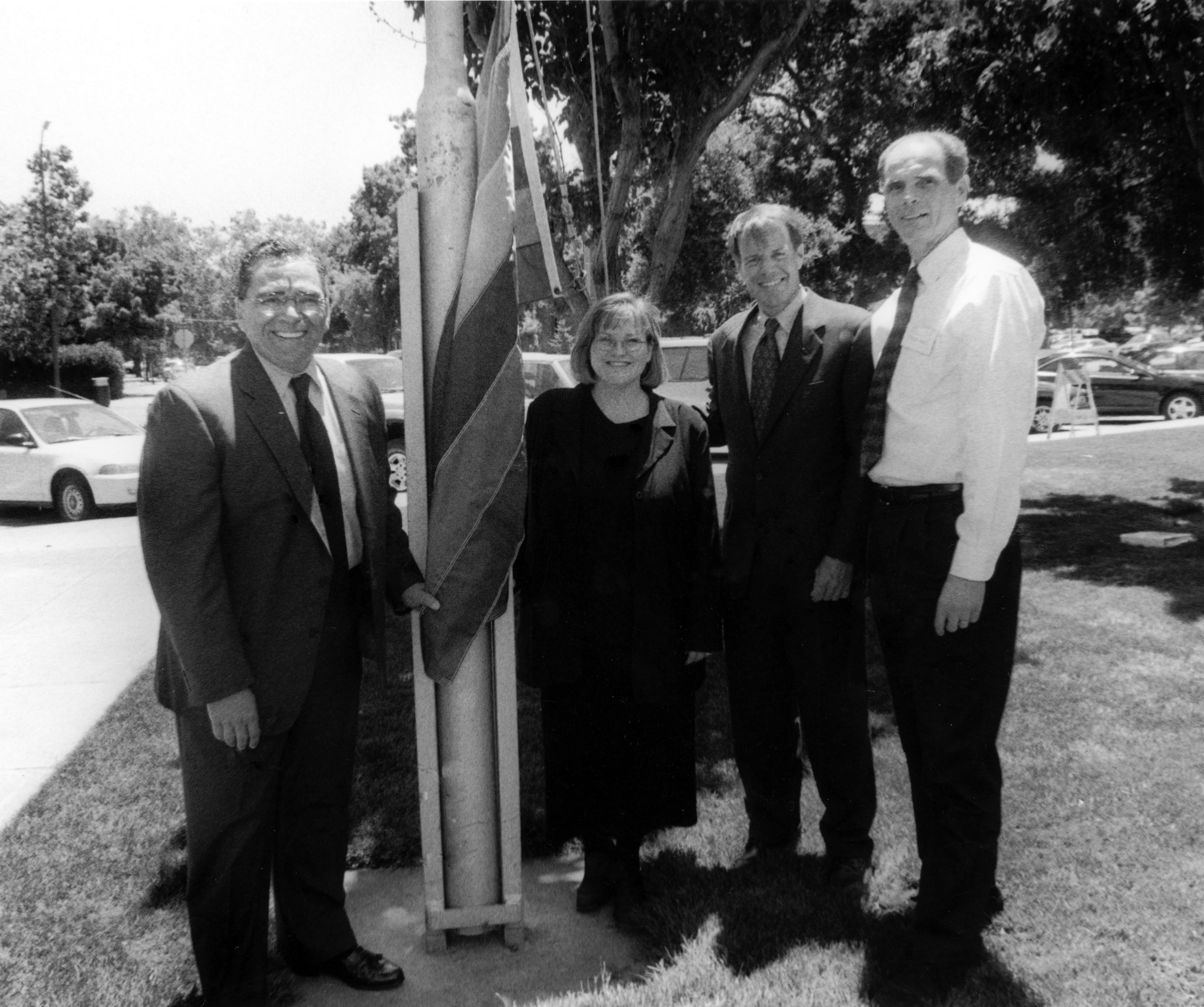
Like city hall before 2001, the rainbow flag had never flown at the County Government Center. That changed in June 2007 when Yeager hoisted the flag after winning election as the first openly gay member of the Santa Clara County Board of Supervisors. Once again, the Silicon Valley Gay Men’s Chorus sang the national anthem.
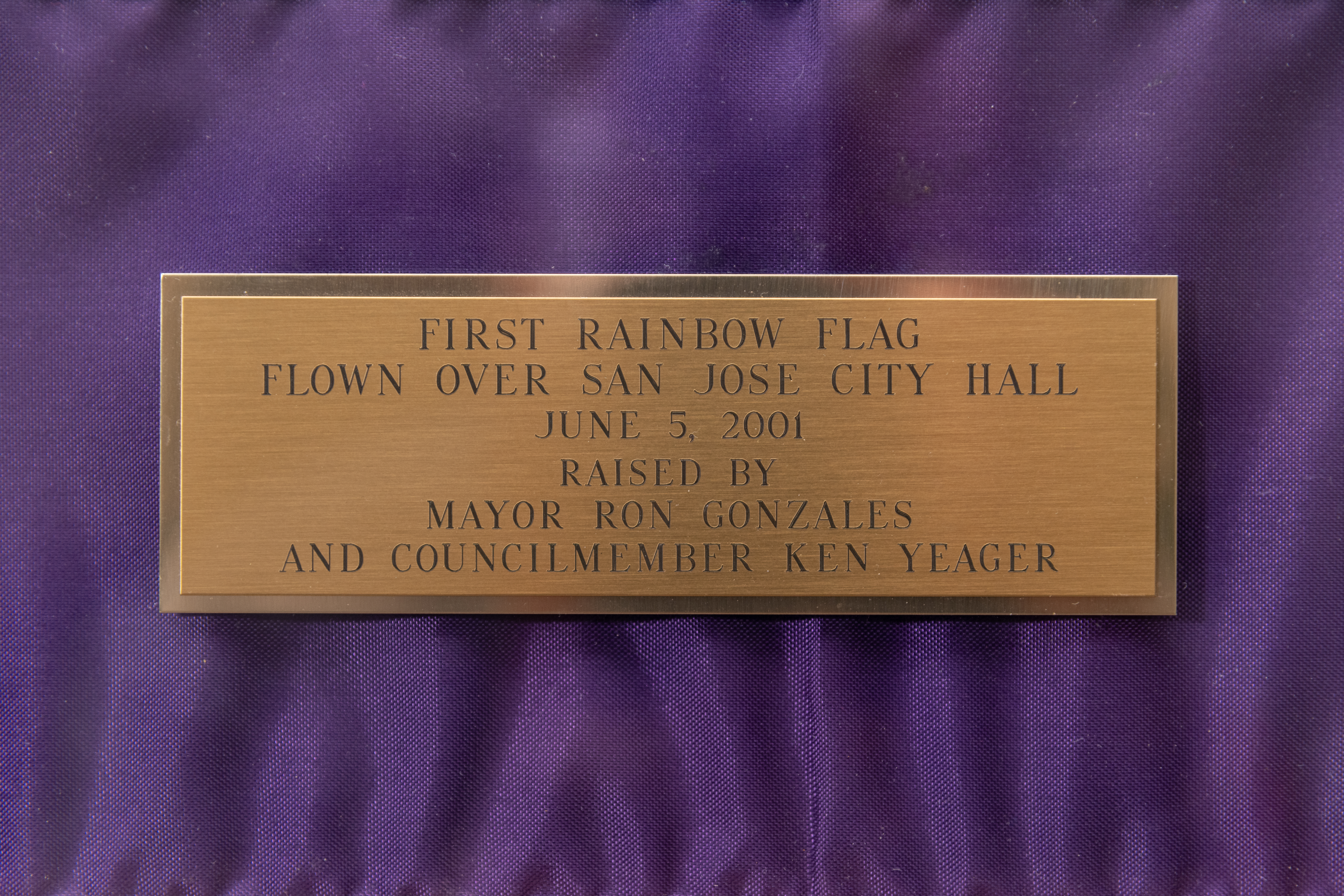
The flag from that first event in 2001 was framed in a large glass case and hung in Yeager’s office during his time on city council, and later hung outside his door at the county building.

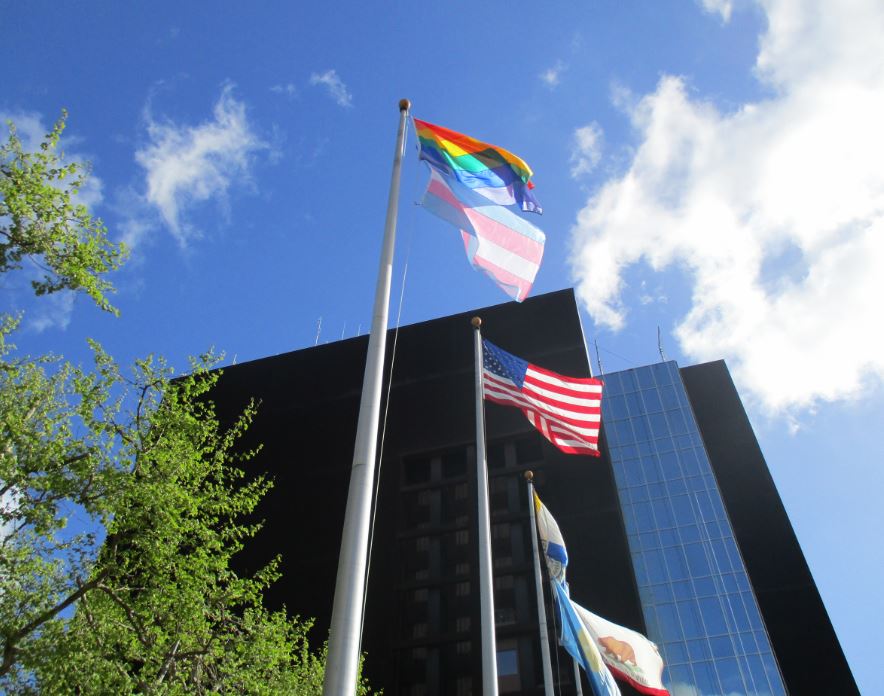
The rainbow flag has flown over the County Government Center during LGBTQ Pride Month every year since 2007. In fact, the rainbow flag has become such an important symbol of the values of the county that when the U.S. Supreme Court legalized same-sex marriages in 2013 County Executive Jeff Smith agreed with Supervisor Yeager that it should fly every workday, which it did from that day forward.
On the 6th annual International Transgender Day of Visibility on March 22, 2016, the county raised the Transgender Pride Flag at the County Government Center, making it the first county in the nation to do so. Afterwards, it was decided to fly it under the rainbow flag everyday as well.
After the horrific killings in Orlando, Florida, at the Pulse Night Club, in grief and solidarity the Rainbow and Transgender Pride Flags were flown at half-staff for two days.
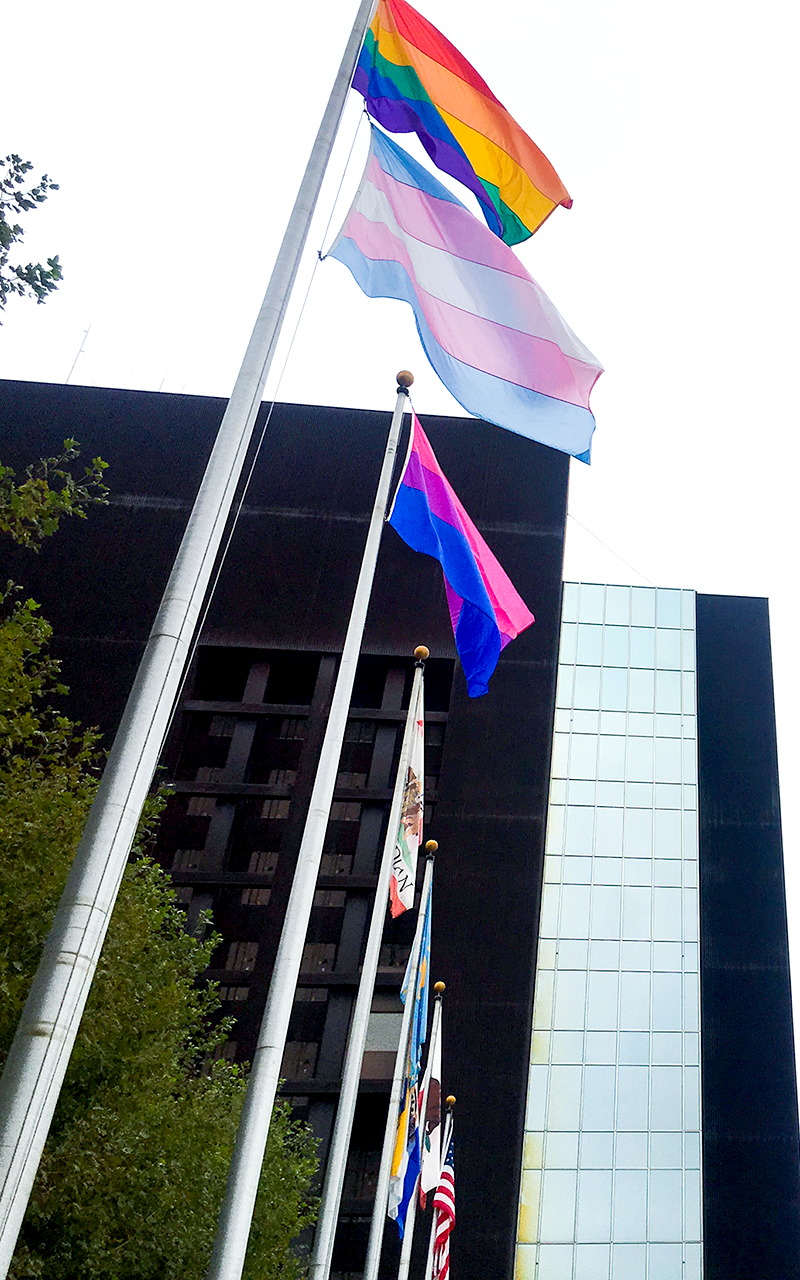
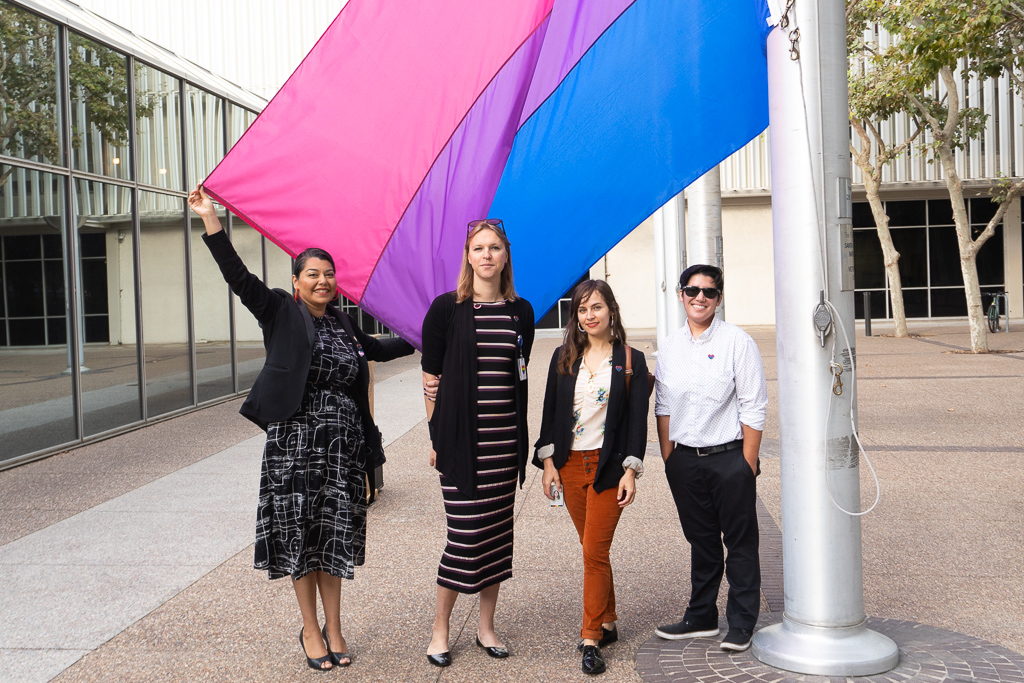
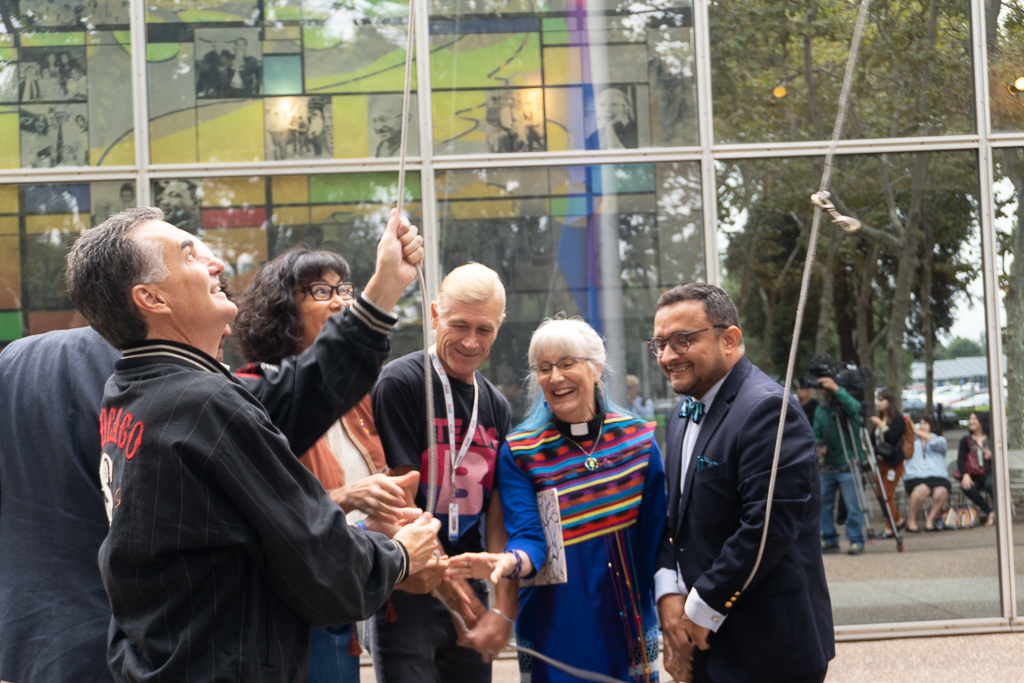
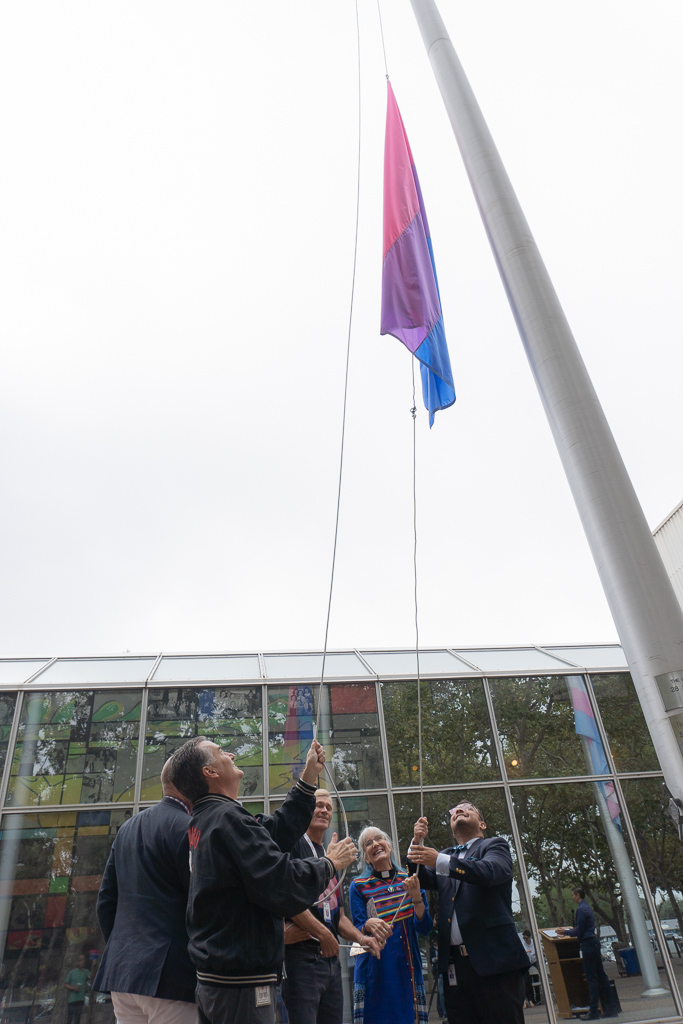
The pink, lavender and blue Bisexual Pride flag was raised for the first time at the Santa Clara County Government Center for the first time on September 21, 2017, as part of Bi Week of Visibility.


In 2019, a large coalition of local organizations and residents who stood united to speak out against the future opening of a Chick-fil-A at Mineta San Jose Int’l Airport (SJC) Terminal B. Unable legally reverse the contract with Chick-fil-A, Ken urged the City Council to instead fly the rainbow and transgender flags as powerful symbol signaling that San Jose is a welcoming place to visit and live. The flags would come to serve to counter the discriminatory causes supported by the company and its leadership.
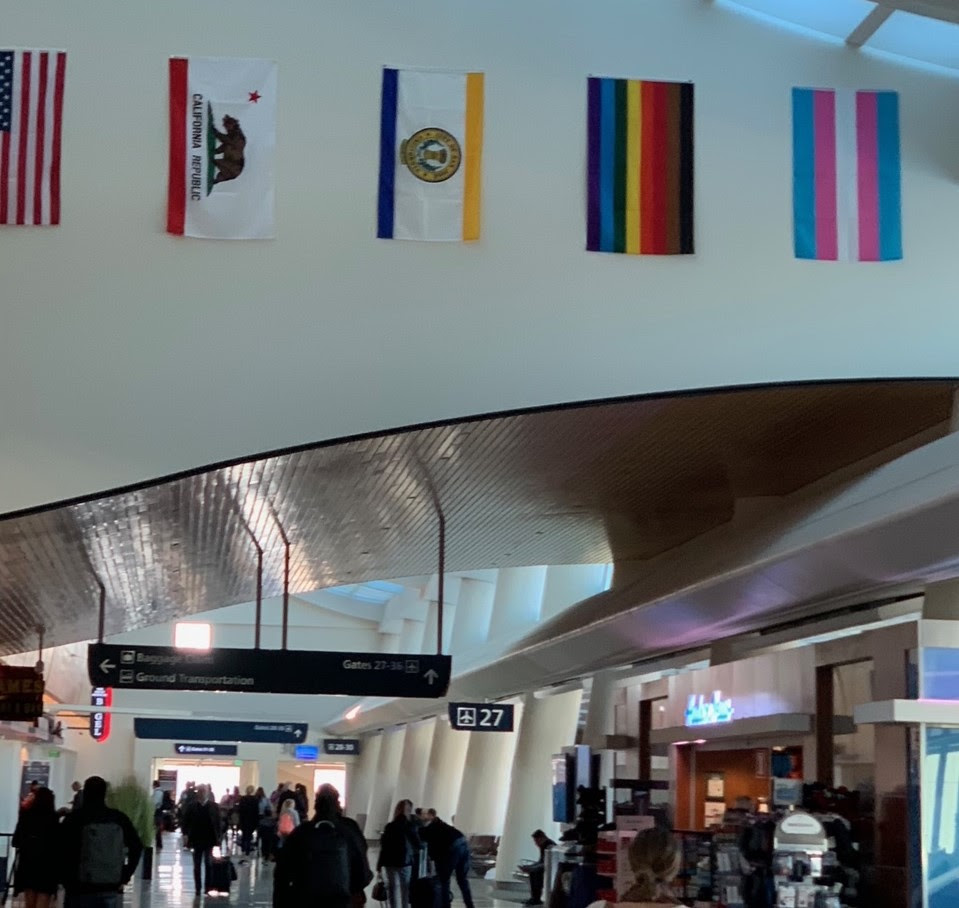
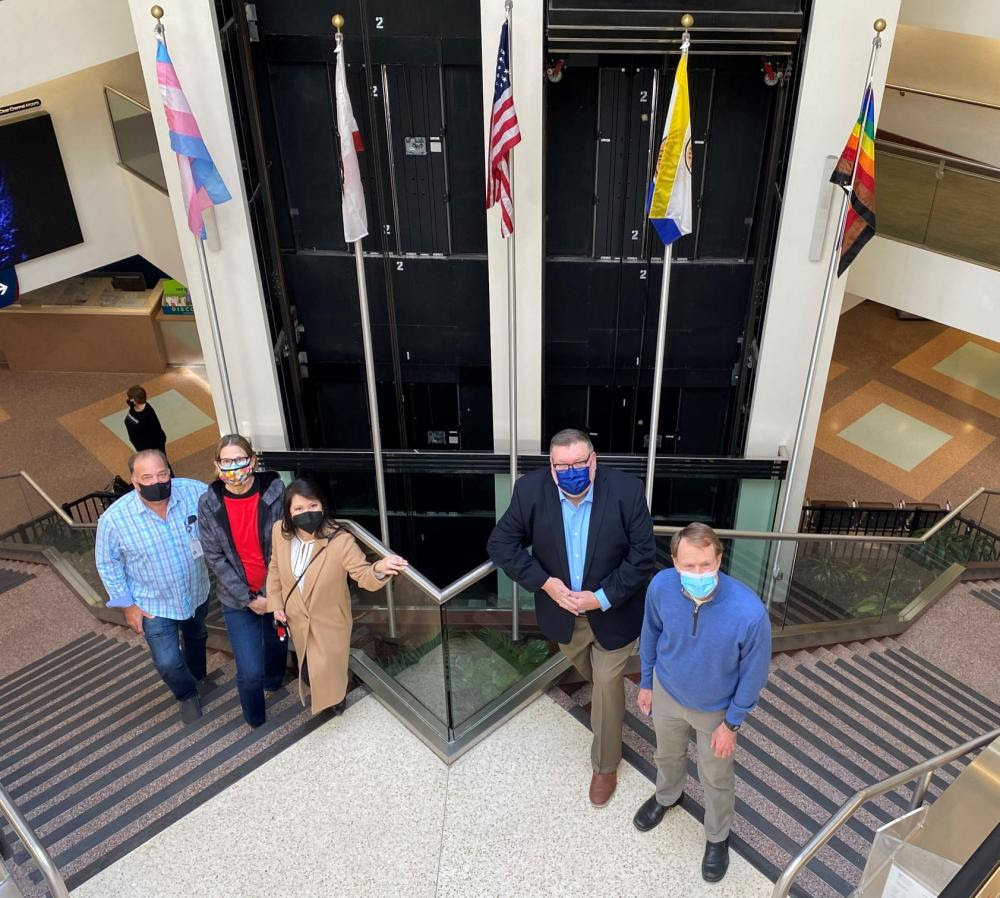
On March 10, 2021, BAYMEC Community Foundation Executive Director Ken Yeager and members of BAYMEC hoisted the rainbow and transgender flags at SJC Terminal A. The flags, which are now prominently displayed in the Terminal A Baggage Claim, expand on the SJC’s commitment to providing a welcoming environment for those traveling to San Jose.
The installation of the new flag poles in Terminal doubles down on that expression of welcoming and celebration of diversity. In addition to the support of the City Council, SJC Aviation Director John Aitken and Communications Director Vicki Day were essential in showing that San Jose welcomes all LGBTQ+ travelers.
Point Newspaper (2000-2004)

Started by George Gonzales in November 2000, Point was made with the intention to invigorate and connect the diverse communities of Silicon Valley. After Gonzales’ passing in late 2004, Point ceased publication.
Rudy Galindo

In 1996, San Jose was the site of one of the biggest upsets in American figure skating history when Rudy Galindo became the oldest male national champion of the modern era at age 26. Galindo was also the first openly gay figure skating champion, having come out before the competition began.
Galindo was raised in a trailer home in East San Jose with his sister Laura. He began figure skating at an early age and his career took off when he began skating pairs with Fremont native Kristi Yamaguchi. As a team Galindo and Yamaguchi won three U.S. national championships. However, after 1990 Yamaguchi retired from pairs competition to focus on individual skating.

The AIDS epidemic had a major impact on Galindo’s personal and professional lives. His and Yamaguchi’s first coach, Jim Hulick, died of AIDS in 1989. In 1994, Galindo lost both his brother George and another coach Rick Inglesi to AIDS.
Despite those hardships, Galindo won the men’s singles champion title in front of a hometown crowd as the U.S. Figure Skating Championships were held at the San Jose Arena on January 20th, 1996. In the competition, he was the only male competitor to land combination triple jumps. After his performance Rudy chanted the names Jess, George, Jim, and Rick, who had all helped him to achieve the victory.
His championship defied the norms of the U.S. Figure Skating Association. Galindo later said he feared being an out skater might lower his score because of some judge’s discomfort with his identity.
In 1997, he released his autobiography Icebreaker. Proceeds from the book were donated toward funding the expansion of the San Jose Public Library’s Biblioteca Latinoamericana.
In 2000, Galindo announced he was HIV positive.
Today, he coaches figure skating at Sharks Ice in San Jose. His students include Kristi Yamaguchi’s daughter.
He was inducted into the San Jose Sports Hall of Fame in 2011 and the U.S. Figure Skating Hall of Fame in 2013. He has set the path for numerous LGBT and HIV-positive athletes to be themselves.
1985: Fatal Police Shooting of Melvin Truss Sparked Public Outcry
By Ken Yeager
The fatal police shooting of Black teen Melvin Truss sparked public outcry as many called into question the conduct of the officer responsible for his death and the handling of the case by the grand jury, law enforcement and city officials.
SJPD’s version of events
On May 4, 1985, San Jose police officer Paul Ewing was on duty in the Street Crimes Unit, wearing civilian clothes and driving an unmarked police car. Around 6:45 pm, Ewing claimed he saw Melvin Truss dressed in women’s clothes and jewelry, soliciting drivers at Second and San Carlos streets, according to a city memo authored by San Jose Police Chief Joseph McNamara.
Truss approached Ewing’s car and asked if he was looking for a date, the memo continued. Ewing drove Truss first to a Highway 280 overpass, then to San Jose Bible College, and finally to Olinder School.
According to McNamara’s memo, Truss then began to act agitated and took a steak knife out of a rolled-up windbreaker on his lap, demanding Ewing’s money. Ewing said he distracted Truss and drew his .357 magnum service revolver, pointing it at Truss in hopes that he would retreat. As Truss came toward him, Ewing fired five rounds and jumped out of the car without any injuries.
Truss was transported to San Jose Hospital, where he died at 9:05 pm the same night, according to records from the Human Relations Commission of the County of Santa Clara. He was 17.
(It should be noted that Truss weighed 115 pounds while Ewing was 6’1″ and weighed 200 pounds.)
Public uproar followed as community members and Truss’s family disputed police accounts. While a police spokesman labelled Truss a “transvestite,” Our Paper reported that advocates denounced police for waging a slander campaign against Truss.
A community fights back
Family and friends knew Truss as a shy but polite kid, a fan of Michael Jackson, Metro reported. “Melvin was the kind of person anyone could read like a book. By that I mean he did not carry any false pretenses” said Sharon Youngblood in a statement to Santa Clara County’s Human Relations Commission. Youngblood, a business instructor at James Lick High School who knew Truss for over two years, also noted: “You could look into his eyes and read his ‘soul.’”
Constance Carpenter, a lawyer with the Attorneys Committee on Police Practices, pointed out to the Human Relations Commission that police attempted to find the rest of Truss’s set of steak knives but found no matches.
In addition, in an attempt to try to identify him as an armed robbery suspect, the police pulled 380 reports of armed robberies, grand thefts, and aggravated assaults in the city, Carpenter detailed: 66 cases were investigated further and none of the victims identified Truss as the suspect, according to Carpenter’s statement to the commission.
A grand jury voted in May 1985 not to indict Ewing for fatally shooting Truss. Ewing returned to regular duty.
After the grand jury result, Laura White, an aunt who helped raise Truss, told the Mercury News: “If this is allowed to stand, the people in San Jose and this society had better watch out. Because every month, these trigger-happy police officers who have taken the oath to preserve and protect are going to be dropping people in the street right and left.”
Despite calls for an independent citizens committee to investigate the shooting, in June 1985 the San Jose City Council voted against the proposal after nearly two hours of testimony from attorneys, friends of Truss, and several police officers. According to the Mercury News, one of Truss’ classmates testified that Truss would never hurt anyone, “especially someone older than him and a lot bigger than him.”
During the council meeting, police in full uniform lined the walls of city hall, opposing the proposed independent investigation, according to Metro reports. White was especially angered by Assistant Police Chief Stan Horton, who said Truss “died because of his lifestyle.”
The legacy of Truss’s death
“No one will ever know what really happened at the time of the shooting,” stated Ken Yeager, a spokesperson for BAYMEC, said at the time “But it isn’t difficult to imagine the circumstances that created the situation in the first place, nor the attitudes of the policeman involved. This is what we find very frightening.”
“Our focus now is to call attention to the fact that police in San Jose seem to believe anyone who might be Lesbian or Gay is a criminal or in the process of committing a crime, notably solicitation or prostitution,” said Wiggsy Sivertsen, BAYMEC’s vice-president. “The ramifications of this are enormous.”
Upon request from BAYMEC, the San Jose City Council approved a program in June 1985 through which San Jose police officers would receive training on gay and lesbian lifestyle. The move was met by opposition from the police, as reported in the Mercury News. The training was done by Sivertsen,
Responding to community concerns, the Santa Clara County Human Relations Commission held a public hearing in August 1985. Youngblood, an advisor for James Lick’s Black Student Union, recalled the time when Truss participated in the group’s fall fashion show.
“He was scared to death on that stage and it was written all over his face, but he knew it was for a worthwhile cause and it was exciting for him too,” Youngblood told the commission. “Melvin was not capable of violence.”
In 1989, a federal jury cleared officer Paul Ewing of violating Truss’ civil rights in a civil suit brought by Truss’s mother.
Ray Aguilar

Aguilar always urged family members to celebrate holidays together. He was a founding member of The Imperial AIDS Foundation, which provided hot meals, paid rent, prescriptions, and provided transportation to medical appointments for people living with AIDS . Ray Aguilar died due to complications from AIDS in February 1995.



OutNow! (1993-2009)

First published by Chris Thomas in 1993, OutNow! began as a newspaper dedicated be the South Bay’s source for gay news. Mark Gillard brought OutNow! out of debt in 1998 and restarted it as a magazine (eliminating the exclamation mark). Troy May took over in 2006. OutNow was forced to stop printing in 2009 during the Great Recession.