1985: Fatal Police Shooting of Melvin Truss Sparked Public Outcry

By Ken Yeager

The fatal police shooting of Black teen Melvin Truss sparked public outcry as many called into question the conduct of the officer responsible for his death and the handling of the case by the grand jury, law enforcement and city officials.

SJPD’s version of events

On May 4, 1985, San Jose police officer Paul Ewing was on duty in the Street Crimes Unit, wearing civilian clothes and driving an unmarked police car. Around 6:45 pm, Ewing claimed he saw Melvin Truss dressed in women’s clothes and jewelry, soliciting drivers at Second and San Carlos streets, according to a city memo authored by San Jose Police Chief Joseph McNamara.

Truss approached Ewing’s car and asked if he was looking for a date, the memo continued. Ewing drove Truss first to a Highway 280 overpass, then to San Jose Bible College, and finally to Olinder School.

According to McNamara’s memo, Truss then began to act agitated and took a steak knife out of a rolled-up windbreaker on his lap, demanding Ewing’s money. Ewing said he distracted Truss and drew his .357 magnum service revolver, pointing it at Truss in hopes that he would retreat. As Truss came toward him, Ewing fired five rounds and jumped out of the car without any injuries.

Truss was transported to San Jose Hospital, where he died at 9:05 pm the same night, according to records from the Human Relations Commission of the County of Santa Clara. He was 17.

(It should be noted that Truss weighed 115 pounds while Ewing was 6’1″ and weighed 200 pounds.)

Public uproar followed as community members and Truss’s family disputed police accounts. While a police spokesman labelled Truss a “transvestite,” Our Paper reported that advocates denounced police for waging a slander campaign against Truss.

A community fights back

Family and friends knew Truss as a shy but polite kid, a fan of Michael Jackson, Metro reported. “Melvin was the kind of person anyone could read like a book. By that I mean he did not carry any false pretenses” said Sharon Youngblood in a statement to Santa Clara County’s Human Relations Commission. Youngblood, a business instructor at James Lick High School who knew Truss for over two years, also noted: “You could look into his eyes and read his ‘soul.’”

Constance Carpenter, a lawyer with the Attorneys Committee on Police Practices, pointed out to the Human Relations Commission that police attempted to find the rest of Truss’s set of steak knives but found no matches.

In addition, in an attempt to try to identify him as an armed robbery suspect, the police pulled 380 reports of armed robberies, grand thefts, and aggravated assaults in the city, Carpenter detailed: 66 cases were investigated further and none of the victims identified Truss as the suspect, according to Carpenter’s statement to the commission.

A grand jury voted in May 1985 not to indict Ewing for fatally shooting Truss. Ewing returned to regular duty.

After the grand jury result, Laura White, an aunt who helped raise Truss, told the Mercury News: “If this is allowed to stand, the people in San Jose and this society had better watch out. Because every month, these trigger-happy police officers who have taken the oath to preserve and protect are going to be dropping people in the street right and left.”

Despite calls for an independent citizens committee to investigate the shooting, in June 1985 the San Jose City Council voted against the proposal after nearly two hours of testimony from attorneys, friends of Truss, and several police officers. According to the Mercury News, one of Truss’ classmates testified that Truss would never hurt anyone, “especially someone older than him and a lot bigger than him.”

During the council meeting, police in full uniform lined the walls of city hall, opposing the proposed independent investigation, according to Metro reports. White was especially angered by Assistant Police Chief Stan Horton, who said Truss “died because of his lifestyle.”

The legacy of Truss’s death

“No one will ever know what really happened at the time of the shooting,” stated Ken Yeager, a spokesperson for BAYMEC, said at the time “But it isn’t difficult to imagine the circumstances that created the situation in the first place, nor the attitudes of the policeman involved. This is what we find very frightening.”

“Our focus now is to call attention to the fact that police in San Jose seem to believe anyone who might be Lesbian or Gay is a criminal or in the process of committing a crime, notably solicitation or prostitution,” said Wiggsy Sivertsen, BAYMEC’s vice-president. “The ramifications of this are enormous.”

Upon request from BAYMEC, the San Jose City Council approved a program in June 1985 through which San Jose police officers would receive training on gay and lesbian lifestyle. The move was met by opposition from the police, as reported in the Mercury News. The training was done by Sivertsen,

Responding to community concerns, the Santa Clara County Human Relations Commission held a public hearing in August 1985. Youngblood, an advisor for James Lick’s Black Student Union, recalled the time when Truss participated in the group’s fall fashion show.

“He was scared to death on that stage and it was written all over his face, but he knew it was for a worthwhile cause and it was exciting for him too,” Youngblood told the commission. “Melvin was not capable of violence.”

In 1989, a federal jury cleared officer Paul Ewing of violating Truss’ civil rights in a civil suit brought by Truss’s mother.

Politics & Activism

Homophobic Assault on Bill Kiley Caught on Camera

william kiley attacked video

Content warning: homophobic violence.

On June 11, 1991, 42-year-old gay, civil rights activist William (Bill) Kiley was tending to the lawn of his San Jose rental property, just across the street from his home, when he became the victim of a hate crime. As Kiley finished watering his tenant’s lawn, he was approached by Joshua Huff, the swastika-sporting 17-year-old who lived next door with his parents. Huff complained to Kiley about grass clippings left on his driveway. Kiley told him he had swept up the grass clippings already, and if Huff would like to discuss the issue any further, he should go get his father. Huff responded with homophobic venom, spitting slurs at Kiley, and taunting him to fight. Kiley refused to respond to the provocation, instead asking Huff to get off his property.

That’s when Huff punched Kiley in the face. Kiley sprayed Huff with his hose to get him away, but Huff only removed his jacket, and yelled, “Come on fucking faggot!” over and over as he slammed his fists into Kiley’s face, and his feet into his chest and stomach. Eventually the neighbors began to gather, including Joshua Huff’s mother, Nancy Huff, who shouted, “What the fuck’s wrong with you, asshole? You fucker. You attacked my minor child.” The police were called to the scene, not by any of the onlooking neighbors, but by the Huffs, who reported that Kiley had attacked their son.

This was, of course, false. Luckily, Bill Kiley could prove it. Kiley had already suffered at length at the hands of his neighbors who repeatedly verbally harassed him with homophobic slurs and damaged his property. Knowing that he needed a way to prove this hate, Kiley set up a handheld camera in his living room window, and set it to record as he managed his rental property. He caught the entire crime on tape.

The tape and following legal proceedings received a frenzy of local and national media attention, spurred on by the timing of the case within the context of California hate crime legislation. With the first hate crime conviction in Santa Clara County taking place only weeks before this crime, the county was in the midst of crucial changes to address the growing problem. As a result, gay rights activists hoped that Kiley’s case would shed much needed light on the issue of hate crimes within the LGBTQ+ community.

Joshua Huff was convicted of three felony charges: felony assault, battery, and committing a hate crime. He was sentenced to 10 months at Santa Clara County Boys Ranch in Morgan Hill along with a requirement to complete substance abuse and reentry programs. This sentence (which was considerably lighter than the 7 years with the California Youth Authority he could have received) was criticized by many LGBTQ+ activists for doing nothing to address rehabilitating Huff for his violence and homophobia, which caused the crime to begin with. Huff’s parents sued Kiley’s lawyer, Paul Wotman, for defamation of character, but lost. Kiley also sued the Huff family for $20 million, a move meant to hold them responsible for their actions, as well as continue to draw attention to the issue of hate crimes.

In 1993, the case was heard by a Court of Appeal in San Jose. This was a landmark case because it proved for the first time that California’s “hate crimes” law does not violate the First Amendment. This statute allows for additional persecution of offenders who engage in these violent acts.

In reflection of these events, Kiley has left some of his thoughts on the criminal case and its lasting impact today:

It surprises me how much I had forgotten about the details and how it affected the state’s legal decisions where hate crimes are involved. In my situation, the District Attorney’s Office questioned trying a minor for assault of a gay man, even with the video. The question was, who was the aggressor and why or what brought about the hostility.

The common belief, at the time, was that if an older man was involved with a minor in an altercation then it was probably the result of a sexual advance (by the gay man). Fortunately, the video put a stop to that line of thought in my case. But, the question was brought to me by both the police and the DA’s people.

Also, while Paul Wotman got the credit for winning my case against the Huffs. The real trial was in the Santa Clara [sic] Superior Court getting a conviction for the hate crime charge. That was brought about by some great work by a group of women in the Prosecutor’s Office. I think they were as concerned about the White Supremacist aspect as the anti-gay epithets/attack. I didn’t get the names of those women but they had a lot of behind the scenes arm twisting with their bosses in order to take my case to trial. It didn’t hurt that Mayor Susan Hammer saw the prosecution as a step forward for the City of San Jose.

The Fight Against Prop. 64

baymec prop 64 media scaled

By Ken Yeager

Efforts to Quarantine AIDS Patients

The early to mid-1980s was a time of widespread misinformation and hysteria about AIDS. There were public fears that AIDS could be transmitted through the air like the common cold or by mosquitoes.

Into this atmosphere stepped Lyndon LaRouche, a one-time Marxist who, by 1986, had become a far-right reactionary, calling Henry Kissinger a communist and accusing Queen Elizabeth of conspiring to get the U.S. population hooked on drugs. His followers exploited the misinformation and public fears about the AIDS epidemic to secure the 500,000 voter signatures necessary to get an initiative on the ballot.

LaRouche’s initiative appeared on the November 1986 ballot as Proposition 64. It would have allowed public health officials to make HIV testing mandatory for people thought to be infected and required public disclosure of anyone who tested positive. Further, it would have prohibited anyone with HIV from attending or teaching school, as well as restricting their ability to travel.

When Prop. 64 qualified for the ballot in June 1986, many Californians held a negative or even hostile attitude towards both the AIDS epidemic and the LGBTQ community. A Los Angeles Times poll published that summer found half of the public favored quarantining AIDS victims, and a quarter believed that “AIDS is a punishment God has given homosexuals for the way they lived.”

The South Bay fight against Prop. 64

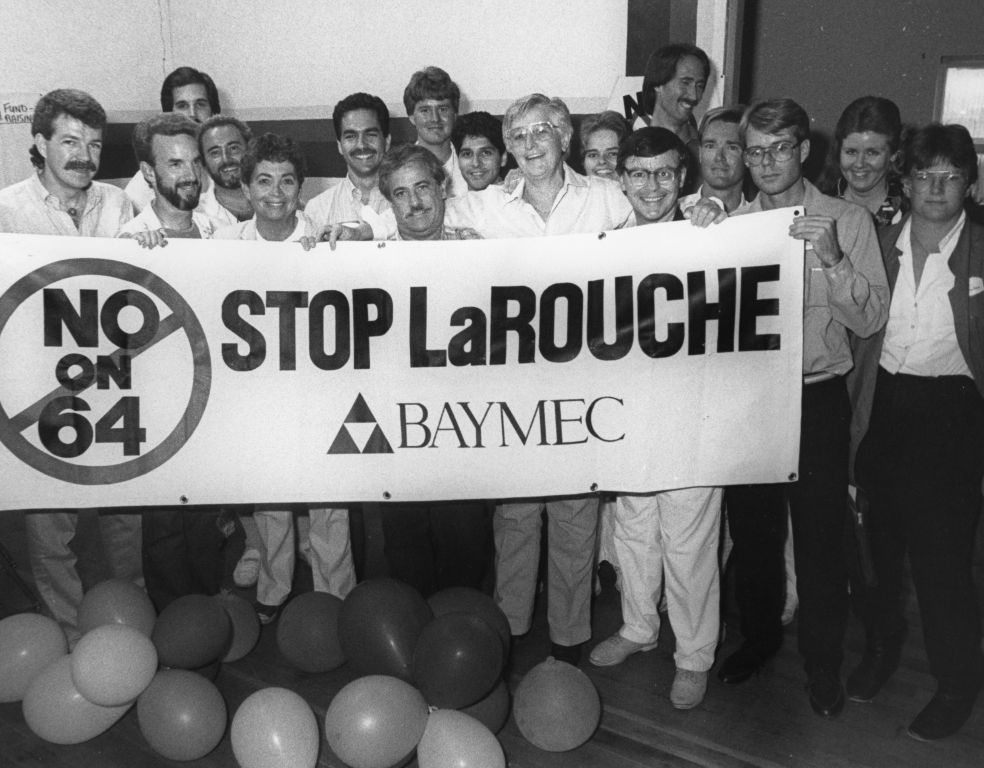
On July 1, 1986, BAYMEC’s board voted to put the organization’s full resources into defeating Proposition 64. The South Bay’s LGBTQ community, demoralized by the passage of Measures A and B and the subsequent arrival of AIDS, gained a renewed sense of activism. The next few months would see a dramatic transformation in the community’s profile and relevance.

The statewide No on 64 campaign initially planned to open offices only in San Francisco and Los Angeles. BAYMEC board members thought this was short-sighted. They feared that the San Francisco and Los Angeles-based campaign leadership would ignore the South Bay and put little or no effort or outreach into the region. There was a lot of work to do in educating voters all over the state about the realities of the epidemic and just how dangerous and disruptive Prop. 64 would be if it were approved.

BAYMEC was eager to run the local campaign for two reasons. First, even though they were a fledgling organization, they felt they had the capabilities to run a professional campaign. Second and equally important, they believed that the South Bay needed a strong LGBTQ organization to lead all the subsequent fights they knew would surely come over the years. It would be a missed opportunity to leave no lasting legacy of progressive gay politics and coalition-building. Though originally there was no universal agreement on BAYMEC’s role by some gay activists, over time most came on board.

Wiggsy Sivertsen agreed to serve as the local No on 64 campaign chair, Paul Wysocki as finance chair, and Ken Yeager became the campaign manager for Santa Clara and San Mateo counties. Wiggsy, Paul, and Rich Gordon also served on the statewide committee.

There was never any question that local campaign headquarters would be at the Billy DeFrank Center, then located on Park Ave. It was not only the hub of South Bay LGBTQ political activity in 1986, but also a landlord who was willing to rent office space for the incredibly low rate of $200 a month.

Financially, the South Bay community stepped up in a big way. State organizers only expected BAYMEC to raise $20,000. In under 14 weeks, they raised $73,000. Santa Clara County donors actually contributed more than those in the much larger San Diego County. The first fundraising letter was mailed out on July 30. The September 7 kickoff fundraiser had over 200 attendees and raised over $7,000.

The fundraising campaign was the definition of grassroots. More than 1,200 contributors wrote checks of $10, $50, or other small amounts. The average contribution was $60. There were no corporations or wealthy individuals writing big checks. Fundraisers were held at bars and nightclubs stretching from San Jose to the Peninsula to Santa Cruz and 23 house parties in Santa Clara and San Mateo counties.

Election night victory

On election night, November 4, 1986, a large crowd of supporters watched the returns at the Billy DeFrank Center. A sense of happiness and relief mounted as it became clear that Prop 64 was going down to defeat. The people of California had listened to the No on 64 campaign’s prevailing message of reason and understanding.

The next day, BAYMEC immediately began planning a celebration. Someone had a connection to Archbishop Mitty High School in San Jose so they decided to hold the event there. Rebecca Obryan organized volunteers who cooked spaghetti for approximately 200 people. Admission cost $5.

Because so many deserved to be recognized for their contributions, during the dinner Ken Yeager asked people to stand up and be acknowledged for their work on voter registration, speakers’ bureau, fundraising, house parties, and voter outreach, or as Billy DeFrank Center board members. When he asked who donated their hard-earned dollars, everyone in the cafeteria stood up. There was a roar of applause, creating a sense of community that was palpable.

23 Years Waiting for a Gay Pride Proclamation

first gay pride proclamation

The politically charged story behind San Jose’s Pride proclamation reflects the local struggle for LGBTQ rights and the community’s long fight with the Religious Right.

Although the first U.S. Pride marches and parades were held in June 1970, it wasn’t until 1975 that leaders in San Jose’s LGBTQ community asked then-Mayor Janet Gray Hayes and the city council for a Pride proclamation. It took three more years, but on February 21st, 1978, Hayes, along with Councilmembers Susie Wilson, Al Garza, and Jim Self, approved a resolution declaring the week of June 18, 1978, as Gay Pride Week in San Jose.

The resolution generated tremendous backlash among the city’s conservative Christian population, which was  numerous and politically influential. Councilmember David Runyon, absent for the initial vote, called for a reconsideration of the proclamation at the Council’s March 14 meeting.

According to Ted Sahl’s 2002 book, “From Closet to Community,” the LGBTQ community made a valiant effort to mobilize support for the proclamation, with a telephone campaign and more than 200 supporters in attendance March 14. However, they were overwhelmed by the opposition. Approximately 800 Pride proclamation opponents, most from area churches, attended the meeting, and their presence was enough to convince Garza to switch his vote and rescind the proclamation.

The council, including Garza, did agree to issue a proclamation for Gay Human Rights Week, but the LGBTQ community saw it as a defeat.

The 1978 rescinding of San Jose’s Pride proclamation foreshadowed the further resurgence of the Religious Right in San Jose and Santa Clara County. Gay Pride proclamations became politically toxic. When Mayor Hayes ran for re-election that November, her campaign was confronted with a newspaper ad reading: “The recent Gay Pride Week initiated by Mayor Janet Grey Hayes is a perfect example of moral insensitivity and weak leadership.”

In 1980, the Religious Right managed to defeat two ballot measures, A and B, which would have prohibited discrimination based on sexual orientation in employment and housing in the city and county. Following those defeats, it became politically dangerous for the mayor and city council to vote for a proclamation supporting a Pride celebration for years.

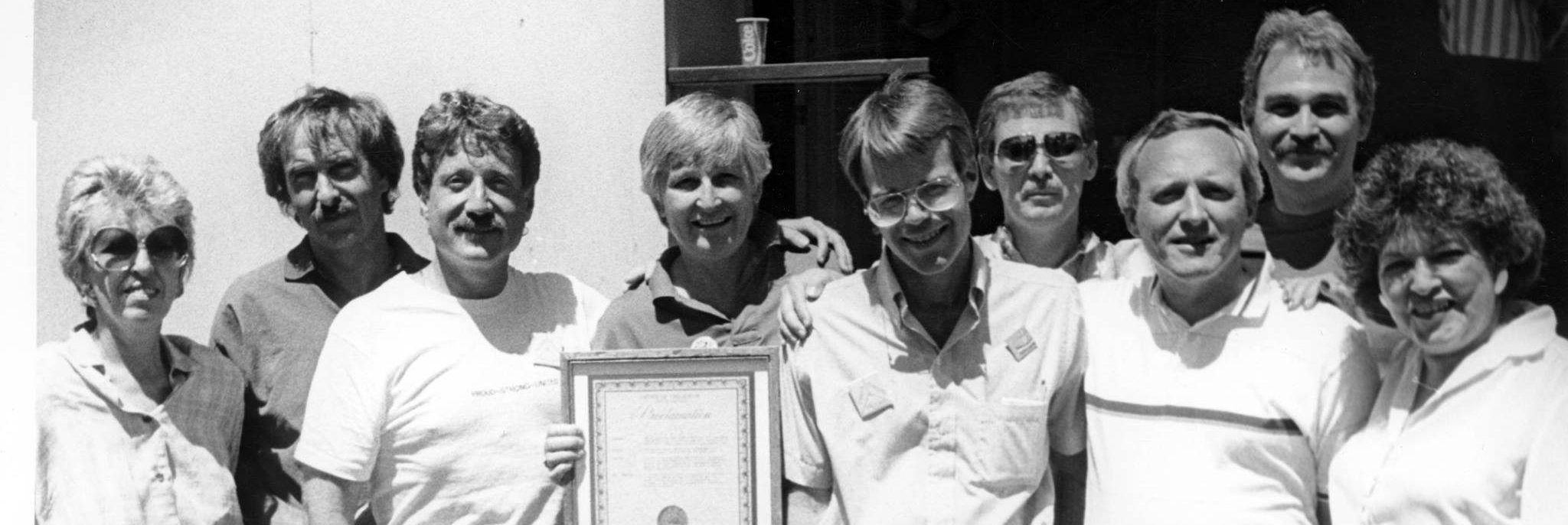
The full San Jose City Council did not issue a proclamation until Councilmember Ken Yeager proposed it in 2001—23 years after the first attempt to secure this city council recognition.

The situation was better at the county level. In June 1993, then-Supervisor Ron Gonzales introduced a resolution declaring a Lesbian and Gay Pride Week. Similar proclamations have been annually adopted by the Board of Supervisors since then.

Today, getting a city proclamation for an LGBTQ event generates no more controversy than any other cultural celebration in San Jose’s diverse community. It wasn’t always the case, and it’s a reminder not to take such things for granted. What is now routine was once unthinkable, and as long as members of the community stay engaged and committed, we will continue moving forward.