Content warning: discussion of transphobic and homophobic violence.
On October 3, 2002, Gwen Araujo was murdered at a party in Newark California. The four killers, Michael Magidson, Jaron Chase Nabors, Jose Merel, and an unnamed fourth man, buried her body near Silver Lake campground, more than 150 miles away in El Dorado County. Although four were arrested, more at the party could have intervened to stop the murder and did not.
Araujo’s mother, Sylvia Guerrero, buried her daughter under her chosen name, Gwen. The funeral, held October 25 in Newark, was open to the public. Guerrero released 17 butterflies, one for each year of Araujo’s life. Many came out to mourn the loss, but anti-transgender protesters were also in attendance. Students from Newark High School wore angel costumes to help block the family from protesters.
For Araujo, living as an out transgender teen at the time was difficult. It was important to Araujo to be true to herself, but met with adversity at both high schools she attended. News articles about her death misgendered her repeatedly, an issue that prevails in the press today. Gwen was an inspiration to many trans youth in her community. Her horrific death also inspired multiple films, including a Lifetime dramatization and a 2007 documentary by a trans director.
During the Araujo trial, defendants invoked a “panic” defense, which attempted to excuse crimes like murder and assault by blaming one’s actions on a heat of passion, mental breakdown or self-defense.
This approach ultimately failed for defendants in Araujo’s case, but panic defenses have historically downgraded the severity of criminal consequences, including reducing charges of murder to manslaughter or even assault and battery.
While the exact number of times this defense has been used against members of the LGBTQ+ community isn’t clear, it has long been utilized by straight men attempting to justify and minimize the killing of gay men, dating as far back as a 1954 murder in Florida to a 2019 homicide in Santa Clara.
Arguably one of the most infamous, yet unsuccessful, uses of the gay panic defense followed the fatal beating of Matthew Shepard in 1998.
Advocates argue that this defense blames victims, thereby insinuating that violence against the LGBTQ community is not only understandable but accepted.
State legislators attempted to remedy this with the Gwen Araujo Justice for Victims Act. Passed in September 2006, the bill required informing members of a jury that they were forbidden from making decisions based on any victim’s gender or sexual orientation.
Those protections were often circumvented, including in 2008 when 15-year-old Lawrence King, also known as Latisha, was shot and later died after flirting with another boy at his school near Los Angeles.
Restrictions were placed on defendants themselves in October 2014, when Gov. Jerry Brown signed Assembly Bill 2501 into law, which banned panic defenses in criminal court entirely.
California became the first state to outlaw blaming victims’ sexual orientation or gender for violence committed against them. Also in 2014, Brown signed off on the Respect After Death Act, which requires that death certificates represent the deceased person’s documented gender expression.
As of 2020, only 11 states have banned the defense, but nine others have introduced legislation. Attempts at federal law outlawing LGBTQ+ panic defenses were introduced in 2018 and 2019, but ultimately failed to move forward.
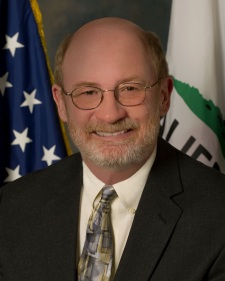
Supervisor Ken Yeager interviews Maribel Martinez, Director of the Office of LGBTQ Affairs, and David Campos, Deputy County Executive, about the county’s Office of LGBTQ Affairs and Division of Equity and Social Justice.
Measures A and B. Anita Bryant. Rev. Marvin Rickard. The Los Gatos Christian Church.
Saying these names today is likely met with blank stares. But in 1980, they were at the center of a battle for local policies protecting LGBTQ people from discrimination in employment, housing, and public services.
In 1979, two years after Harvey Milk helped lead a statewide defeat of anti-gay Proposition 6, there was a push for anti-discrimination ordinances throughout Silicon Valley. Johnie Staggs, a pioneering lesbian activist in San Jose, recalled that the local gay community was “in a kind of euphoria [about Prop. 6]. We knew we were right and we wanted to live our lives openly. Unfortunately, many of us were kind of pie in the sky.” Passing an anti-discrimination ordinance in the first place, however, would be much more difficult.
Initially, it was envisioned that the City of San Jose would pass an anti-discrimination ordinance – but the mayoral race in 1979 bogged down any chance for the city council to make an issue of it. Subsequently, the push for anti-discrimination moved to the Board of Supervisors. David Steward, who was the only openly-gay member of the Human Rights Commission, was able to gather support (albeit lukewarm) from the commission to ask the Board of Supervisors to pass the ordinance; At the same time, Jim McEntee, Director of Santa Clara County Office of Human Relations, was able to bring the ordinance directly to the Board of Supervisors.
After receiving the proposed anti-discrimination ordinance, the Board of Supervisors oversaw six public hearings and more than 25 hours of testimony. The opposition was entrenched; Rev. Marvin Rickard of the Los Gatos Christian Church fervently argued against the ordinance and was able to bury the public hearings with hundreds of protesting fundamentalists.
By a 4 to 1 vote (with supervisors Diridon, McCorquodale, Steinberg and Wilson supporting and Supervisor Cortese opposed) the Santa Clara County Board of Supervisors would finally pass an ordinance that banned discrimination on the basis of sexual orientation. The opposition quickly responded with promises of retaliation on the ballot. With far less fanfare, the San Jose City Council voted 6 to 1 for a similar city ordinance.
Opponents wasted no time gathering signatures to stop the ordinances from taking effect. Two measures were placed on the June 1980 ballot, Measure A for the county and Measure B for the city of San Jose. A “yes” vote meant you favored the protections; a “no” vote signified you wanted them repealed.
The campaign was ugly, with opponents receiving a great deal of support from out of the area, with money and organizers (even campaign manager) coming straight from Anita Bryant’s “Save Our Children” group in Florida. In the wake of the Moral Majority, there was a clear
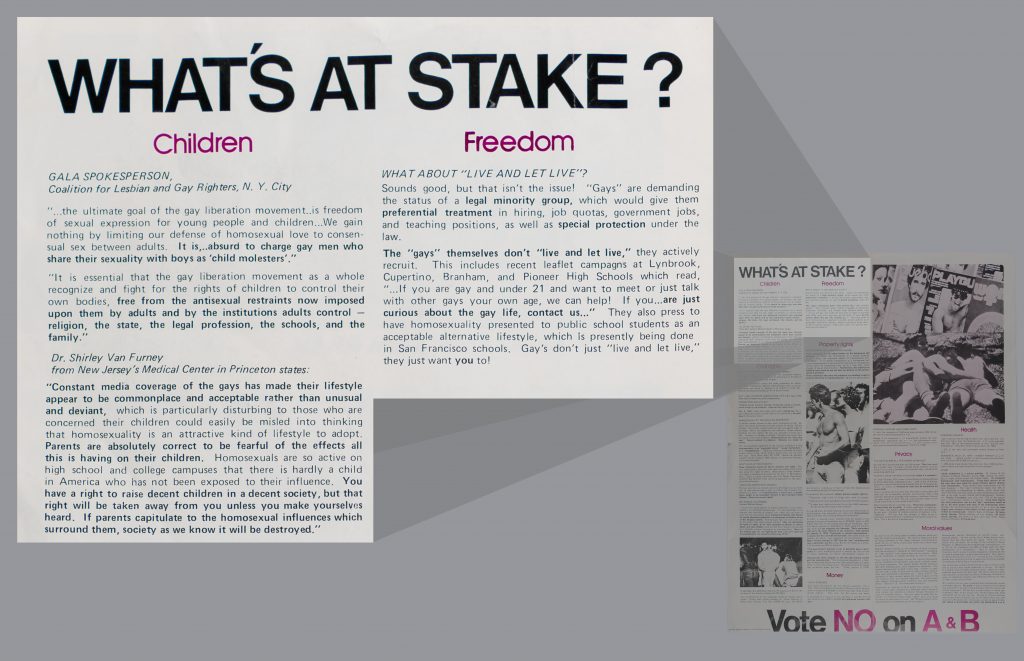
“Vote ‘no’ for the sake of our children. Don’t let it spread,” read their literature.
Don’t Let IT Spread!
GAYS say… Vote NO
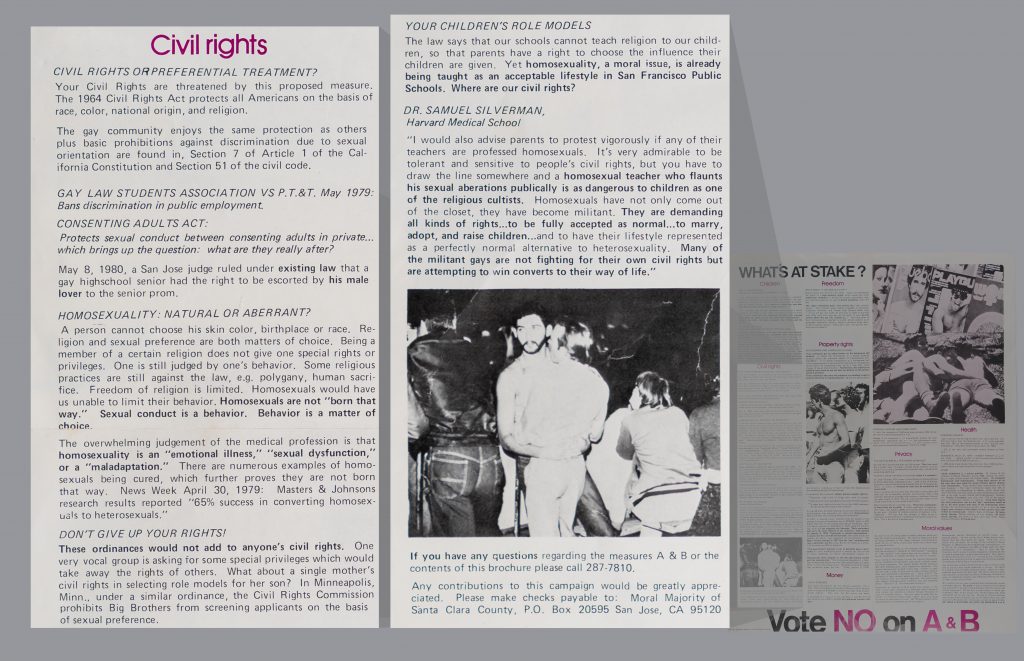
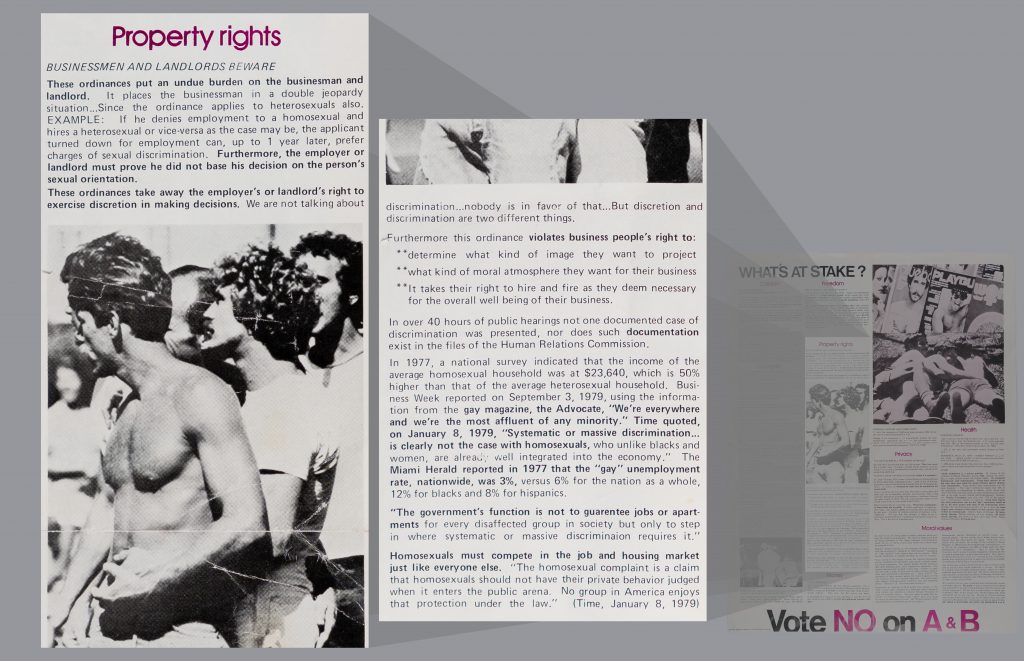
What’s At Stake
Children and Freedom
Civil Rights
Property
Money
Privacy and Health
Moral values
For proponents of Measures A and B, support was hard to find. Beleaguered organizers, lack of local interest, and vague platform significantly harmed the “Yes on A & B” campaign. Despite San Francisco’s sizeable gay political community, there was little to no support given, which was something campaign manager Johnie Staggs attributed to “a kind of arrogance because San Francisco is recognized, justifiably or not, as the gay Mecca.”
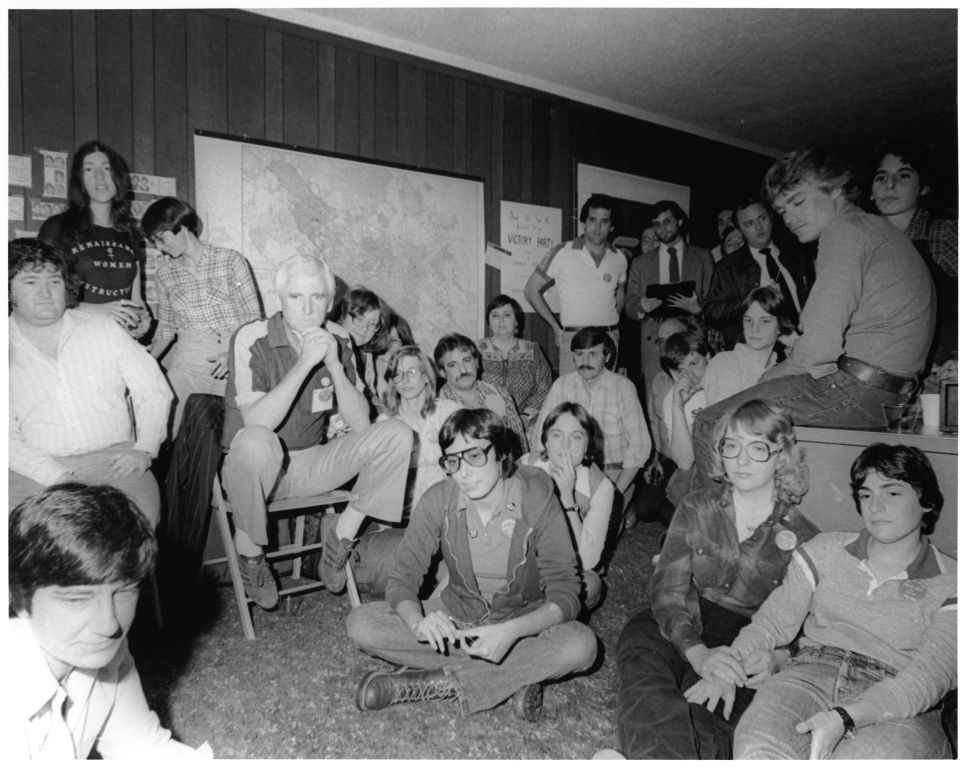
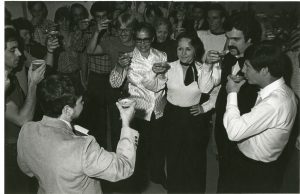
Rosalie “Nikki” Nichols (center left) and Johnie Staggs (center right) toast at a Yes on A & B event
The election was a blowout, with 70 percent of San Jose voters and 65 percent of Santa Clara County voters rejecting the ordinances. The message was clear: gays were not wanted.
The repercussions were immediate. The nascent LGBTQ rights movement vanished. Gay activism came to a dead stop. Supervisor Rod Diridon, who ran for state senate in the April 1980 special election, lost to a Republican. The Religious Right also successfully supported two San Jose City Council candidates that year. Moreover, many local political leaders backed away from gay rights issues, although not the supervisors who voted for the gay rights bill.
Four Former County Supervisors Recall the Turbulent Times of Measures A and B
Dan McCorquodale, Ken Yeager, Susie Wilson, Terry Christensen, Rod Diridon, Dominic Cortese
reunited for a panel discussion about Measures A and B on CreaTV’s Valley Politics show
Supervisor Susanne Wilson began with a recollection of her earlier experience with the religious right. In her previous position as a San Jose City Councilmember, conservative church members turned out in force to insist that the Council rescind a vote they had taken in March 1978, which provided recognition for a planned Gay Pride Week later that year.
She recalled the Council Chambers being packed with opponents of the Council’s action and that the crowds also filled to overflowing the downstairs cafeteria where the meeting was being broadcast. In the end, she and Councilmember Jim Self were the only ones who remained in support and refused to rescind their previous votes for the proclamation.
Supervisor Wilson also talked about the fallout from this vote she encountered when she walked door to door in her campaign that year for a seat on the Board of Supervisors. In the end, she was victorious in winning the Board seat, but she remembered experiencing lots of doors slammed in her face, something she noted had never happened to her when campaigning before her vote on gay pride.
Supervisor Dan McCorquodale commented that discrimination against gays was not a new issue for him. He recounted the anger and helplessness he felt when, as a young Marine, one of his friends was discharged from the Corps for having been seen leaving what was thought to be a gay bar.
There was no due process and no avenue for recourse. He said that he considered his 1979 vote on the anti-discrimination ordinance as one of his opportunities to speak out for equality and justice.
Supervisor Rod Diridon recalled, at the time of the gay antidiscrimination ordinance vote, he already was planning a campaign for a State Senate seat that would be decided in an April 1980 special election. He said that the Senate district electorate had become more conservative under Governor Ronald Reagan and with the growth of the Moral servative under Governor Ronald Reagan and with the growth of the Moral Majority, and he was aware a “yes” vote on this issue would impact his chance for success. However, despite the trepidation this caused, he felt he had to vote his conscience.
Supervisor Dominic Cortese said he considered the vote on the ordinance premature and that it concerned a moral issue to be discussed by the church and not legislated by government. “In many ways, I still feel that way.” He added his thought that “my church has not done enough to open that door.” He reminisced, “I was in a learning process. The whole country was in a learning process.” He concluded by saying, “I commend my colleagues for moving forward in a very bold manner. We had a very proactive Board.”
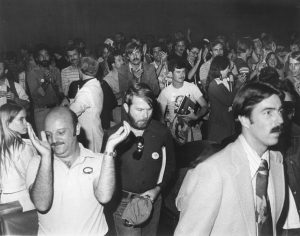
Sal Accardi (right) and other supporters applaud the anti-discrimination ordinance during the public hearing
The crowd at the public hearing on the anti-discrimination ordinance
In response to a question concerning what the hearings were like, Wilson said she remembers, despite her previous experiences, still being amazed by the extent of the anger and hatred demonstrated by the ordinance opponents. Diridon said that the calls and letters received by the Board offices numbered at least 10 to 1 in opposition to the ordinance, but he didn’t believe the opponents reflected the entirecommunity. He commented that anti-gay sentiment was being preached from the pulpits of the conservation churches, as reflected, in part, by the number of calls against the ordinance the Board offices received on Monday mornings.
When asked if they saw the referendum coming, Wilson said “no”; Diridon said “yes”; Cortese said he felt the whole controversy was likely to set back the movement. McCorquodale said he could tell the proponents were in trouble from the very beginning but that rescinding the vote wasn’t an option as it would have been much “too disheartening for too many people.”
All described the campaign as “brutal.”
Diridon recalled leaving church with his wife and children on one occasion during that time and finding that every car in the church lot had a flyer on the windshield condemning his vote and stating “Diridon is a false person” and “actually he is gay.” He subsequently found out this distribution of flyers that Sunday morning involved virtually every car in all the church parking lots in his district.
Diridon went on to say that his support for the ordinance was a dominant factor in his losing the Senate election in April 1980. He clearly remembered being told by a state Democratic Party leader that “If he voted for this issue, he was committing suicide.” After his vote, he said some state Democratic leaders lost interest in his campaign. However, he concluded, “If you don’t vote your conscience, you’re not worth a damn.”
Wilson said that this issue didn’t seem to hurt her in her 1982 re-election campaign. Diridon, too, was reelected to the Board in 1982. Cortese won election to a seat in the State Assembly in the 1980 election, the same year as the Measure A and B vote. McCorquodale ran unopposed that year for another term on the Board of Supervisors.
However, in McCorquodale’s 1982 State Senate campaign, his opponent, incumbent Senator Dan O’Keefe, tried to make an issue of the gay rights vote in Stanislaus County, the more conservative part of the district. McCorquodale commented that, while he received negative reactions from certain individuals, the issue never seemed to gain traction.
When interviewer Terry Christensen asked if the supervisors ever regretted their vote, all said “no.” Cortese added that he had been consistent with his votes in support of LGBT issues over his 16 years in the Assembly. Diridon said that it was emancipating to vote his conscience despite the consequences. He expressed regret that the ordinance supporters hadn’t been better organized, though, because he thought the Measures A and B votes could have been successful.
Christensen asked if the supervisors had any advice to advocates of unpopular causes. Diridon responded, “Get organized early.” He went on to say that the Democratic Party, organized labor, the Council of Churches, and the Mercury News all supported the ordinances and, if the supporters had been organized, they could have won.
McCorquodale recommended that advocates research their issues carefully and also study and understand their oppositions’ issues in order to formulate responses. In addition, he suggested they make sure they have enough volunteers to go door to door and take the issue to the public.
Wilson said when you feel something deeply, you must stand up and fight for it. Cortese added that he always recommends following the golden rule and treating people with respect. Further, he said it is important to analyze the issues, make considered decisions, and stick with them.
McCorquodale said he wanted to take the opportunity to recognize the contributions of then-Human Relations Commissioner David Steward, the first openly gay commissioner, who secured a unanimous vote from the Commission to send the ordinance to the Board. He called Steward “the spark plug.”
Diridon and Cortese both added that the role of then-Human Relations Director Jim McEntee shouldn’t be overlooked. Diridon noted that McEntee never hesitated in his support for the ordinance, and Cortese recalled that “Jim McEntee gave of himself unconditionally.”
When asked how the supervisors thought the County was functioning now, Wilson said, “very well” and concluded with, “They are taking care of people.” McCorquodale made special note of the County’s fine hospital and park system. Cortese added to his positive comments about the current Board that he was extremely proud of his son, former Board President Dave Cortese, and that “Dave was his legacy.” Diridon expressed that he perceived that the dynamics of the current Board were similar to the Board at the times of Measures A and B, and that they were “taking up progressive issues” and “doing a wonderful job.”