

- Trustee, Oak Grove School District (2021-2024
Notables
Jesus Salazar
- Trustee, Luther Burbank School District (2021-present)
Elizabeth Birch

As a lawyer, corporate executive and open lesbian, Elizabeth Birch helped coordinate LGBT company policies and guide cultural perspectives of the queer community on a national scale throughout the 1980s and 90s.
While activists and LGBTQ+ workers pushed for civil rights, she used her legal expertise to solidify changes and acceptance during six years at Apple and nearly a decade with the Human Rights Campaign (HRC), the United States’ largest LGBT organization.
Elizabeth first arrived in the South Bay to attend Santa Clara University School of Law, where she graduated in 1985. She was previously living out of her home at the age of 17 as an open lesbian, moving around the United States. She credits those experiences and struggles for her ability to advocate within both a legal and corporate structure.
While still a student, Elizabeth brazenly called the head of Apple’s legal department asking for her dream job. To her surprise she was told she could work there—once she got a few years of experience practicing law under her belt. She joined McCutcheon, Doyle, Brown, and Enersen after graduation, where she help found AIDS legal services in San Jose, and left in 1989. She entered the political arena as a member of the San Jose-based Bay Area Municipal Elections Committee.
She was one of the lawyers representing BAYMEC in a case against the Macy’s located at Valley Fair Shopping Mall in 1988. They successfully argued for the First Amendment right to campaign against Prop 102, which would have required people who tested positive for HIV/AIDS to be reported to health authorities.
Elizabeth was thrust into the high-tech world when she joined Apple in 1989, where she directed international litigation. After LGBTQ+ employees formed Apple Lambda and pushed for non-discrimination policies earlier, her influence and rank as Senior Counsel for the company’s Human Resources department essentially ran interference for their continued efforts.
She decided her duty as a lawyer was to break through cultural barriers and make the company even better for LGBTQ employees. The advent of employee resource groups provided both a sanctuary within corporate companies, as well as an organizing platform to accomplish goals and change.
Whether that meant providing contacts, advice, or green-lighting ideas like making shirts with the Apple logo – an ask that initially made Apple Lambda members shiver – she helped garner support and benefits from the inside out.
Most notably, she spent time with then-Apple CEO John Scully, arguing for these changes, especially for a company using a rainbow-colored logo at the time.
Management often brushed off offering benefits, claiming they posed a financial burden. Elizabeth argued equality policies were breakthroughs to productivity, creativity and innovation—all coveted by high tech companies in competition with each other—in addition to offering to cover any costs from her own salary.
If one employer didn’t offer benefits, talent could move to the next town over or across the street to places that did, which led to a wave of change in Silicon Valley.
Scully eventually kicked off a 100-employee meeting by committing to domestic partner benefits by that January. This was the third attempt of Apple Lambda, after previous rejections.
“Every member of the board, you just saw the outpouring of emotion. There were tears,” Elizabeth said. “I saw the cascading through the culture, and that was a big lesson for me up up to and including Apple.”
Former Apple employees and South Bay activists have credited Elizabeth with the decision to work with businesses before politicians; her pragmatic approach to make incremental policy changes proved successful, as opposed to solely pursuing slow, polarizing legislation.
While on business trips for Apple, Elizabeth said she would travel to nearby companies, such as Kodak, Chevron, McDonald’s and General Mills, to speak with employee resource groups and CEOs. These heartfelt, genuine and trusting conversations about personal experiences are what she says allowed people to learn about and become comfortable with the LGTBQ community.
Despite a few holdouts, including Perot Systems and Exxon Mobil, as those companies passed more progressive policies, more liberal people went to work for those companies—not exclusive to LGBTQ people.
Elizabeth’s work in Silicon Valley was just the tip of the iceberg of her legal and political career.
She was the co-chair of the National Gay and Lesbian Task Force from 1992 to 1994. Around that same time, Elizabeth sat on the board of Digital Queers, a Castro-based activist group founded to bring LGBTQ+ organizations across the country up-to-speed online, in part through organizations like NGLTF.
“By the time I leave the San Jose area, I’m now thinking big,” Elizabeth said. “How do we really use corporate America to help revolutionize progress?”
By January 1995, she accepted the position of president and executive director of HRC, where she spent nearly a decade working to stem discrimination of LGBTQ+ people by sharing their stories, struggles and successes within society.
She helped acquire, rewrite and implement the Corporate Equality Index for LGBTQ employees–which she retroactively sees as her best contribution to the organization–in addition to helping form the Human Rights Business Council, which brought together gay executives across industries, from airlines to entertainment. Together, they figured out who to talk to within top management to have their friends and competitors fall in line.
Elizabeth continued efforts to change how people across the United States viewed the LGBTQ+ community through programming on Good Morning America, the Today Show and NewsHour, as well as an entire rebranding of HRC.
She also revisited her Silicon Valley roots in company-driven policy making when the HRC formed its Business Council in 1997, which brought together dozens of LGBT employees—including those at Apple—who already had on-the-ground experience making policy changes. They leveraged internal knowledge, such as budgetary timelines and proposal requirements, to craft best practices for other hopeful LGBT employees nationwide.
Some have estimated that the HRC Business Council helped around 100 companies across different industries earn nondiscrimination and domestic partner benefits by 2002.

Elizabeth Birch in an HRC shirt

Elizabeth Birch with Hillary Clinton
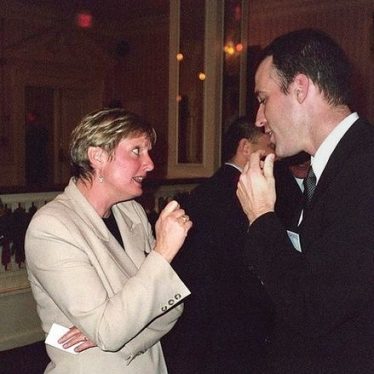
Elizabeth Birch
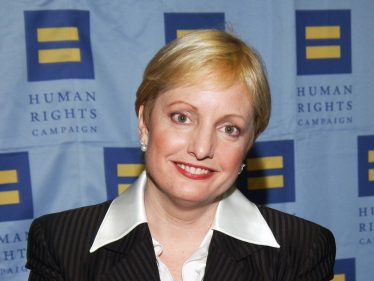
Elizabeth Birch
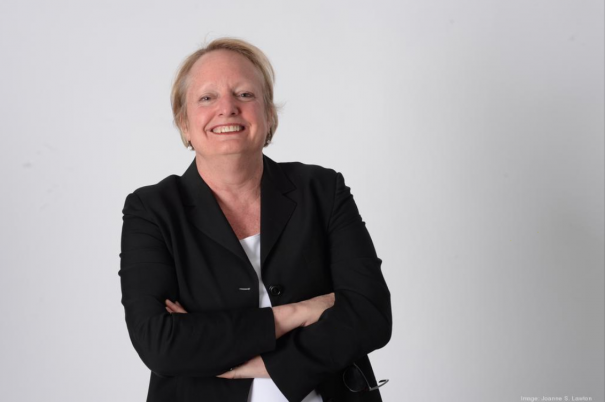
Elizabeth Birch, courtesy Joanne Lawton
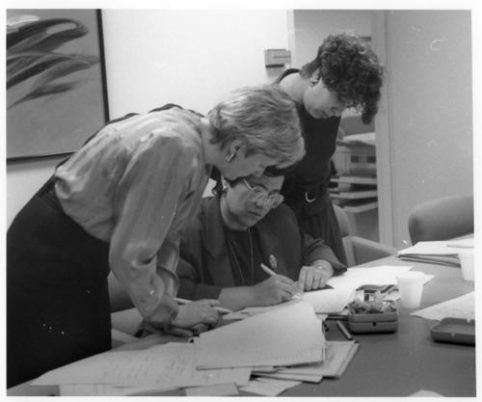
Elizabeth Birch at BAYMEC in 1988
New Haven Inn
DISCLAIMER:
BAYMEC Community Foundation does not provide any services, and has only created this page for historical purposes. IF YOU ARE SEEKING HELP, PLEASE CALL 2-1-1 FOR ASSISTANCE. ADDITIONALLY, PLEASE VISIT LIVEMOVES.ORG/GET-HELP FOR MORE INFORMATION.
In 2019, LifeMoves opened New Haven Inn, a downtown San Jose LGBTQ+ inclusive housing shelter, with support from the County of Santa Clara. It’s the second shelter of its kind in the country and houses up to 20 adults.
Karla Papula

Karla Papula(she/her/they/them) is a Therapist, Belonging Activist and LGBTQQIA+ Youth Ambassador. She moved to the Bay Area from New York in 2014 and received a Master’s Degree in Holistic Counseling Psychology. She is now an Associate Marriage and Family Therapist and a doctoral student at Pacifica Graduate Institute in their Depth Psychology Program with a specialization in Community, Liberation, Indigenous and Eco-Psychologies. Her experience at community-based nonprofits committed to meeting the needs of folx that have been historically marginalized led her to ACS’ Outlet Program. She is dedicated to being an active agent in dismantling systems of oppression in the field of psychology and to making mental health education and therapy accessible to more people. She believes in the formation of a psychology and practice that reaches out beyond the fragility of the independent mind and into the interdependent heart, soul, culture, nature, spirit, body and politics of our modern world. She maintains a private practice where she works with queer couples, youth and families. Outside of advocacy, you can find Karla parenting her plants, near running water or drinking hot sauce from the bottle.
Stanford’s Old Firehouse
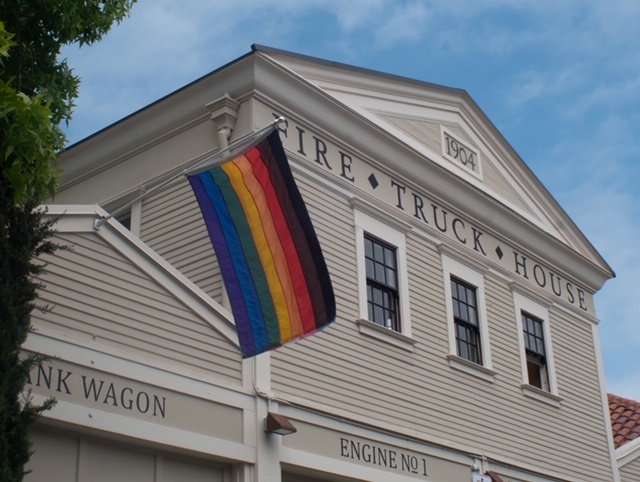
Stanford’s Old Fire Truck House became a hub for LGBTQ students and community members alike – one of the first campus organizations of its kind nationally.
Built in 1904, the aptly named structure transitioned in the 1970s from housing fire trucks to community meetings for those who were queer, questioning or allies to connect and politically organize. Despite a history of name changes – from the original Gay People’s Union to today’s QSpot – students have walked up the Firehouse’s steep outdoor steps to find a community of their own on the second floor.
Stanford has a piecemeal history with gay, lesbian, bisexual, transgender and queer people, dating back to the first documented relationship in 1911.
However, organization started coming to a head in the 1960s, when folks began creating forums and discussion groups dedicated to the exploration of sexual rights, including civil rights for homosexuals. By November 1970, a Stanford Gay Students Union was formed off-campus by students and community members.
This idea stuck. The Gay People’s Union officially began in December 1971 with a desk in the Old Union Clubhouse. Founded by Maud Hanson Nerman and Fred Oakford, the movement started with the intent to be accessible to the entire Palo Alto community.


Its members began efforts to provide personal outreach, mentorship, mental health counseling and support groups geared to gay students, especially through smaller groups like the Women’s Collective and the Gay and Lesbian Speakers Bureau.
This was risky business at a time when students and faculty feared facing retribution for being gay from Stanford, including expulsion or termination. Non-campus locations were originally considered for safety concerns.
The Gay People’s Union found a permanent home in the Old Firehouse in the fall of 1974, growing from a small office to claiming the entire second floor of the building along Santa Teresa Street.
Within its early years, GPU’s work catalyzed the formation of state-funded mental health programs for the Bay Area gay community, the first gay and lesbian awareness week held on campus, hiring of openly gay faculty and an unsuccessful campaign to exclude discriminatory employers from Stanford’s Career Planning and Placement Center.
Four members carried a GPU banner within the first National March on Washington for Gay and Lesbian Rights by October 1979.
Despite growing recognition of the LGBTQ community in the Bay Area and beyond, progress wasn’t entirely met with open arms. Notably, the campus’ “Gay Liberation” statues were repeatedly vandalized with hammers and spray paint.
As tensions heightened in the 1980s during the AIDS crisis, the Firehouse’s community worked to provide practical and emotional supporters for people with AIDS, increase visibility with Gay Family Days and simply educate others that queer people spanned the entire campus, including students living in dorms, teachers and entertainers.
Known as the Lesbian, Gay and Bisexual Community Center by 1989, students continued political activism throughout the 1990s, planning “Queer Be-Ins” at local coffee houses, establishing student orientation celebrations and hosting queer graduation events.
Despite the Old Firehouse’s consistent, decades-long presence, all of its opportunities and events were solely student-driven and supported by staff because it remained unrecognized as an official community center by Stanford.
Stanford eventually provided a full-time director for the LGBCC in 1999, after student requests and task force studies, which allowed for increased access to resources and targeted programming.
The organization was renamed the LGBT Community Resources Center in 2001 to increase transgender representation, and later morphed into the Queer Student Resource Center, or QSpot, by 2017.