The Fight Against Prop. 64

baymec prop 64 media scaled

By Ken Yeager

Efforts to Quarantine AIDS Patients

The early to mid-1980s was a time of widespread misinformation and hysteria about AIDS. There were public fears that AIDS could be transmitted through the air like the common cold or by mosquitoes.

Into this atmosphere stepped Lyndon LaRouche, a one-time Marxist who, by 1986, had become a far-right reactionary, calling Henry Kissinger a communist and accusing Queen Elizabeth of conspiring to get the U.S. population hooked on drugs. His followers exploited the misinformation and public fears about the AIDS epidemic to secure the 500,000 voter signatures necessary to get an initiative on the ballot.

LaRouche’s initiative appeared on the November 1986 ballot as Proposition 64. It would have allowed public health officials to make HIV testing mandatory for people thought to be infected and required public disclosure of anyone who tested positive. Further, it would have prohibited anyone with HIV from attending or teaching school, as well as restricting their ability to travel.

When Prop. 64 qualified for the ballot in June 1986, many Californians held a negative or even hostile attitude towards both the AIDS epidemic and the LGBTQ community. A Los Angeles Times poll published that summer found half of the public favored quarantining AIDS victims, and a quarter believed that “AIDS is a punishment God has given homosexuals for the way they lived.”

The South Bay fight against Prop. 64

On July 1, 1986, BAYMEC’s board voted to put the organization’s full resources into defeating Proposition 64. The South Bay’s LGBTQ community, demoralized by the passage of Measures A and B and the subsequent arrival of AIDS, gained a renewed sense of activism. The next few months would see a dramatic transformation in the community’s profile and relevance.

The statewide No on 64 campaign initially planned to open offices only in San Francisco and Los Angeles. BAYMEC board members thought this was short-sighted. They feared that the San Francisco and Los Angeles-based campaign leadership would ignore the South Bay and put little or no effort or outreach into the region. There was a lot of work to do in educating voters all over the state about the realities of the epidemic and just how dangerous and disruptive Prop. 64 would be if it were approved.

BAYMEC was eager to run the local campaign for two reasons. First, even though they were a fledgling organization, they felt they had the capabilities to run a professional campaign. Second and equally important, they believed that the South Bay needed a strong LGBTQ organization to lead all the subsequent fights they knew would surely come over the years. It would be a missed opportunity to leave no lasting legacy of progressive gay politics and coalition-building. Though originally there was no universal agreement on BAYMEC’s role by some gay activists, over time most came on board.
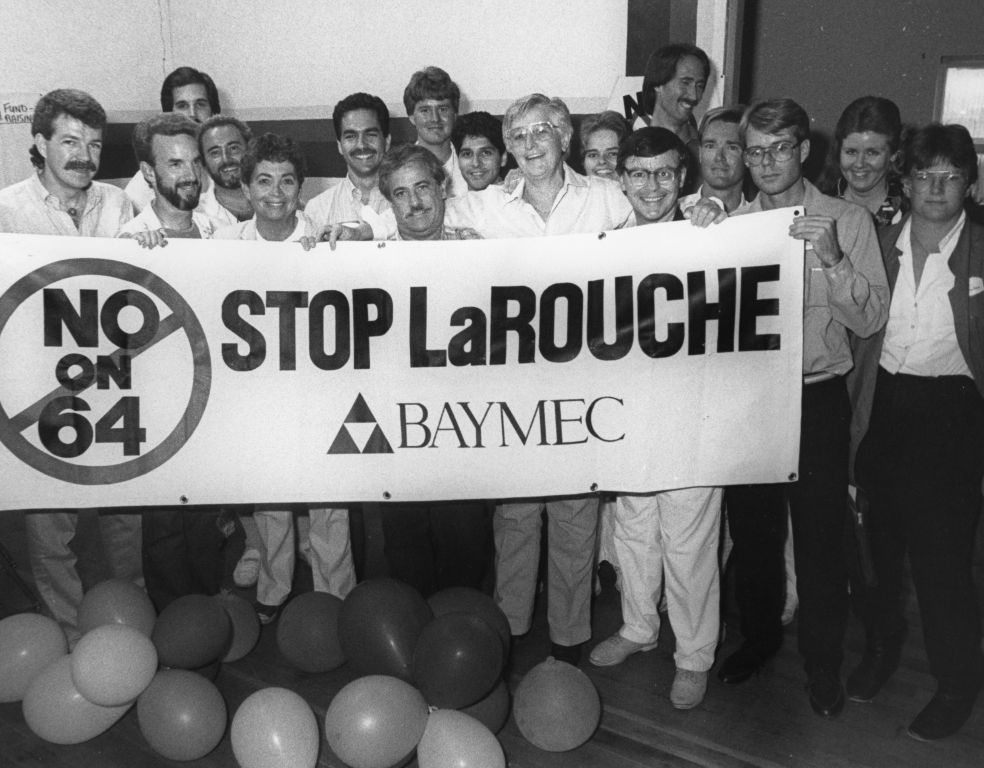
Wiggsy Sivertsen agreed to serve as the local No on 64 campaign chair, Paul Wysocki as finance chair, and Ken Yeager became the campaign manager for Santa Clara and San Mateo counties. Wiggsy, Paul, and Rich Gordon also served on the statewide committee.

There was never any question that local campaign headquarters would be at the Billy DeFrank Center, then located on Park Ave. It was not only the hub of South Bay LGBTQ political activity in 1986, but also a landlord who was willing to rent office space for the incredibly low rate of $200 a month.

Financially, the South Bay community stepped up in a big way. State organizers only expected BAYMEC to raise $20,000. In under 14 weeks, they raised $73,000. Santa Clara County donors actually contributed more than those in the much larger San Diego County. The first fundraising letter was mailed out on July 30. The September 7 kickoff fundraiser had over 200 attendees and raised over $7,000.

The fundraising campaign was the definition of grassroots. More than 1,200 contributors wrote checks of $10, $50, or other small amounts. The average contribution was $60. There were no corporations or wealthy individuals writing big checks. Fundraisers were held at bars and nightclubs stretching from San Jose to the Peninsula to Santa Cruz and 23 house parties in Santa Clara and San Mateo counties.

Election night victory

On election night, November 4, 1986, a large crowd of supporters watched the returns at the Billy DeFrank Center. A sense of happiness and relief mounted as it became clear that Prop 64 was going down to defeat. The people of California had listened to the No on 64 campaign’s prevailing message of reason and understanding.

The next day, BAYMEC immediately began planning a celebration. Someone had a connection to Archbishop Mitty High School in San Jose so they decided to hold the event there. Rebecca Obryan organized volunteers who cooked spaghetti for approximately 200 people. Admission cost $5.

Because so many deserved to be recognized for their contributions, during the dinner Ken Yeager asked people to stand up and be acknowledged for their work on voter registration, speakers’ bureau, fundraising, house parties, and voter outreach, or as Billy DeFrank Center board members. When he asked who donated their hard-earned dollars, everyone in the cafeteria stood up. There was a roar of applause, creating a sense of community that was palpable.
The ARIS Project

aris-founded

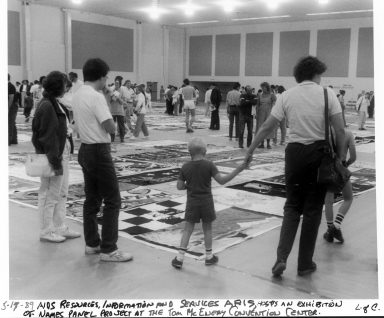
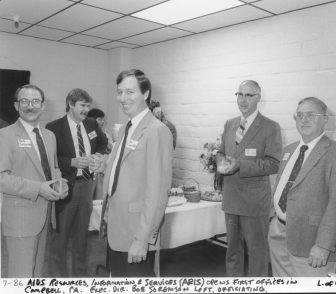
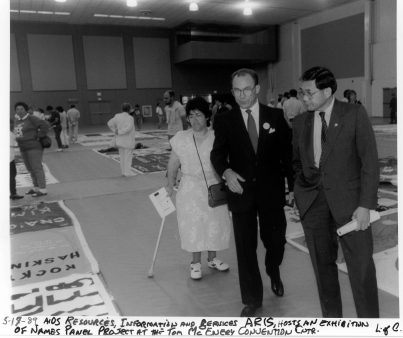
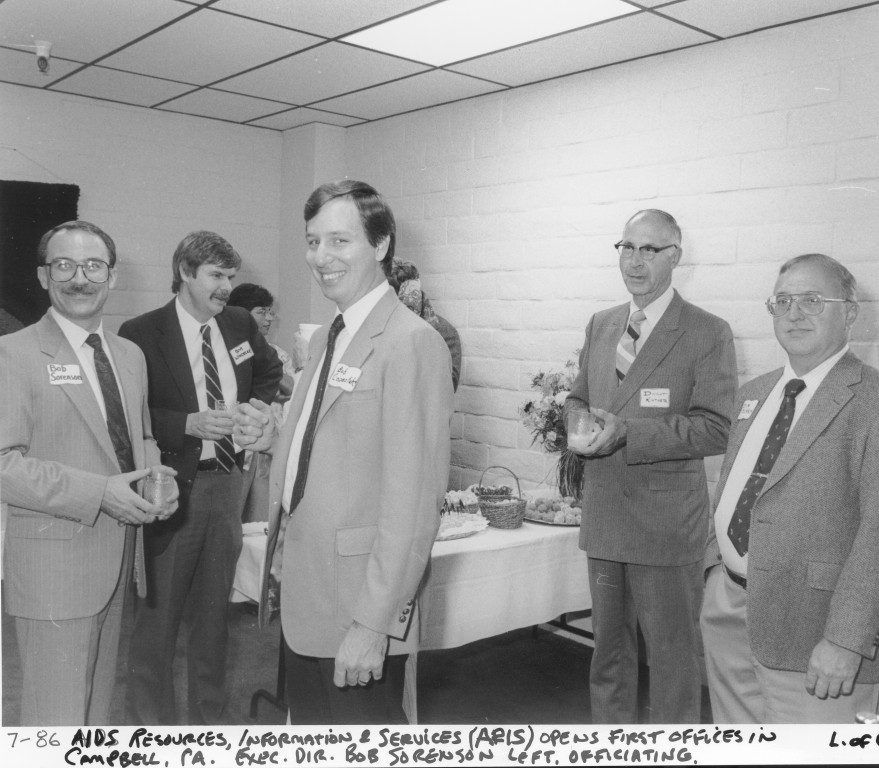
The AIDS Resources, Information & Services (ARIS) Foundation formed in 1986 to provide information, resources, and support for AIDS & HIV positive patients in Santa Clara County. ARIS supplied assistance to patients through a monthly food basket and nutritional supplements program, a 24-hour residential care facility, transportation services, and weekly emotional support groups. ARIS offered a housing program for the HIV and AIDS patients who needed assistance: they had 4 houses and 18 bedrooms for patients with regularly scheduled visiting nurses.

ARIS’s newsletter, Pages, shared several times a year. Many back issues have been preserved in the ARIS collection archive at San Jose State University.

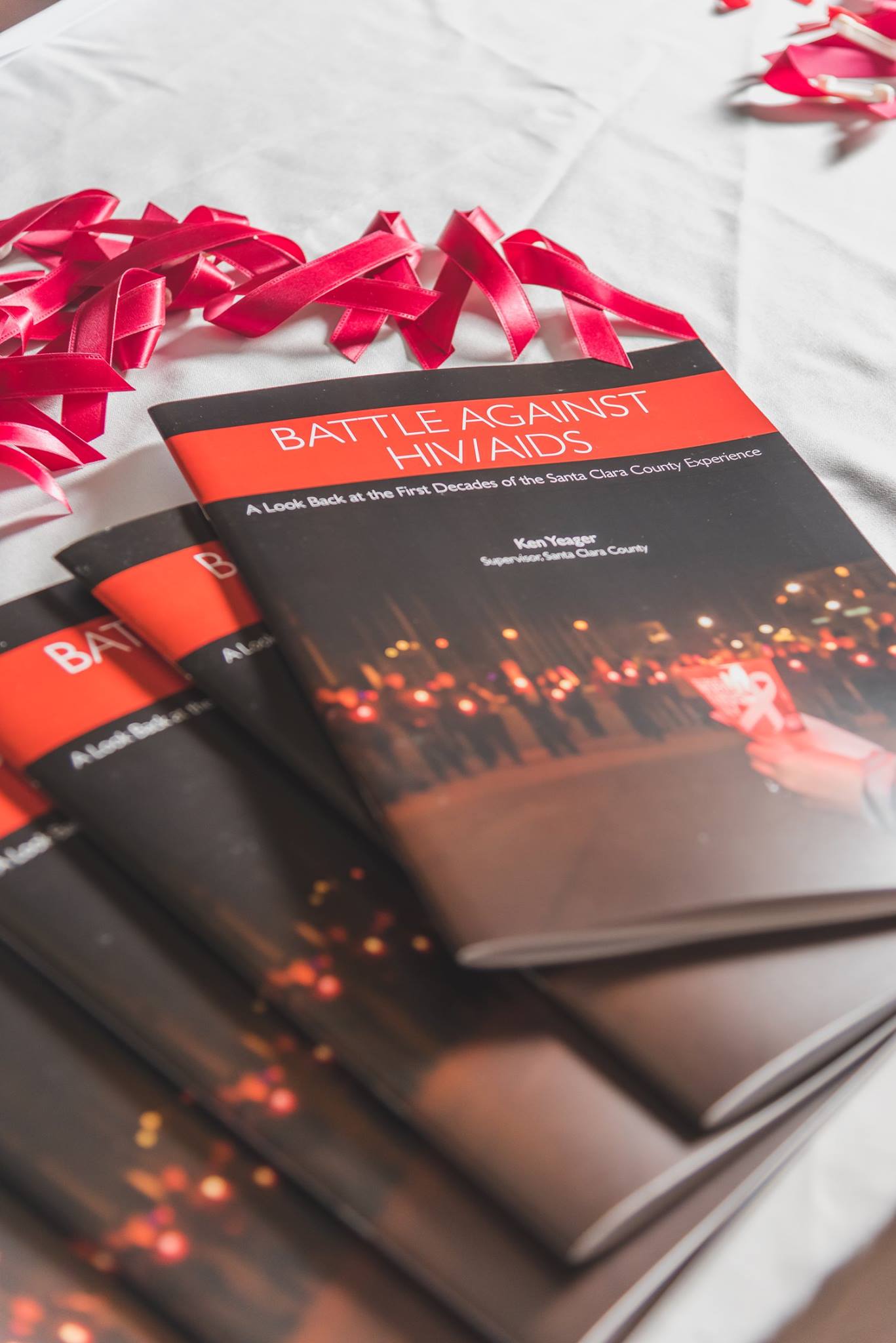
ARIS was working closely with the Public Health Department to create public education programs to end the stigmatization of HIV & AIDS, as well as a sex education program to prevent the spread of HIV. The foundation shut down in 2003. Read more about the organization in Battle Against HIV/AIDS (PDF).

Battle Against HIV/AIDS

battle hiv aids booklet

On June 5, 1981, the U.S. Centers for Disease Control and Prevention’s newsletter Morbidity and Mortality Weekly Report published a story about five young, previously healthy gay men who had come down with a rare lung infection, pneumocystis pneumonia. This was the first public mention of what the CDC would name in just over a year the Acquired Immune Deficiency Syndrome. The AIDS epidemic had begun in the United States.

Karl Vidt, who became a prominent local HIV/AIDS advocate—including a multi-year term as chair of the Santa Clara County World AIDS Day committee—said that during 1981-82 people in Santa Clara County thought AIDS was “something affecting people in San Francisco.”

A crisis emerges

In 1983 that attitude changed rapidly. AIDS arrived in Santa Clara County with the first diagnosis being confirmed by the public health department in April. The first signs of AIDS-related fear followed shortly afterwards.

The Santa Clara County Public Health Department’s AIDS Program was formed in 1983 to conduct community education. Utilizing a small grant from the state, the team began to educate people in jails, gay bars, and elsewhere. They also distributed condoms. In November, Santa Clara County obtained its first state funding for AIDS.

In 1985, the first HIV tests became available and the Public Health Department opened Santa Clara County’s first HIV clinic. Numbers were climbing: 53 deaths, 148 people living with HIV/AIDS.

Dr. Marty Fenstersheib took on the difficult role of telling people they were HIV positive. In a 2012 San Jose Business Journal interview, he recalled the reactions of those earliest patients, “They would run out, bang doors, sometimes they’d cry, sometimes they’d scream. It was horrible.”

In January 1986, BAYMEC, led by BAYMEC co-founder Ken Yeager, successfully secured the support of the Santa Clara County Board of Supervisors to make a substantial commitment to funding AIDS-related services. Even as the County was facing tight budget times, they were committing critical dollars to AIDS services. Yeager was also named chair on the new Santa Clara County AIDS Task Force. The epidemic, and the lack of an adequate government response to it, was becoming the dominant issue in the LGBTQ community.

Life expectancy from diagnosis to death was around two years. People got sick and died very fast. Tens of thousands of families learned for the first time that their sons were gay only after they became sick. Often parents had to simultaneously come to grips with their son’s sexuality and their deaths.

The total death count continued to climb from 1986 to 1990: 96, 172, 265, 296, 433.

As the 1980s came to a close, the death toll from AIDS continued to rise, reaching 124 new deaths in Santa Clara County in 1989. By 1990, total deaths reached 433 with more than a thousand people living with HIV/AIDS.

Dark times

The early 1990s were some of the darkest times of the AIDS epidemic. Death tolls continued to increase locally and nationally. 1993 and 1994 were the years of highest deaths in Santa Clara County: 219 in 1993 and 220 in 1994.

AIDS patients continued to die at a rapid pace. At the end of 1994, the Public Health Department produced an analysis of the first 10 years of the epidemic in the county. It revealed that through 1990 more than 90% of individuals diagnosed with AIDS had died within the same year. In both 1983 and 1986, every single individual in Santa Clara County died the same year they were diagnosed with AIDS.

Thankfully, 1995 would bring some hope for HIV/AIDS sufferers. A medical breakthrough, whose impact continues to be felt today, dramatically transformed an AIDS diagnosis from a likely death sentence to a serious but manageable health condition.

Finally, a breakthrough

Public pressure and the growing death toll from AIDS led the Food and Drug Administration to approve the protease inhibitor Saquinavir for use outside of clinical trials in June 1995. The era of the AIDS cocktail had begun. It would not become widely used in the U.S. until 1996, but the earliest results were extremely promising.

By 1997 the full effects of the “cocktail” were becoming apparent to public health officials in Santa Clara County as the year-end statistics showed that only 67 people died of AIDS-related causes. That is a drop of almost 50% compared to the previous year.

Almost overnight, HIV/AIDS went from being a near-certain death sentence to a manageable health condition if diagnosed and treated. This change was extremely welcome after more than a decade of darkness, when friends and loved ones got sick, wasted away, and then died with blinding speed.

From 1984 when the first AIDS deaths were reported in the county to the end of 2017, there had been a total of 2,498 deaths from AIDS. A tragic loss.

While HIV/AIDS has been a treatable condition for almost a quarter-century, it is still a health crisis that impacts thousands in our community.

African-American and Hispanic residents continue to be disproportionately impacted, with rates among African-Americans more than four times higher than rates among non-Hispanic Whites.

We have come so far since those early dark days. But much work still needs to be done.


For help with HIV/AIDS or to volunteer, visit GettingToZeroSCC.org.